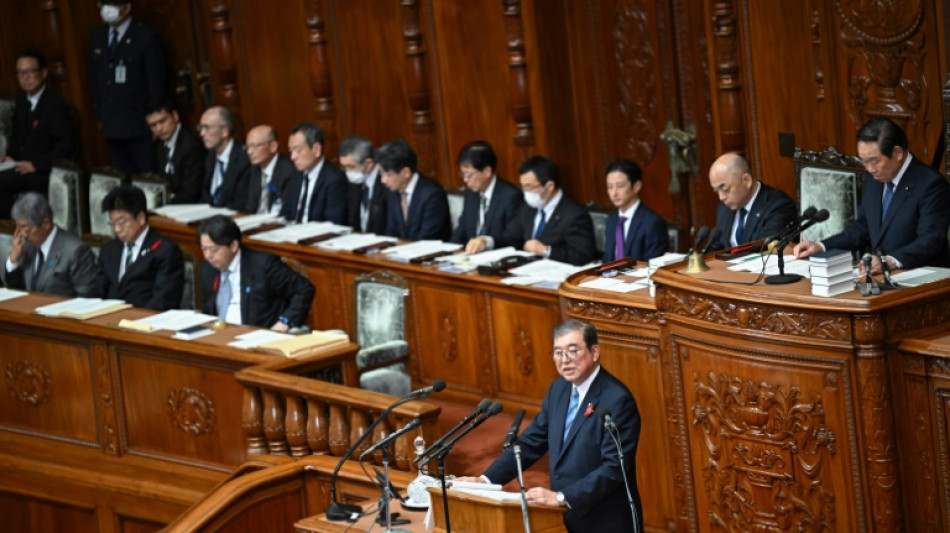
Japan PM dissolves parliament for 'honeymoon' snap election / Photo: © AFP
Japanese Prime Minister Shigeru Ishiba dissolved parliament on Wednesday ahead of October 27 snap elections, banking on his political honeymoon and a fragmented opposition to lead his scandal-tainted party to victory.
Ishiba's Liberal Democratic Party (LDP) has governed Japan almost uninterrupted for decades -- albeit with frequent leader changes -- and is almost certain to be re-elected.
But Ishiba, named prime minister just last week, wants to shore up his mandate to push through policies that include beefing up spending on defence as well as on poorer regions hit hard by Japan's demographic crisis.
"We want to face this election fairly and sincerely, so as for this government to obtain (public) trust," Ishiba told reporters on Wednesday.
Later the speaker of parliament read out a letter from the prime minister with the emperor's seal, formally dissolving parliament as lawmakers shouted the traditional rallying cry of "banzai".
The three-year government of Ishiba's predecessor Fumio Kishida suffered record-low approval ratings due to a slush fund scandal and voter discontent over rising prices.
Polls last week gave Ishiba's cabinet approval ratings of 45-50 percent, compared with 20-30 percent for the Kishida administration's final month.
Ishiba's backers hope the self-confessed defence "geek" and outspoken critic of the LDP establishment will boost the party's popularity, including by persuading young people to vote.
By dissolving parliament now, the 67-year-old wants to put his party to the test before his "honeymoon" period ends, said Yu Uchiyama, a political science professor at the University of Tokyo.
"It makes sense that he wanted to call a snap election as soon as the 'face' of the party changed, while the momentum is still there", he told AFP.
Uchiyama added that Ishiba also wanted to catch opposition forces flat-footed, as the LDP's foes remain undecided about how to coordinate with each other in the election.
But the prime minister's decision to call a snap election this early was also criticised for contradicting his previous vows to prioritise facing the opposition in parliament.
Some voters saw it as a disappointing sign that he had "yielded to the pressure within his party" to dissolve parliament for political gain, Uchiyama said.
Over the weekend, Ishiba announced that the LDP would not endorse some disgraced party members implicated in the political funding scandal in the election.
The announcement reflected his desire to demonstrate to the public that he can be "strict" and "likely regained public trust in him a bit", Uchiyama said.
- Fresh promises -
To counter China, Ishiba has backed the creation of a regional military alliance along the lines of NATO, although he admitted on Monday it would "not happen overnight".
Analyst Yee Kuang Heng of the University of Tokyo's Graduate School of Public Policy, told AFP the idea sounded like a "blast from the past" recalling the now-defunct SEATO (Southeast Asia Treaty Organization).
Ishiba said the security environment in Asia was "the most severe since the end of World War II", and warned in his first policy speech Friday that "today's Ukraine could be tomorrow's East Asia".
Japan is also facing a looming demographic crisis as its population ages and the birth rate stays stubbornly low -- a situation Ishiba called a "quiet emergency" on Friday.
He said his government would promote measures to support families such as flexible working hours.
Ishiba has also pledged to "ensure Japan's economy emerges from deflation", and wants to boost incomes through a new stimulus package as well as support for local governments and low-income households.
The main opposition Constitutional Democratic Party of Japan, meanwhile, seeks to differentiate itself from the LDP on a range of diversity issues, including vowing to legalise same-sex marriages.
It also pledges to allow married couples to maintain separate surnames.
tmo-kh-hih-stu/rsc
T.Bailey--TNT