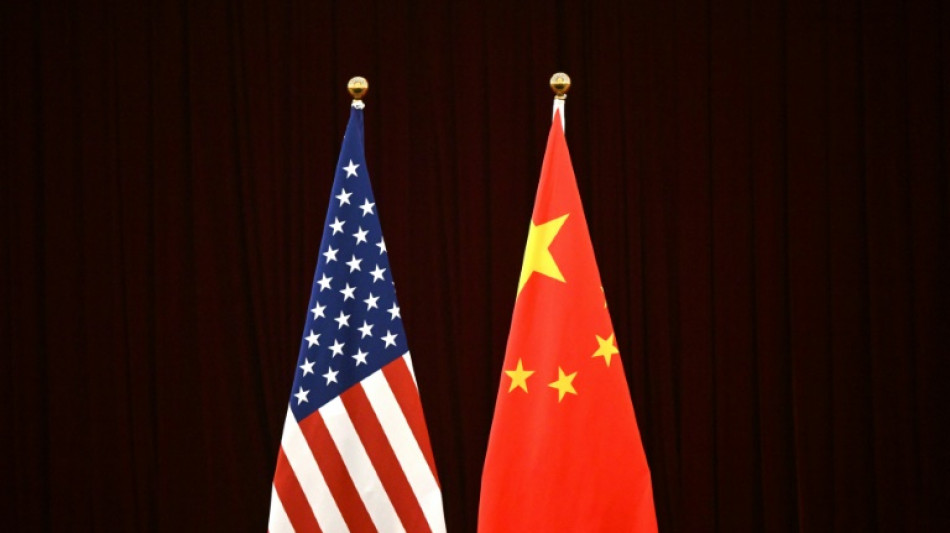
China says raised 'serious concerns' with US over trade curbs / Photo: © AFP
China's Commerce Minister Wang Wentao on Tuesday raised "serious concerns" with his US counterpart Gina Raimondo on Washington's curbs on its trade, urging it to lift sanctions on his country's firms "as soon as possible".
The call, which Beijing described as "candid, in-depth and pragmatic", comes a few weeks after sharp US tariff increases on Chinese electric vehicles, EV batteries and solar cells took effect -- with levies down the line on other products also recently finalised.
In addition, the United States is planning to ban the sale of connected vehicles incorporating Chinese and Russian technology, citing national security risks.
Washington has also restricted technology exports to China such as semiconductors and the machinery used to manufacture them.
On Tuesday, Wang "focused on expressing serious concerns about US semiconductor policy on China and its restrictions on China's network-connected cars," said a statement from Beijing's commerce ministry.
He "stressed that it is particularly necessary to clarify national security boundaries in economic and trade fields".
That would allow for "maintaining the security and stability of global industrial and supply chains", the ministry said.
It added that Beijing "urges the US side to attach importance to the specific concerns of Chinese companies, lift sanctions on Chinese companies as soon as possible, and improve the business environment for Chinese companies in the United States".
Recent tariff hikes, targeting $18 billion in Chinese goods, come weeks before November's US presidential election -- with both Democrats and Republicans pushing a hard line on China as competition between Washington and Beijing intensifies.
US President Joe Biden has largely maintained tariffs imposed by former president Donald Trump, which impacted some $300 billion in goods from China. The hikes this year affect earlier products and added ones.
The US defends its restrictions on sensitive high-tech goods as aimed at limiting Chinese companies' access to cutting-edge equipment purchased abroad, particularly for military purposes.
China has condemned those curbs as "protectionist".
And on Tuesday, Wang said trade ties between the world's two largest economies "should become the ballast of bilateral relations".
Beijing, he said, was willing to push "China-US economic and trade relations back on the correct track".
A.Robinson--TNT