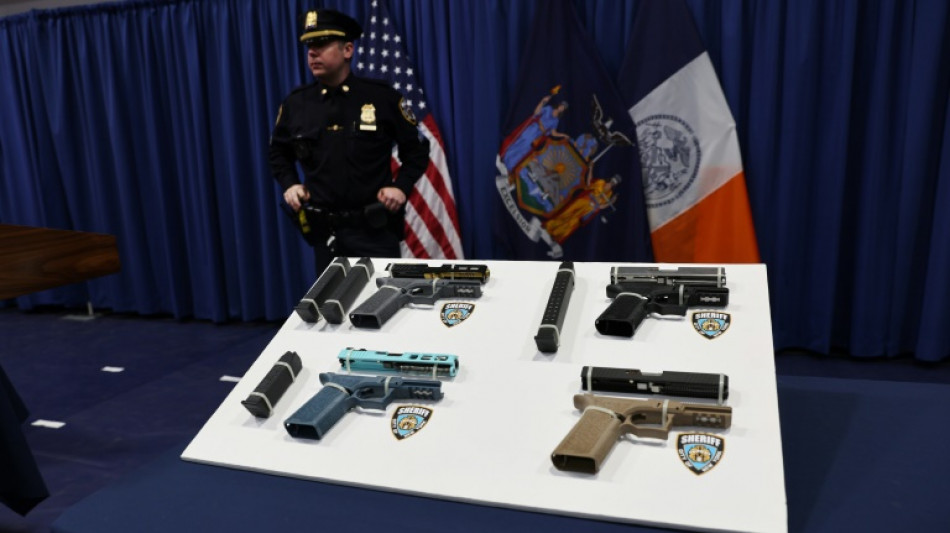
US Supreme Court to hear 'ghost guns' regulation case / Photo: © GETTY IMAGES/AFP
The US Supreme Court hears a challenge on Tuesday to federal regulation of "ghost guns" -- firearms sold in easy-to-assemble kits.
Gun manufacturers and owners are objecting to a 2022 rule from the Bureau of Alcohol, Tobacco, Firearms and Explosives (ATF) that requires ghost guns, like other firearms, to have serial numbers and for purchasers to undergo background checks.
The ATF rule also requires commercial sellers of what are known as "buy-build-shoot" kits to be licensed and maintain records.
Attorney General Merrick Garland has defended the rule under the Gun Control Act of 1968, saying it makes it "harder for criminals and other prohibited persons to obtain untraceable guns."
According to ATF figures, nearly 20,000 ghost guns were recovered at crime scenes in the United States in 2021, a tenfold increase from 2016.
Ghost guns, some of which include parts made by 3D printers, are sold online or in stores in kits that can be assembled at home.
Gunmakers and gun rights groups challenged the ATF rule. A federal judge in Texas ruled that the bureau had exceeded its authority and that such regulation is up to Congress.
The Biden administration appealed to the US Supreme Court after the district court ruling was upheld by a conservative-dominated appeals court panel.
The Supreme Court, by a slim 5-4 vote, stayed the order of the lower courts striking down the ATF rule pending Tuesday's oral arguments in the case.
In their brief to the Supreme Court, the gun rights groups said "an incomplete collection of parts is not a 'weapon'" and ghost gun kits should not be considered "firearms" under the Gun Control Act.
Solicitor General Elizabeth Prelogar, in her brief, said ghost gun manufacturers are seeking to get around the ATF rule using "trivial evasion" and included an analogy to the Swedish home goods giant IKEA.
"If a State placed a tax on the sale of tables, chairs, couches, and bookshelves, IKEA could not avoid paying by insisting that it does not sell any of those items and instead sells 'furniture parts kits' that must be assembled by the purchaser," Prelogar wrote.
"So too with guns: A company in the business of selling kits that can be assembled into working firearms in minutes... is in the business of selling firearms."
The Supreme Court is expected to deliver a decision in the case before the end of June 2025.
L.A.Adams--TNT