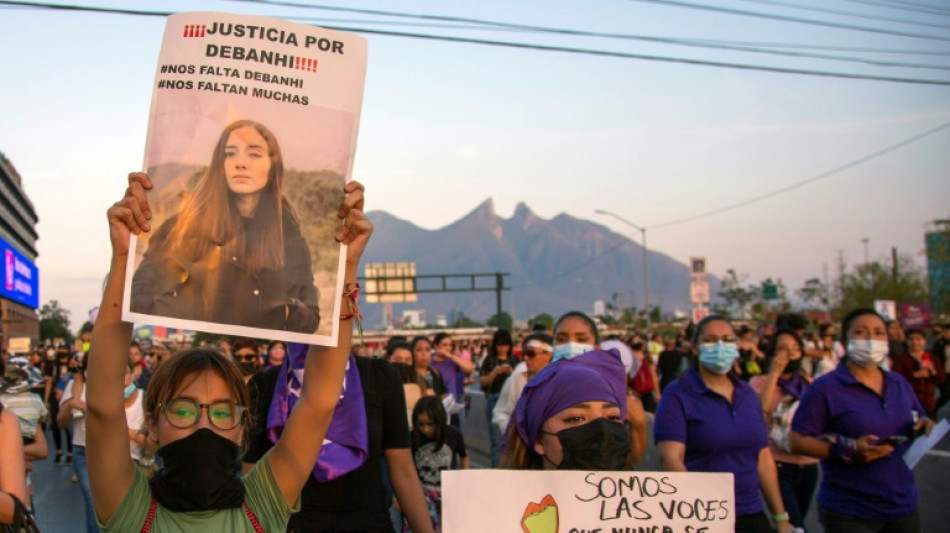
Mexican teenager's death becomes media, justice 'spectacle' / Photo: © AFP/File
The still-unsolved death of teenager Debanhi Escobar has brought into sharp focus not just the dangers facing women in Mexico but also the questionable judicial and media handling of the high-profile case.
Three weeks after the 18-year-old's body was found on the outskirts of the northern city of Monterrey, all hypotheses remain open, from an accident to murder.
So far prosecutors have only confirmed that she died of a blow to the head and was found in the water tank of a motel, 12 days following her disappearance after attending a party.
Investigators visited the site four times before discovering the law student's body.
The attorney general's office in the northern state of Nuevo Leon, whose capital is Monterrey, dismissed two public prosecutors for "errors" and "omissions" in a case that has shocked the country.
"We have a lot of evidence that Debanhi was killed," said her father, Mario Escobar, who arranged a private autopsy and is expected to meet President Andres Manuel Lopez Obrador on Friday.
On the night she died, Escobar left a party then got out of a taxi after an altercation with the driver, who took a photo of her standing alone by the side of a road at night that went viral.
He denies being involved in her death.
- Ethical questions -
Theories about the teenager's fate have proliferated on social networks and in some media, encouraged by videos released or leaked by prosecutors.
Video surveillance footage shows Escobar's movements after leaving the party, having argued with a man, until she arrived on foot alone at the motel.
A brief glimpse of her looking out of a restaurant window is the last image of her alive.
The videos have been shown repeatedly on news and talk shows, in one of which a psychic claimed to have been in contact with Escobar in the afterlife.
"It's becoming a media spectacle," although it does helps to keep the case alive, said sociologist Christian Ascencio, a professor at the National Autonomous University of Mexico (UNAM).
A risk, he said, is that the pressure on prosecutors leads to "a guilty party being fabricated."
The reporting has upset Escobar's mother, Dolores Bazaldua.
"I hear things like 'she was the one who took drugs. She bought the vodka.' Unfortunately, she's not here to defend herself," Bazaldua said.
The repeated broadcasting of images, including one of Escobar apparently buying liquor, victimizes her again and marks an ethical decline in the press, said Andres Vidal, professor of political science at UNAM.
Mexico's Congress is considering legislation that would make leaking information about victims a crime punishable by up to 10 years in prison.
- 'Risk of impunity' -
Psychosocial support specialist Valeria Moscoso sees a pattern in the case of Escobar and others.
"The indolence, limited investigation capacity, criminalization of the victims and risk of impunity are being repeated," she said.
According to prosecutors, there have been 56 murders of women this year in Nuevo Leon, 42 of which were categorized as femicides -- killings of women because of their gender.
Around 300 women have disappeared in the state so far in 2022, of which 90 percent have been found alive.
The problem extends throughout Mexico, where in 2021 there were 3,751 murders of women, most of which are still unpunished.
Nearly 100,000 people have gone missing nationwide, mostly since 2006 when the deployment of the military in the war of drugs set off a spiral of violence.
Escobar's death sparked unusually intense media interest in Mexico, whose femicide crisis dates back to the 1990s and affects poorer women in particular, many of them killed by their partners.
The outcry surrounding the case has brought femicide "closer to more privileged social sectors, with more media and political influence, who are considered less likely to suffer this violence," said Ascencio.
"Many women think that the same thing could happen to them" because they also go out with friends or use taxis, he added.
C.Blake--TNT