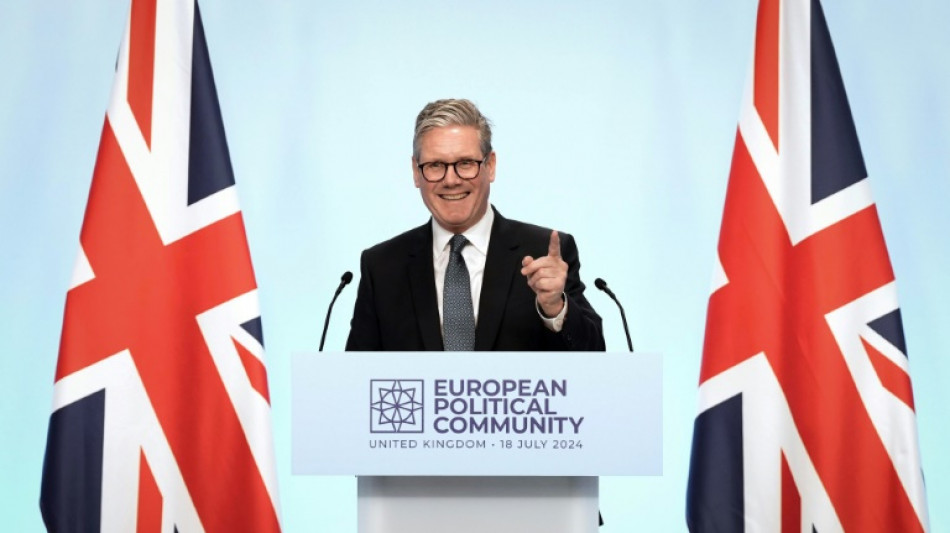
Britain's Starmer in Brussels to flesh out EU 'reset' pledge / Photo: © POOL/AFP
Keir Starmer arrived in Brussels on Wednesday on his first visit as British prime minister, looking to build on a promised "reset" of relations with the European Union after the rancour of Brexit.
Starmer will hold his first formal meeting with European Commission president Ursula von der Leyen since his Labour party ousted the Conservatives from power in a general election in July.
It is a further sign of new British goodwill towards European neighbours following the UK's rancorous 2020 departure from the bloc under Brexit champion Boris Johnson.
But Starmer is also under pressure to be more precise about what exactly he wants for Britain from the EU -- and what he is willing to give in return.
Downing Street said the prime minister would use Wednesday's trip to discuss "his ambitions for the next few months" with the commission chief and other EU leaders.
Ahead of the visit, the British premier said he was "so determined to put the Brexit years behind us and establish a more pragmatic and mature relationship" with the EU.
- Seeking improvements -
Before heading to Brussels, Starmer has already held bilateral meetings with French President Emmanuel Macron, German Chancellor Olaf Scholz and Italian premier Giorgia Meloni -- a timeline that has raised some eyebrows.
"In view of London's public announcement of a new start in our relations, it is indeed remarkable that a visit to Brussels has not yet taken place," commented David McAllister, the German chair of the European Parliament's foreign affairs committee.
That said, as McAllister acknowledged, Starmer started rebuilding bridges with Brussels in July, when he hosted dozens of leaders at the European Political Community meeting.
Starmer also met von der Leyen on the sidelines of the UN General Assembly last month.
The visit to Brussels is "symbolic of this great blowing away of the fog that's been across the Channel," professor Richard Whitman, an EU expert at the University of Kent, told AFP.
"But I think it's also probably the prelude to a reality check on the side of the UK that it's going to be a long old slog if you're going to get anything worth boasting about in terms of improving the relationship."
Starmer, who voted in the 2016 referendum to remain in the EU, has insisted that his reset will not mean reversing Brexit, which remains a politically toxic subject in the UK.
Instead, Labour wants improvements to the existing Trade and Co-operation Agreement between the UK and the EU that is due for renewal in 2026.
These include negotiating a new security pact with the 27-member bloc, a veterinary agreement to ease border checks on farm produce and mutual recognition of professional qualifications.
- 'Broad brushstrokes' -
But Starmer has put forward little detail, while also laying down red lines for any negotiations, pledging no return to the European single market or customs union, or any return to freedom of movement.
"Starmer has to present the plan," said Mujtaba Rahman, managing director for Europe at political risk consultancy Eurasia Group.
Starmer has also poured cold water on the EU's big proposal so far -- a youth mobility scheme for 18- to 30-year-olds.
Brexit ended the free movement of EU citizens to live and work in Britain, and vice versa.
The EU would like younger people from its member countries to be able to move freely in the UK.
But Starmer has rejected the idea over fears it looks too much like freedom of movement. The interior ministry is resistant to anything that increases levels of legal migration.
The EU's ambassador to the UK, Pedro Serrano, played down the notion that the proposal was a stumbling block last week. He likened it to a "gap year" that would not give EU citizens the right to work in Britain.
Analysts say Labour could be tempted by a limited exchange programme if it helps to achieve its overarching objective of boosting economic growth.
The European Commission has called the meeting "simply be the beginning of a conversation".
An EU diplomat speaking on condition of anonymity indicated the chat would focus on "broad brushstrokes", with nothing concrete expected from it.
"A lot of work would need to go into defining how anything could work," the diplomat said.
burs-pdh-ec/del/jj
T.Ward--TNT