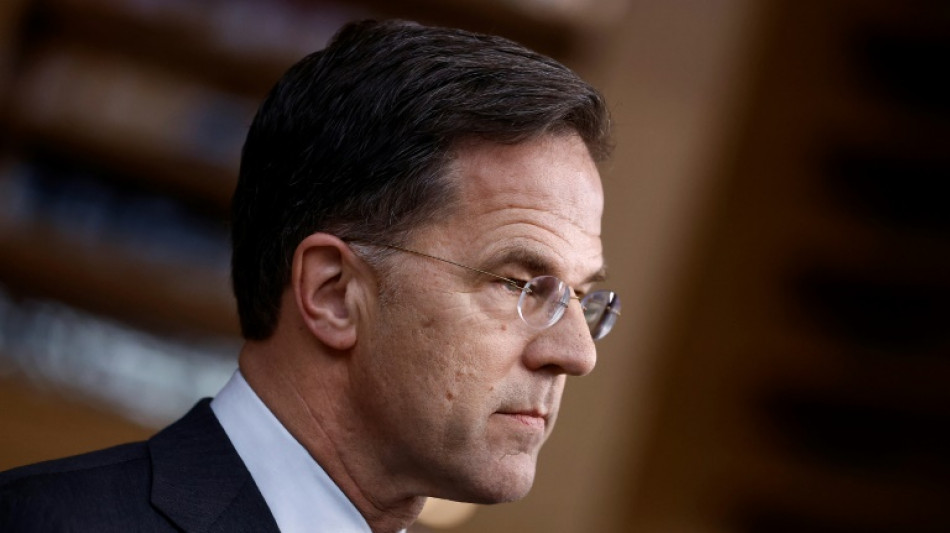
Trump to Putin: the key challenges facing Rutte at NATO / Photo: © AFP
Dutch former prime minister Mark Rutte will take the reins as NATO's new secretary general on Tuesday at a perilous time for the Western military alliance.
With Russia's war in Ukraine raging through a third year, its leading power the United States set for a crunch election, and China rising, NATO is grappling with major challenges.
Here are the key issues set to fill Rutte's in-tray as he enters office:
- Trump 2.0? -
Looming over the 32-nation alliance is the potential return of former US president Donald Trump to the White House after November elections.
The volatile ex-reality TV star reportedly mulled withdrawing the United States from NATO during his first term -- and threatened not to protect allies that do not spend enough on defence.
Outgoing NATO chief Jens Stoltenberg was credited with averting a major crisis that could have seen the magnate blow a hole in the alliance.
Should Trump be re-elected, Rutte will need all the diplomatic skill he acquired during more than 13 years in charge of the Netherlands to ward off any weakening of Washington's role.
European allies will be informally war-gaming options to try to steward Trump and have already been showcasing their increased spending to keep him on board.
A victory for Democrat Kamala Harris would reassure NATO in the short term.
But diplomats say they expect a gradual US disengagement from Europe as Washington pivots to Asia, whoever is in charge.
- Keep Ukraine going -
While the threat from Trump may not come to pass, one inescapable reality will be the situation on the battlefield in Ukraine.
NATO countries -- spearheaded by the United States -- have provided 99 percent of the foreign military aid that has helped keep Kyiv's forces in the fight since 2022.
As the war drags on towards its fourth year, Rutte will have a key role in rallying Kyiv's backers to make sure support does not dry up.
Meanwhile, calls for a negotiated settlement are growing louder.
NATO at its summit in Washington this summer took over a greater role in coordinating arms deliveries -- but failed to lock-in long-term commitments of support.
Kyiv at the same time is also pushing for membership of NATO.
The United States and Germany have so far blocked any concrete progress on that front -- but pressure is likely to increase again.
Balancing the expectations from Ukraine against the caution of leading allies will be a major task.
- Fit to fight Russia? -
Regardless of how the war in Ukraine pans out, NATO allies say they are likely to face a threat from Russia for decades to come.
Last year the alliance signed off on its most comprehensive defence plans since the end of the Cold War, aimed at stopping any potential attack by Moscow.
While officials insist the combined might of NATO could currently defeat a Russian military weakened by the Ukraine war, the Kremlin is already looking to rebuild its forces.
Rutte's core task will be to try to make sure NATO is ready while ensuring that tensions do not spill over into a possible nuclear conflict with Russia.
Some allies estimate Russia could be prepping for a potential war with the alliance within a decade.
That gives NATO countries a shrinking window of opportunity to plug the gaps in key weaponry and personnel they need to put the new plans into action.
On top of the list are air defences, longer-range missiles, and making sure there are ample stocks of staples like artillery shells.
Western firms were ill-prepared to meet the demands of the full-scale war in Ukraine after decades of underinvestment.
Countries have begun ramping up production but Rutte will have to keep the pressure on to make sure industry is fit for purpose -- and allies keep buying what is required.
- Money matters -
All that will take cash -- and lots of it.
A decade after NATO set a target for allies to spend two percent of their gross domestic product on defence, only 23 hit that bar this year.
The new NATO boss will have to corral the laggards to make good on the target and make sure others do not slip back.
And there are already calls for the alliance to go even further and considerably ratchet up spending beyond the current two percent floor.
For notoriously frugal Dutchman Rutte -- who only pushed the Netherlands to the target in his last year in office -- that could be a hard sell.
- China threat -
Further afield, NATO eyes are also increasingly drawn to another potent rival: China.
While the alliance is bound in its founding treaty to the Euro-Atlantic area, Washington has increasingly been pushing allies to pay more attention to the risks posed by Beijing.
China's burgeoning partnership with Russia has propelled the threat in the minds of many European allies and seen NATO build up ties with allies such as Japan, South Korea and Australia.
But some -- notably France -- remain wary of diverting NATO's attention away from its principal theatre and Rutte will have to perform a careful balancing act.
A.Little--TNT