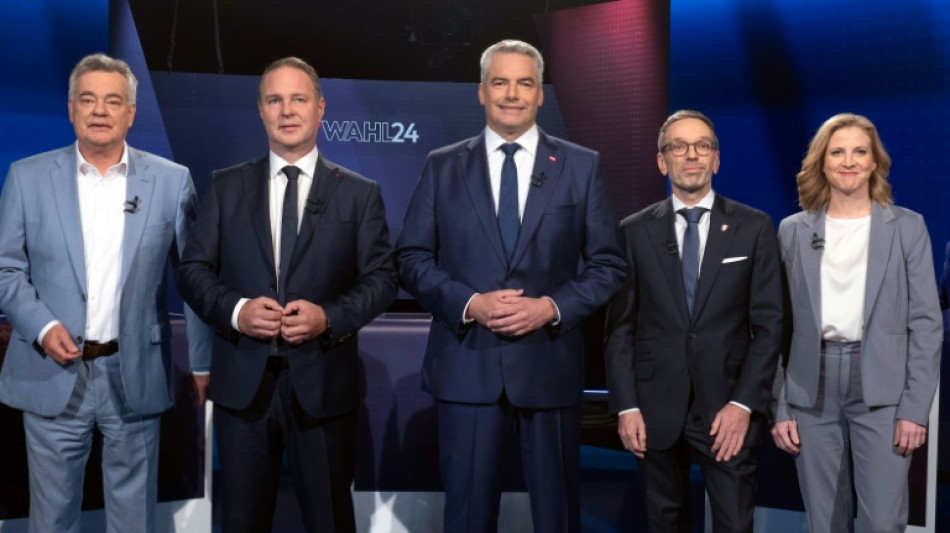
The three contenders vying for power in Austrian election / Photo: © AFP
A combative far-right marathon-runner is up against a mild-mannered chancellor and a left-wing former warehouse worker in Austria's national election on Sunday.
In a campaign dominated by immigration concerns and an economic downturn, polls put the far right ahead for the first time ever -- narrowly followed by the ruling conservatives and the Social Democrats in third place.
Here are mini-biographies of the three party leaders.
- Abrasive far-right leader -
Herbert Kickl, 55, the abrasive leader of the far-right Freedom Party (FPOe) since 2021, has made his career largely behind the scenes as its long-time ideologue.
By tapping into voter anger and anxieties over restrictions during the Covid pandemic, migration and the war in Ukraine, Kickl has succeeded in restoring his party's popularity after a massive corruption scandal rocked it in 2019.
A passionate marathon runner and climber, he has employed virulent rhetoric, often launching personal attacks against political opponents.
Despite his popularity on the campaign trail, Kickl's provocative style has left him short of potential coalition partners with whom to govern.
Interior minister in a previous conservative-led government, Kickl has never made a secret of his proximity to the extremist Identitarian Movement to target what they see as their common enemy: Islam.
Kickl, who studied philosophy and history, has also espoused the far-right concept of "remigration" that calls for expelling people of non-European ethnic backgrounds deemed to have failed to integrate.
In the lead-up to Sunday's vote, Kickl has called himself the future "Volkskanzler," the people's chancellor, as Adolf Hitler was termed in the 1930s.
- Ex-soldier turned 'crisis' chancellor -
Chancellor Karl Nehammer, who heads the conservative People's Party (OeVP), has campaigned on the promise of "stability for Austria".
The 51-year-old former soldier and amateur boxer took the helm of the Alpine country after its charismatic leader Sebastian Kurz spectacularly stepped down in 2021 following a series of corruption allegations.
As chancellor, Nehammer has been steering the nation through multiple crises ranging from the pandemic to the soaring cost of living following Russia's invasion of Ukraine, with Austria's economy flagging.
Despite a perceived lack of charisma, his supporters praise him as loyal, straightforward and trustworthy.
After becoming a lawmaker in 2017, Nehammer was tasked with heading the interior ministry just months before Austria faced its first jihadist attack, which killed four people in November 2020.
To claw back voters from the far right, Nehammer, a pro-European, has hardened his stance on immigration, claiming he has drastically reduced the number of irregular migrants entering the country.
- Former labourer with Marxist leanings -
As the leader of the left-wing Social Democratic Party (SPOe) since 2023, Andreas Babler has struggled to turn around the fortunes of the party, which long dominated Austria's post-war politics but has found itself in opposition since 2017.
The son of a blue-collar worker and himself a former warehouse labourer, Babler, 51, has gradually risen through the SPOe ranks and has sought to unite the party plagued by infighting.
Mayor of the town of Traiskirchen, which hosts the country's main refugee centre, Babler has campaigned on proposals to introduce a wealth tax, widen access to affordable healthcare and shorten working hours to reduce what he sees as growing inequalities in Austria.
Babler, who enjoys hunting in his free time, last year described himself as a Marxist before backpedalling.
Lagging behind in third place, according to polls, the SPOe could yet find itself in government, together with the OeVP and perhaps a third partner to thwart a Kickl chancellorship.
P.Barry--TNT