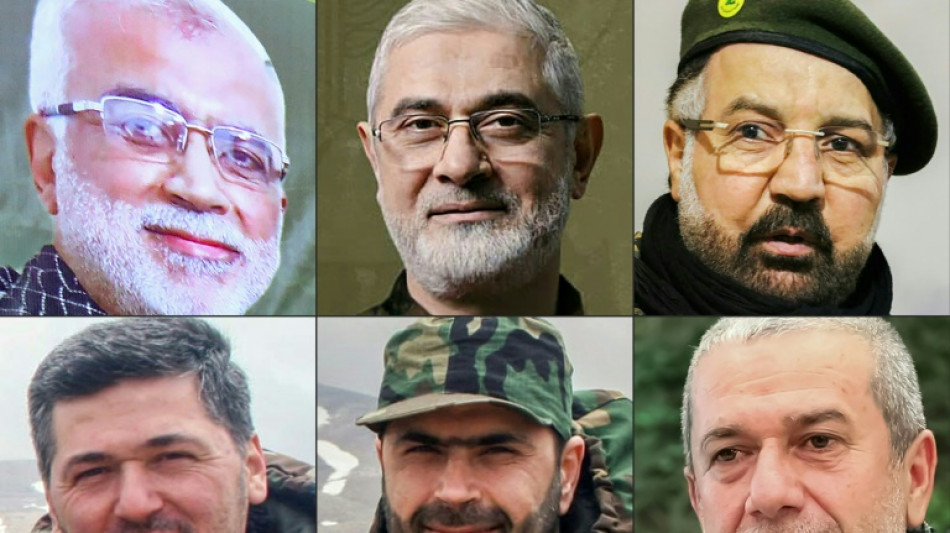
The Hezbollah commanders killed in Israeli strikes / Photo: © AFP/File
Israel has killed several top Hezbollah commanders in a series of targeted strikes on the Iran-backed movement's stronghold in Beirut.
Here is what we know about the slain commanders.
- Shukr: right-hand man -
A strike on July 30 killed Fuad Shukr, the group's top military commander and one of Israel's most high-profile targets.
Shukr, who was in his early 60s, played a key role in cross-border clashes with Israeli forces, according to a source close to Hezbollah.
The two sides have traded near-daily fire across the frontier since Hezbollah ally Hamas's unprecedented October 7 attack on Israel.
Shukr helped found Hezbollah during Lebanon's 1975-90 civil war and became a key adviser to its chief, Hassan Nasrallah.
Shukr was Hezbollah's most senior military commander, and Nasrallah said he had been in daily contact with him since October.
Israel blamed Shukr for a rocket attack in July on the Israeli-annexed Golan Heights that killed 12 children in a Druze Arab town. Hezbollah has denied responsibility.
In 2017, the US Treasury offered a $5 million reward for information on Shukr, saying he had "a central role" in the deadly 1983 bombing of the US Marine Corps barracks in Beirut.
- Aqil: US bounty -
A strike on September 20 killed Ibrahim Aqil, head of Hezbollah's elite Radwan Force, along with 15 other commanders.
According to Lebanese officials, the attack killed a total of 55 people, many of them civilians.
A source close to Hezbollah described Aqil as the second-in-command in the group's forces after Shukr.
The Radwan Force is Hezbollah's most formidable offensive unit and its fighters are trained in cross-border infiltration, a source close to the group told AFP.
The United States said Aqil was a member of Hezbollah's Jihad Council, the movement's highest military body.
The US Treasury said he was a "principal member" of the Islamic Jihad Organisation -- a Hezbollah-linked group behind the 1983 bombing of the US embassy in Beirut that killed 63 people and an attack on US Marine Corps in the Lebanese capital the same year that killed 241 American soldiers.
- Kobeissi: missiles expert -
On September 25, a strike killed Ibrahim Mohammed Kobeissi, who commanded several military units including a guided missiles unit.
"Kobeissi was an important source of knowledge in the field of missiles and had close ties with senior Hezbollah military leaders," the Israeli military said.
Kobeissi joined Hezbollah in 1982 and rose through the ranks of the group's forces.
One of the units he led was tasked with manning operations in part of the south of Lebanon, which borders Israel.
- Srur: drone chief -
A strike on September 26 killed Mohammed Srur, the head of Hezbollah's drone unit since 2020.
Srur studied mathematics and was among a number of top advisers sent by Hezbollah to Yemen to train the country's Huthi rebels, who are also backed by Iran, a source close to Hezbollah said.
He had also played a key role in Hezbollah's intervention since 2013 in Syria's civil war in support of President Bashar al-Assad's government.
Hezbollah will hold a funeral ceremony for Srur on Friday.
Other commanders killed in recent strikes include Wissam Tawil and Mohammed Naameh Nasser.
A.Wood--TNT