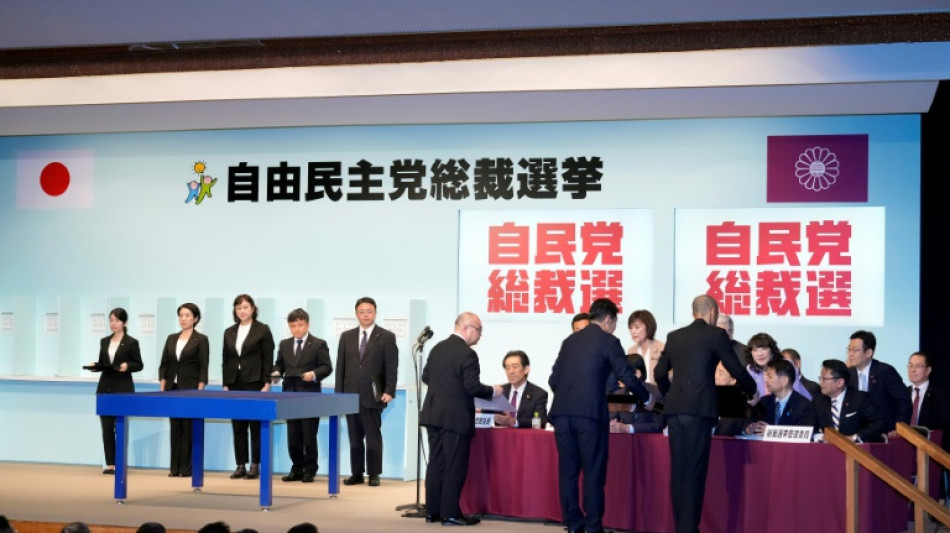
Former defence minister Ishiba to be Japan's PM after winning party vote / Photo: © POOL/AFP
Former defence minister Shigeru Ishiba will become Japan's next prime minister after winning the ruling party's leadership vote on Friday, the official count showed.
Ishiba, 67, beat arch-nationalist Sanae Takaichi -- who would have been the country's first ever woman leader -- in a run-off.
After his victory was announced at the Liberal Democratic Party (LDP) headquarters in Tokyo, Ishiba smiled and took off his glasses to wipe his teary eyes, bowing repeatedly as his associates congratulated him.
"I will do my utmost to believe in the people, to speak the truth with courage and sincerity, and to make this country a safe and secure place where everyone can live with a smile on their face once again," he said in a short speech.
Ishiba has come close to the top job before, including in 2012 when he lost to nationalist Shinzo Abe, Japan's longest-serving leader who was later assassinated.
The military model-maker with an affinity for 1970s pop idols says his experience tackling tough social issues, such as agriculture reforms, makes him qualified for the job.
As scandals fuel public discontent with the LDP, "the tide is in favour of Ishiba and his 'fair and square' attitude," Yu Uchiyama, a University of Tokyo politics professor, said ahead of the vote.
The conservative party has governed almost uninterrupted for decades and holds a majority, meaning Ishiba will be elected premier by parliament on Tuesday.
As prime minister he will need to face down regional security threats, from an increasingly assertive China and its deepening ties with Russia to North Korea's banned missile tests.
At home, Ishiba will be tasked with breathing life into the economy, as the central bank moves away from decades of monetary easing that has slashed the value of the yen.
In the first round of voting, a record nine candidates had been in the running after the LDP's long-powerful factions disbanded earlier this year over a funding scandal.
Takaichi, economic security minister, is a vocal nationalist popular with the LDP's conservative wing. The 63-year-old was close to assassinated ex-premier Abe, whose supporters are still powerful.
In third place behind Ishiba and Takaichi was former environment minister Shinjiro Koizumi, a keen surfer whose father was prime minister in the 2000s.
LDP leaders are in office for three years and can serve up to three straight terms. Unpopular Prime Minister Fumio Kishida did not run for re-election.
On the streets of Tokyo, 72-year-old retiree Yasumi Fujino told AFP she was "concerned about China" and hoped "the next person will focus on diplomacy".
Yuji Ikeda, also 72, said "I understand that the times call for defence spending with the thing about Russia's plane and China and all that".
"But I feel we spend too much on national defence now. I am interested in what the next person would do in terms of policy for seniors."
The LDP has governed Japan almost uninterrupted for decades, with the main opposition parties rarely seen as viable alternatives.
During his term, Kishida has taken steps to double Japan's defence spending, opening the door for military exports as the LDP seeks to revise the pacifist post-war constitution.
He welcomed Ukrainian President Volodymyr Zelensky to a G7 summit in Hiroshima and has strengthened Japan's often testy ties with its neighbour South Korea.
But his rule was also tarnished by scandals, voter anger over rising prices and sliding poll ratings.
F.Adams--TNT