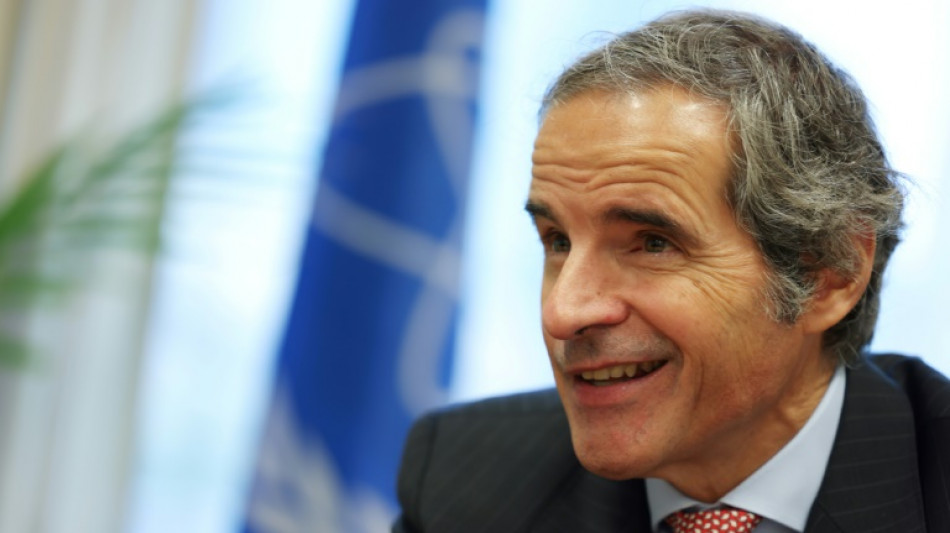
Iran shows 'willingness' to re-engage on nuclear issue: IAEA chief to AFP / Photo: © AFP
The head of the United Nations nuclear watchdog on Thursday said Iran is showing "willingness" to re-engage on the nuclear issue, but that Tehran will not reconsider its decision to deny access to top UN inspectors.
International Atomic Energy Agency chief Rafael Grossi said Tehran was "showing signs of willingness to reengage, not only with the IAEA, but also... with our former partners in the nuclear agreement of 2015."
Grossi spoke after meeting this week with Iran's Foreign Minister Abbas Araghchi, who played a key role in the negotiations that culminated in the 2015 landmark nuclear deal with world powers which has since unraveled.
"It's a moment where there is a possibility to do something" on the nuclear question, Grossi told AFP on the sidelines of the United Nations General Assembly.
"The advantage Araghchi has is that he knows everything about this process, so that allows us to move faster," Grossi said at the IAEA's New York offices.
In recent years, Tehran has decreased its cooperation with the IAEA, while significantly ramping up its nuclear program, including amassing large stockpiles of uranium enriched to 60 percent -- close to the 90 percent needed to develop an atomic bomb.
But since the July election of Iranian President Masoud Pezeshkian, Tehran has signaled openness to relaunching talks to revive the nuclear agreement.
The landmark deal -- also known by its acronym JCPOA -- started to unravel in 2018 when then-US president Donald Trump unilaterally withdrew from it and reimposed sanctions, and Iran retaliated by stepping up its nuclear activities.
- 'For them to decide' -
Efforts to revive the deal -- bringing the United States back on board and Iran back into compliance -- have so far been fruitless.
"If things move in a positive way... and I think this is the intention of the president and the foreign minister (of Iran), there will be a return to the conversations with the former partners," Grossi said.
Tehran, however, is not willing to walk back on a decision it took last year to ban some of the IAEA's "best inspectors," Grossi said, a move Teheran initially described as retaliation for "political abuses" by the United States, France, Germany and Britain.
"They are not going to restore the inspectors to the list," Grossi said.
"Maybe there will be a review of that. I will keep pushing," he added, explaining that he is due to visit Tehran in the "coming weeks."
During his visit, Grossi plans to discuss "different monitoring and verification measures that we could agree on prior to a wider agreement."
"I think getting an agreement with Iran on these things would be a very constructive indication... towards a future negotiation," Grossi said.
"If you do not allow me to establish a baseline of all the capacities that the country has at the moment, then what kind of confidence and trust are you injecting in the system for a negotiation with other partners?" he added.
According to a diplomatic source, the European side is skeptical about the possibility of returning to the framework of the initial pact.
Grossi said the actual framework of the deal would be left to Iran and Western powers.
"Will it be the same? Will it be updated? Will it be something completely different? This is for them to decide," Grossi said.
H.Davies--TNT