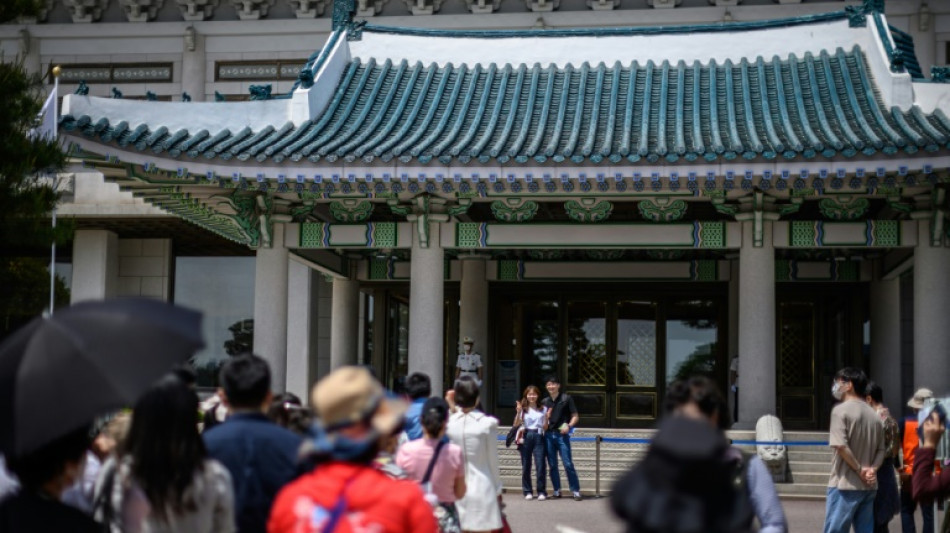
South Korea's new president opens Blue House to the public / Photo: © AFP
Thousands of South Koreans poured into the presidential Blue House in leafy northern Seoul on Wednesday, after President Yoon Suk-yeol made good on a campaign promise to return the once-fortified compound to the people.
The building, named for the approximately 150,000 hand-painted blue tiles that adorn its roof, has been home to South Korea's leaders since 1948, and was largely restricted to the public.
That has changed since Yoon, a former top prosecutor who was sworn in on Tuesday, refused to move in, saying the hilltop headquarters -- on a site once used by former colonial power Japan -- fostered an "imperial" presidency and undermine communication with the public.
Instead, Yoon is working from the 10-storey defence ministry building -- an undistinguished office block in downtown Seoul, hastily adorned with the presidential seal.
Critics have slammed the move as a costly waste of time and money, which could also put the country's security in jeopardy at a time of high tensions with the nuclear-armed North.
But on opening day, South Koreans flocked to the 250,000-square-metre complex, which is flanked by mountains and nestled behind the royal Gyeongbokgung Palace.
"It is an honour of my life to come here and actually see the presidential office," Choi Jung-bun, 70, told AFP as she ate a packed lunch by a stream in its garden.
"This is a deeply storied site that conjures up old Korean kings and modern-day presidents. I am sure it will become one of the major tourist attractions."
- Back to the people -
According to officials, more than 25,000 people toured the complex on the first day of full opening, having signed up in advance.
Visitors seemed thrilled to finally be allowed inside, with huge queues in front of the main building as people waited patiently to take photographs.
That was despite the fact that the building itself has not yet been opened to visitors over security concerns, for example over communications equipment that still needs to be removed.
Up to 39,000 visitors per day will be allowed to visit the complex, officials said, during the first phase of the public opening, which runs until May 22.
In the past, the presidential office ran a much smaller tour program that allowed 1,500 visitors per day, with restrictions on many areas.
However, the changes may not be permanent if the opposition has its way.
"When the Democratic Party wins the next presidency, we will go back to the Blue House," former party chairman Song Young-gil said last week in an interview with local media.
But Cho Ok-kyung, a 61-year-old visitor from Bucheon, west of Seoul, said the compound had been returned to the people -- and it should stay that way.
"I'd like this place to keep open indefinitely so that future generations can enjoy it too."
- Bad feng shui? -
Yoon's critics have said his desire to move the office was tied to his belief in feng shui, a traditional religious practice which stresses the importance of harmony between humans and nature.
The former prosecutor has been dogged by accusations of ties to a shaman, which he has denied.
The Blue House has long been rumoured to foster bad luck for its residents, given the assassination, impeachment, corruption trials and imprisonment that have befallen South Korean presidents.
Yoon's vow that he would not spend a single day in the Blue House compound even drew criticism from his predecessor Moon Jae-in, who called the decision "dangerous" amid heightened tensions with North Korea.
"It is hard to understand how the decision was formulated to determine Yoon would not spend a day at the Blue House," Moon said last month.
The move is also to blame for Yoon's record-low approval rating of just 41 percent, according to a recent Gallup poll.
Yoon started his term in office with a security briefing in an underground bunker, as he faces an increasingly belligerent Pyongyang.
North Korea has conducted a record 15 weapons tests since January, including two launches just days before his inauguration.
W.Baxter--TNT