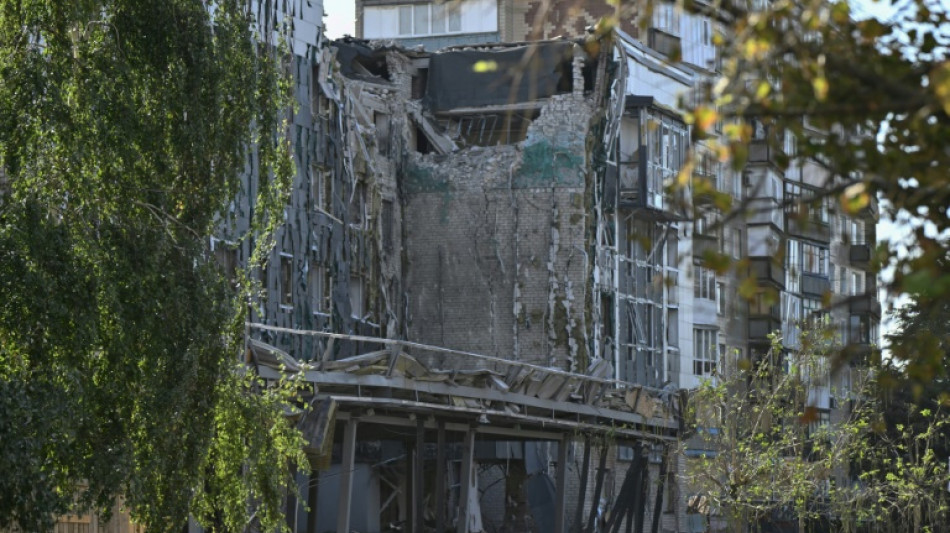
In Ukraine's Pokrovsk, some quietly waiting for Russian troops / Photo: © AFP
Walking through the deserted streets of Pokrovsk as Russian troops inch closer and closer every day, Galyna said she was not worried about the prospect of occupation.
She was making her way home as artillery echoed in the distance, before the beginning of the 3pm to 11 am curfew that authorities in the eastern Ukrainian city imposed due to increasing shelling.
"I'm not scared. Why should I be?" the 53-year-old said.
"We are not going anywhere. This is our homeland... I'm for peace," said Galyna, who did not want to give her family name citing fears of retaliation.
She is one of thousands of frontline residents who refuse to flee, frustrating evacuation teams trying to save their lives.
Civilians are running out of time to evacuate Pokrovsk, according to authorities who estimate the population has whittled down in a month from 48,000 to around 16,000.
People delay their departure for many reasons: some are too attached to their homes and jobs, while some are discouraged by past experience of displacement.
Others are quietly waiting for Russian troops.
"There's no bad nation, only bad people, you know what I mean?" Galyna said with a knowing glance.
- 'Absurd, surreal' -
Evacuation teams say they are coming across some cases of pro-Russian disinformation as they plead with people to leave.
"There are cases of people staying to wait for the 'Russian world' but they represent a small percentage, by no means massive," said Pavlo Diachenko, a Pokrovsk police spokesman.
"It's a big problem, we are facing heavy propaganda," said Alina Subotina, an evacuation coordinator with Children New Generation.
Moscow says the protection of Russian-speakers in the Donbas region was one of its reasons for invading, but has bombarded cities in the Donbas for over two-and-a-half years.
Subotina can only plead with remaining residents, pointing to the myriad of cities like Bakhmut or Avdiivka that Moscow razed to the ground.
"It's absurd, surreal. You tell them: it's not true, the cities are just burning, nothing good awaits you, you need to leave," Subotina said.
Lilya Deynega raged against those who believed Russian troops would spare anyone.
The 28-year-old was fleeing Russian troops for a second time, after leaving the nearly occupied town of Grodivka where two neighbours died in a drone attack.
"They say 'we will save you' but from what? We don't need to be saved from anything, everything was fine before they came," she said.
- 'Friends, comrades' -
Even so, Moscow's narrative has won some over.
On a bench in front of the Pokrovsk church, 82-year-old Sergei seemed indifferent to the prospect of Russian troops capturing the city.
"People are still living their lives in occupied territories!" he told AFP.
Sergei's friend Nina interjected.
"What about Russians? We were always friends, comrades," said Nina, also 82.
"This whole mess started in 1990," she said referring to the separation of Ukraine and Russia at the collapse of the Soviet Union.
Both refused to give their surnames citing fears of retribution.
Nina's argument was reminiscent of the claims hammered home for years by Russian officials and state-controlled media.
The Kremlin has refused to accept Ukraine's democratic turn toward Europe and the West in the decades following the collapse of the Soviet Union.
It has instead alleged -- without evidence -- that Kyiv only implemented orders from Washington that it accuses of turning Ukrainians against Russians.
When pro-European protests took over Ukraine in 2014, Russia launched a first assault on Ukraine that led Moscow-backed separatists to occupy parts of the Donbas.
- 'Die in the motherland' -
Russian President Vladimir Putin has said that the capture of the Donbas is Russia's primary objective in the 2022 full-scale invasion.
To seize territory, his troops have caused widespread destruction, according to images captured by drones and satellites.
But Olena, another local resident, said life would go on if Russian troops take over.
"We have potatoes, we won't die of hunger," she said.
She was ready for anything to avoid a second exile, having already left her hometown once in 2022.
There is little volunteers can do as they are forbidden to force people out.
"People will stay there in any case. They've made up their minds. We will help them as long as we are able to reach them," Subotina said.
She said locals often left the decision to the last moment, too late for evacuation teams.
For now, Galyna did not seem close to changing her mind.
"If I die, at least it'll be on my land," she said.
T.Allen--TNT