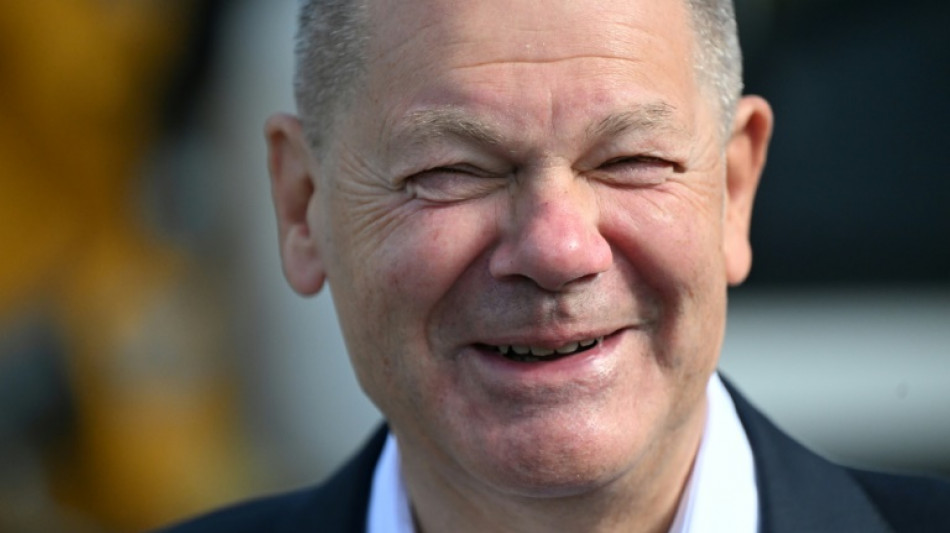
Scholz's party beats far-right AfD in east German state vote / Photo: © AFP/File
German Chancellor Olaf Scholz's Social Democrats narrowly beat the far-right AfD in a state election Sunday in the formerly communist east, in rare good news for his party.
Scholz's centre-left SPD won around 31 percent in the state of Brandenburg against the anti-immigration, pro-Russian Alternative for Germany, which scored about 29 percent, projections by public broadcasters said.
The result offers a rare moment of respite for Scholz's embattled coalition government, which has sunk in opinion polls a year ahead of national elections.
The vote in Brandenburg has been closely watched because Scholz's SPD has ruled there ever since Germany's 1990 reunification. The chancellor's own electoral district is in the state capital Potsdam, outside Berlin.
The AfD, which rails against asylum-seekers, multiculturalism, Islam and Scholz's three-party government, had hoped to replicate its recent electoral success in the east.
Three weeks ago, it stunned the political establishment by winning its first-ever parliamentary vote -- in the eastern state of Thuringia -- and coming a close second in neighbouring Saxony.
Despite its ballot box success, the AfD is unlikely to take power in any state since all other mainstream parties have so far ruled out entering into a governing alliance with the party.
- 'Gold once, silver twice' -
Brandenburg's popular SPD state premier Dietmar Woidke had kept his distance during the campaign from party colleague Scholz.
In office for more than a decade, Woidke had also thrown down a challenge to voters, by telling them he would quit if the AfD won.
The AfD, which failed in its aim "to send Woidke into retirement", nonetheless hailed its strong showing. Party co-leader Tino Chrupalla said it had "taken gold once and silver twice" in three elections in the east this month.
A visibly relieved Woidke basked in applause by party faithful, celebrating the close win in a race where just weeks ago his party had trailed the AfD in the opinion polls.
The goal, he said, had been to prevent Brandenburg from being marked with a "great, brown stamp", the colour associated with fascism.
The message appeared to have energised voters, and turnout reached 74 percent.
Another AfD co-leader, Alice Weidel, declared it was now clear that overall "we are the strongest force in the east", a region that still lags behind western Germany in jobs and wealth.
"It's an important stage, as you'll see in the federal elections," she said.
For now the SPD celebrated its win, but Scholz is unlikely to profit much, pollster Manfred Guellner told the Tagesspiegel daily, arguing that the election was all about Woidke.
"Woidke has everything that Olaf Scholz lacks: approval, sympathy, a down-to-earth attitude, cohesive strength," said Guellner. "In this respect, Woidke is the anti-Scholz."
- Fear of attacks -
The decade-old AfD, originally a eurosceptic fringe party, has long stoked public fears about irregular migration, especially after a string of recent attacks with suspected Islamist motives.
The AfD's rhetoric has heaped pressure on Scholz and his governing allies, the Free Democrats and the Greens, an ecologist party that looked set to be booted out of the state legislature.
In the long run-up to national elections in September 2025, the opposition conservatives of the CDU-CSU alliance last week selected their party leader Friedrich Merz as their top candidate.
But the CDU also took a beating in Brandenburg, winning only around 11 percent.
- Leftist kingmaker? -
This year has also seen the emergence of a second populist party, the left-wing Sahra Wagenknecht Alliance (BSW), which won around 12 percent in Brandenburg.
Hailing from former East Germany, Wagenknecht is a veteran opposition politician and frequent TV talk show guest who quit the hard-left Die Linke party to form her own movement.
She has described the BSW's policies as "leftist-conservative" -- a blend of economic policies that help workers and the poor and conservative cultural positions including on limiting immigration.
After scoring well in three eastern state elections, Wagenknecht's party could gain a potential kingmaker role, complicating the task for the other parties who oppose her pro-Russia and anti-NATO stance.
L.A.Adams--TNT