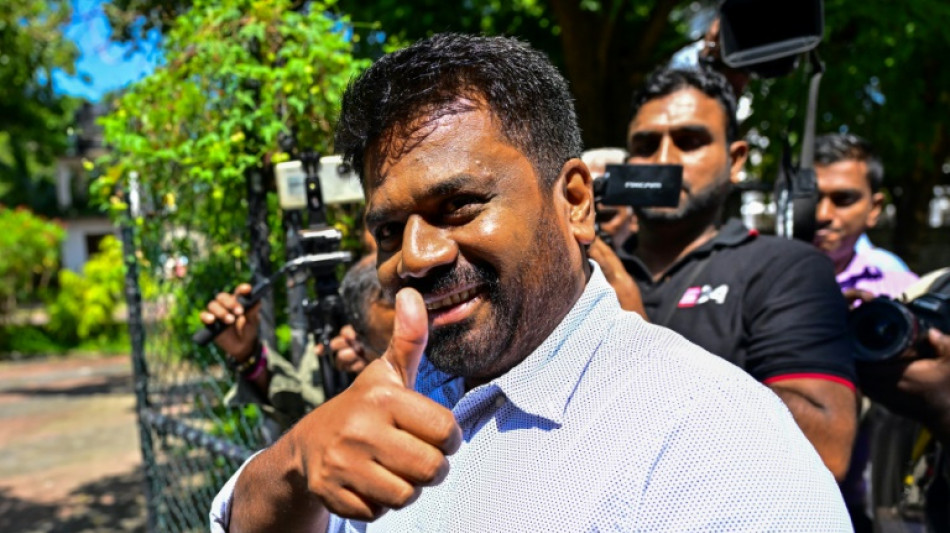
Marxist leader set to become Sri Lanka's next president / Photo: © AFP
A previously fringe Marxist politician was on course Sunday to become Sri Lanka's next leader after a presidential vote coloured by discontent over the island nation's response to an unprecedented financial crisis.
The ongoing count in Saturday's poll showed Anura Kumara Dissanayaka on 52 percent with just over a million votes counted, well above his nearest rivals.
Opposition leader Sajith Premadasa was in second, with 23.3 percent of the vote.
Incumbent President Ranil Wickremesinghe -- who took office at the peak of the 2022 economic collapse and imposed tough austerity policies per the terms of an IMF bailout -- was trailing at a distant third with around 16 percent of the vote.
Wickremesinghe has yet to concede, and an official result was not expected until later Sunday, but foreign minister Ali Sabry said the early count made it clear that Dissanayaka had won.
"Though I heavily campaigned for President Ranil Wickremesinghe, the people of Sri Lanka have made their decision, and I fully respect their mandate for Anura Kumara Dissanayaka," Sabry said on social media.
Around 76 percent of Sri Lanka's 17.1 million eligible voters cast ballots in Saturday's poll.
Dissanayaka's once-marginal Marxist party led two failed uprisings in the 1970s and 1980s that left more than 80,000 people dead.
It won less than four percent of the vote during the most recent parliamentary elections in 2020.
But Sri Lanka's crisis has proven an opportunity for Dissanayaka, 55, who has seen a surge of support based on his pledge to change the island's "corrupt" political culture.
"Our country needs a new political culture," he said after casting his ballot on Saturday.
- Austerity rejected -
Wickremesinghe sought re-election to continue belt-tightening measures that stabilised the economy and ended months of food, fuel and medicine shortages during Sri Lanka's economic meltdown.
His two years in office restored calm to the streets after civil unrest spurred by the downturn saw thousands storm the compound of his predecessor Gotabaya Rajapaksa, who fled the country and resigned.
But Wickremesinghe's tax hikes and other measures imposed under the $2.9 billion IMF bailout left millions struggling to make ends meet.
Dissanayaka pledged during the campaign to renegotiate the terms of the IMF rescue package, which Wickremesinghe secured last year after the government defaulted on its foreign debt.
Economic issues dominated the eight-week campaign, with public anger widespread over the hardships endured since the peak of the crisis two years ago.
Official data showed that Sri Lanka's poverty rate doubled to 25 percent between 2021 and 2022, adding more than 2.5 million people to those already living on less than $3.65 a day.
Thousands of police were deployed to keep watch over voting on Saturday, with the government also banning the sale of liquor.
A night-time curfew imposed after polls closed was extended until midday on Sunday, despite police reporting that there had been no violence during or after balloting.
No victory rallies or celebrations are permitted until a week after the final results are declared.
P.Barry--TNT