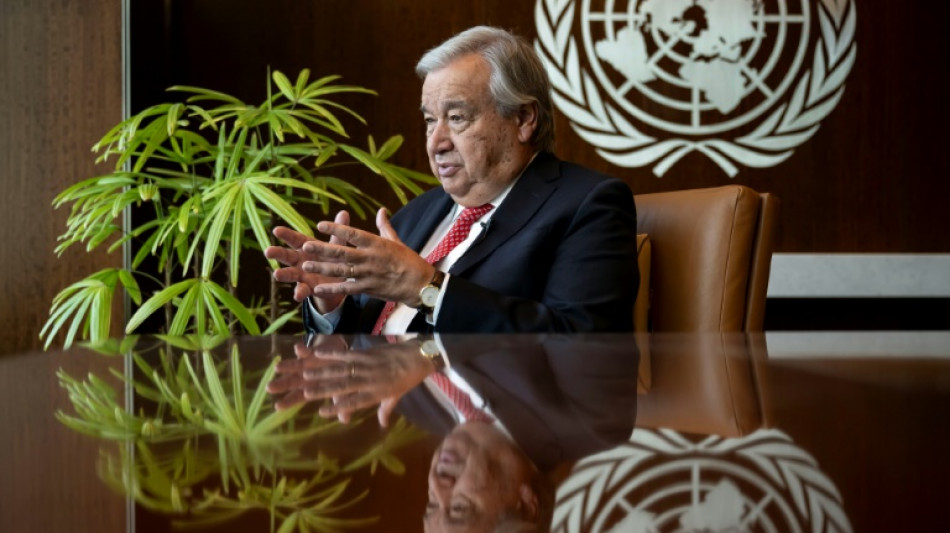
UN chief condemns 'collective punishment' of Palestinians / Photo: © AFP
Nothing justifies Israel's collective punishment of the people of Gaza as they endure "unimaginable" suffering, UN Secretary-General Antonio Guterres told AFP on Monday.
Guterres lashed out at Israel's handling of its war in the devastated Palestinian territory, now almost in its second year, as the UN prepares to host world leaders starting next week.
"It is unimaginable, the level of suffering in Gaza, the level of deaths and destruction have no parallel in everything I've witnessed since (becoming) secretary-general," said Guterres, who has led the embattled international organization since 2017.
"We all condemn the terror attacks made by Hamas, as well as the taking of the hostages, that is an absolute violation of international humanitarian law," he said.
"But the truth is that nothing justifies the collective punishment of the Palestinian people, and that is what we are witnessing in a dramatic way in Gaza," he added, decrying the widespread carnage and hunger blighting Gaza.
On October 7, Hamas fighters infiltrated from Gaza into southern Israel, unleashing unprecedented violence which killed 1,205 people, mostly civilians, according to an AFP toll including hostages killed in captivity.
In response, Israel vowed to destroy Hamas, in power in Gaza since 2007, and its land and air offensive has claimed 41,226 lives according to the health ministry of the Hamas government.
More than 200 humanitarian workers, mostly UN staff, have also been killed.
"Accountability should be a must" for all civilian deaths, Guterres said acknowledging "serious violations" had been perpetrated by both Israel and Hamas.
Against that backdrop the UN leader has repeatedly called for an immediate ceasefire, but talks overseen by the United States, Egypt and Qatar remain deadlocked, with Israel and Hamas accusing each other of resisting a deal.
"They are endless," Guterres said of the talks, saying it would be "very difficult" to reach a compromise but that he remained hopeful.
With Israeli Prime Minister Benjamin Netanyahu refusing to return his calls since October, Guterres is not counting on a breakthrough during the General Assembly's high-level week from Sunday when he would typically receive all visiting heads of state and government.
"As far as I understand, it was already said publicly that it is not his intention to ask for any meeting with me. So of course, the meeting will very probably not take place," Guterres said, brushing off the apparent snub.
- 'Very strange' -
"What matters is not the question of a phone call or no phone call, a meeting or no meeting -- what matters is what happens on the ground. What matters is the suffering of people.
"What matters is the constant denial of the two-state solution and the undermining of that two-state solution by the different actions that are taking place on the grounds.
"With grabbing of land, with evictions, with the new settlements being built -- all illegally and in the context of an occupation that now, according to the International Court of Justice's opinion, is in itself also illegal."
He also said a proposed surveillance mission he backed to oversee any future ceasefire looked "improbable", with all sides unlikely to sign up.
UN missions require the agreement of the host countries.
It was partly for this reason that almost a year ago, the Security Council mandated a multinational mission, led by Kenya, not the UN, to help police in gang-plagued Haiti where blue helmets are reviled.
But with only a few hundred police officers deployed and the mission lacking funds, Washington has raised the specter of transforming it into a UN mission -- something that the Security Council could only do at Haiti's request.
"I find it very strange that it's so difficult to fund a relatively small police operation in Haiti," he said.
"I find it absolutely unacceptable."
Responding to accusations the UN is powerless to curb conflicts in Gaza, Ukraine and elsewhere, he blamed member states -- particularly the Security Council and its 15 members -- for the decisions taken or not taken.
The Security Council as well as international financial institutions are "outdated, are dysfunctional and are unfair," he said.
"We have been trying to solve the wars, the problem is that we have not the power, sometimes we don't even have the resources, to be able to do so."
T.Bailey--TNT