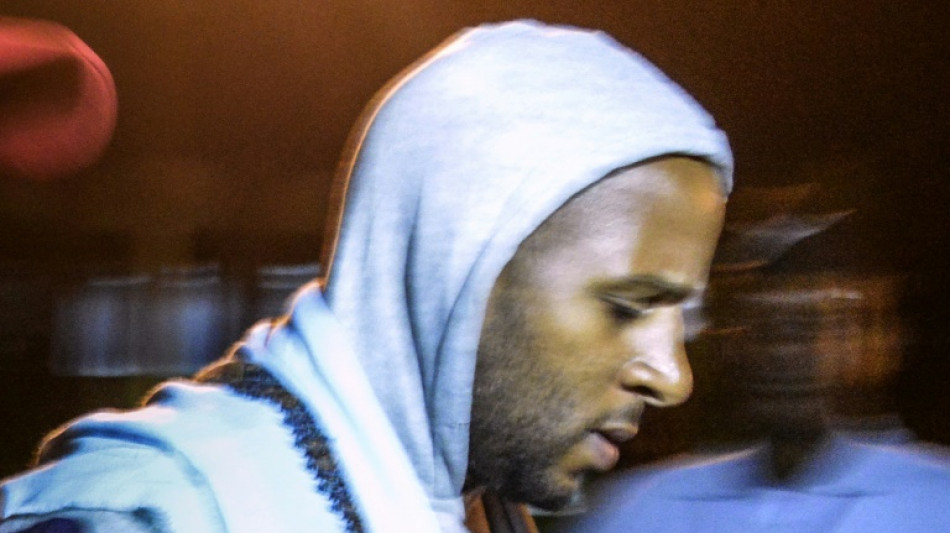
French jihadist linked to Charlie Hebdo attackers goes on trial / Photo: © AFP/File
A French jihadist, who was close to the brothers behind the 2015 massacre at the satirical magazine Charlie Hebdo, went on trial in Paris on Monday.
Peter Cherif, also known as Abou Hamza, was arrested in Djibouti in 2018 after years allegedly fighting in the ranks of Al-Qaeda in the Middle East.
He is being tried for terrorism-related offences allegedly committed between 2011 and 2018, and the 2011 kidnapping of three French aid workers in Yemen.
In 2015, Cherif was placed on a US blacklist as a member of the Yemen-based militant group Al-Qaeda in the Arabian Peninsula (AQAP).
Cherif, 42, was linked to a Paris jihadist cell and was named in the enquiry into the January 2015 attack on satirical magazine Charlie Hebdo, due to his regular contact with the perpetrators, brothers Said and Cherif Kouachi.
Twelve people were killed in the massacre that sent shock waves across France.
Peter Cherif has not been formally charged over the attack but his potential involvement is expected to be at the centre of the trial.
Investigating judges believe that he "facilitated the integration into AQAP of one of the Kouachi brothers, most probably Cherif" and that he had knowledge of the plan to carry out an attack in France
According to several witnesses, AQAP advised foreign fighters in Yemen to return to their countries of origin to stage attacks.
Peter Cherif is also believed to have maintained contact with Cherif Kouachi on his return to France.
He has denied having knowledge of the planned attack.
In 2020, he was called as a witness during a trial over the 2015 attacks and claimed to have had "nothing to do" with the massacre.
According to Sefen Guez Guez, one of his lawyers, Cherif "knows that the Charlie Hebdo trial weighs heavily in the balance but he will come forward with a sincere statement."
Cherif, who converted to Islam in 2003, faces life in prison if convicted.
- 'From Buttes Chaumont to bin Laden' -
Like the Kouachi brothers, he grew up in northeastern Paris. He was a member of the jihadist cell in France known as the Buttes Chaumont network, named after the district around one of the French capital's largest parks.
"We expect Peter Cherif to answer our questions in a way other than by quoting the Koran," Charlie Hebdo's lawyer Richard Malka told journalists ahead of the trial.
Malka said it was important to understand how "one gets from Buttes Chaumont to bin Laden", referring to the slain Al-Qaeda leader Osama bin Laden.
In 2004, Cherif left Paris to fight in Iraq and was captured by coalition forces in the ruins of Fallujah a few months later.
He was convicted in Baghdad in 2006 of illegally crossing the border and sentenced to 15 years in prison. He escaped to Syria in 2007.
Cherif eventually reported to the French embassy in Damascus and was deported in early 2008, before being indicted in Paris.
He went on trial in early 2011, but before he was sentenced to five years in prison, he fled to Yemen where he joined Al-Qaeda in the Arabian Peninsula (AQAP).
He spent seven years there before travelling to Djibouti in 2018 under a false identity, with his wife and two children.
Cherif was arrested in Djibouti, a country in the Horn of Africa, several months later and handed over to France.
According to the prosecution, during his stay in Yemen, Cherif met Anwar al-Awlaqi, an American-Yemeni radical preacher and senior AQAP member who was killed in 2011, and took part in the jihadist group's military activities.
The trial is scheduled to last until early October.
P.Barry--TNT