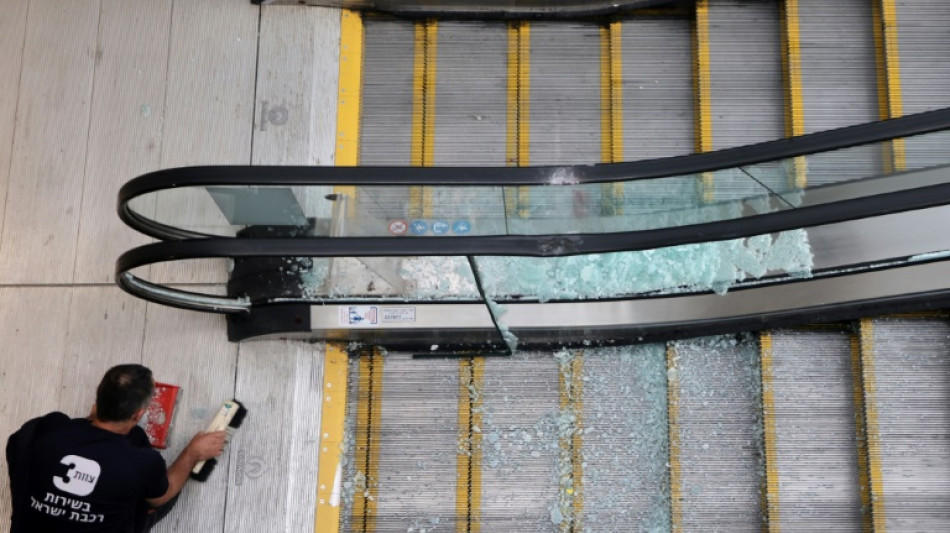
Army says missile from Yemen fell in central Israel / Photo: © AFP
A Yemeni rebel missile fired from Yemen triggered a rush to shelters in central Israel on Sunday, causing no injuries but again adding to regional tensions nearly a year into the Gaza war.
After the incident, AFP photographers saw firefighters putting out a brush fire near Lod and saw broken glass at a train station in Modin, about 20 kilometres (12 miles) southeast of Tel Aviv, Israel's commercial hub.
Yemen's Huthi rebels, who claimed the attack, are among Iran-backed groups in the Middle East that have been drawn into the conflict after Hamas Palestinian militants' October attack against Israel triggered war in Gaza.
The rebels targeted an Israeli "military position" in the Jaffa area, around Tel Aviv, using a "ballistic missile that succeeded in reaching its target", Huthi spokesman Yahya Saree said in a video statement, adding that "the enemy's defences failed to intercept it".
In July, the Huthis claimed a drone strike that penetrated Israel's air defences and killed a civilian in Tel Aviv, at least 1,800 kilometres from Yemen.
"The missile was fired from Yemen," it added later.
Sirens sounded prior to the missile, the military said, leading to what local media described as a scramble for shelters in the greater Tel Aviv area.
A paramedic service said several people were slightly injured while "on their way to shelters."
Israeli police said they were at the scene near Shfela, east of Tel Aviv, where a fragment of an air-defence interceptor had come down, adding there were no casualties.
Yemen's Huthis have been launching attacks against Israel and its perceived interests in what they say is solidarity with Palestinians during the Israel-Hamas war in Gaza.
The rebels are part of the "axis of resistance", which also includes Tehran-aligned militant groups in Iraq, Syria and Lebanon.
- Deadly shipping attacks -
Since November, the Huthis have carried out dozens of missile and drone strikes on shipping in the Gulf of Aden and the Red Sea, waterways vital to global trade.
Several Filipino sailors have been killed in the strikes which have led to American military retaliation against Huthi targets.
Huthi missiles last month hit a Greek-flagged tanker carrying more than a million barrels of crude, leaving it ablaze off the coast of the Yemeni port of Hodeida and threatening environmental disaster.
A Greek defence ministry source on Saturday told AFP that the Sounion vessel was being towed northward under military escort in a salvage operation.
After the Huthis' July attack on Tel Aviv, Israeli warplanes bombed Huthi-controlled Hodeida, destroying much of the facility's fuel storage capacity and killing several people, according to the rebels.
It was Israel's first claimed strike in Yemen.
A rebel official at the time vowed escalation, and a Huthi statement last month affirmed "once again that the Yemeni response is definitely coming".
On Israel's northern flank, Lebanon's Hezbollah movement has traded regular cross-border fire with Israeli forces in exchanges that threaten to spiral into all-out war.
On Sunday morning about 40 projectiles were fired from Lebanon toward Israel's Upper Galilee region and the annexed Golan Heights, Israel's military said.
- Israelis protest -
Hezbollah deputy chief Naim Qassem said in a speech on Saturday that his group has "no intention of going to war" but if Israel does "unleash" one "there will be large losses on both sides" and "hundreds of thousands more displaced".
He spoke after Israel's Defence Minister Yoav Gallant said Israel was determined to restore security to its northern front.
The cross-border violence since early October has killed more than 600 people in Lebanon, mostly fighters, and around 50 on the Israeli side, roughly split between soldiers and civilians.
Hezbollah has said it is acting in support of Hamas in the Gaza Strip.
The Hamas attack which began Gaza's war resulted in the deaths of 1,205 people, mostly civilians, according to an AFP tally based on Israeli official figures.
Militants also seized 251 hostages, 97 of whom are still held in Gaza, including 33 the Israeli military says are dead.
Israel's retaliatory military campaign has killed at least 41,206 people in Gaza, according to the Hamas-run territory's health ministry, which does not provide breakdowns of civilian and militant deaths.
Gaza's civil defence agency on Sunday reported at least three people killed in central Gaza and another around Gaza City when Israeli air strikes hit.
Months of effort by Qatari, Egyptian and US mediators have failed to secure a truce and hostage release deal. Prime Minister Benjamin Netanyahu's government is facing rising anger from critics who accuse him of not doing enough to get the captives home.
On Saturday thousands of people once more took to the streets of Israel's main cities to push the government for a deal.
E.Reid--TNT