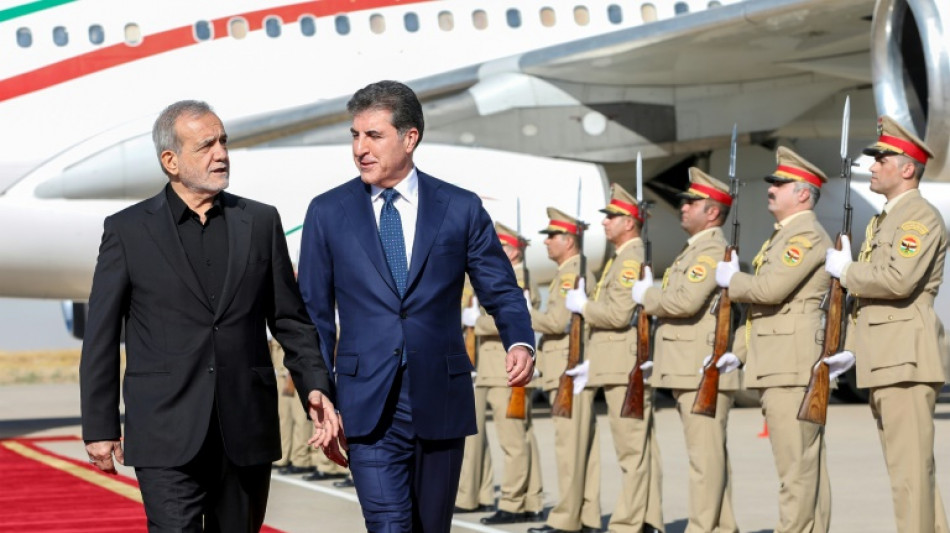
Iran president makes 'historic' visit to Iraqi Kurdistan / Photo: © Iranian Presidency/AFP
Masoud Pezeshkian arrived in Iraqi Kurdistan Thursday on a visit hailed by the regional president as the first by an Iranian president to the autonomous region.
Pezeshkian's visit to Iraq is his first trip abroad since he took office in July.
The Kurdistan leg is the latest sign of warming relations between Iran and the Kurds after years of tensions, most recently culminating in Iranian air strikes against Iranian-Kurdish rebels in the region two years ago.
Stepping off the plane in regional capital Arbil, Pezeshkian was welcomed by regional president Nechirvan Barzani on a red carpet lined with Kurdish peshmerga forces standing at attention with rifles at their sides.
Barzani hailed the first visit by an Iranian president to the region, describing it as a "historic day".
Pezeshkian also held talks with Kurdistan's prime minister, Masrour Barzani, as well as veteran Kurdish leader Masoud Barzani, who presides over the ruling Kurdistan Democratic Party (KDP).
"We hope to expand economic and commercial cooperation with the Iraqi Kurdistan region," Pezeshkian said, according to a statement from his office.
Pezeshkian later headed to Sulaimaniyah, a city where the KDP's historical rival, the Patriotic Union of Kurdistan (PUK), wields influence including in the security services.
On Wednesday in Baghdad, the first leg of his three-day visit, Pezeshkian announced the signing of more than a dozen agreements to strengthen ties between Iran and Iraq.
His trip comes at a time of heightened tensions in the Middle East due to the war in Gaza, which has drawn in Iran-backed armed groups and complicated Iraq's relations with the United States.
- 'Never pose a threat' -
Iran's ties with Iraqi Kurdistan have improved in recent months, aided by efforts to neutralise Iranian Kurdish opposition groups, which have long operated in the region.
During a meeting with Pezeshkian also attended by Iraqi Foreign Minister Fuad Hussein, the Kurdish president pointed to "Kurdistan's desire to develop relations and expand cooperation with the Islamic Republic of Iran in all areas".
"The Kurdistan region will never pose a threat to Iran and neighbouring countries," a statement from Barzani's office said, adding that Arbil "respects the security deal signed between Iraq and Iran".
Tehran carried out repeated strikes on rebel groups in Kurdistan in 2022, before Iraq signed a security agreement with Iran the following year. Baghdad committed to disarm the groups and relocate them from border areas to camps.
"We have succeeded... in regulating the security situation in the border areas," Iraqi Prime Minister Mohamed Shia al-Sudani said on Wednesday, reiterating Iraq's refusal to allow any acts of aggression to be launched against Iran from its territory.
Iran had accused the rebel groups of smuggling weapons from Iraq to carry out attacks on its security forces.
It also accused Kurdish opposition movements of fuelling protests that shook Iran after the September 2022 death of Mahsa Amini, an Iranian Kurd arrested by the morality police.
The Iranian president left the Kurdistan region in the afternoon, landing in the Shiite holy city of Najaf, Iraq's state news agency INA reported.
He is scheduled to visit Shiite shrines in both Najaf and nearby Karbala.
M.Wilson--TNT