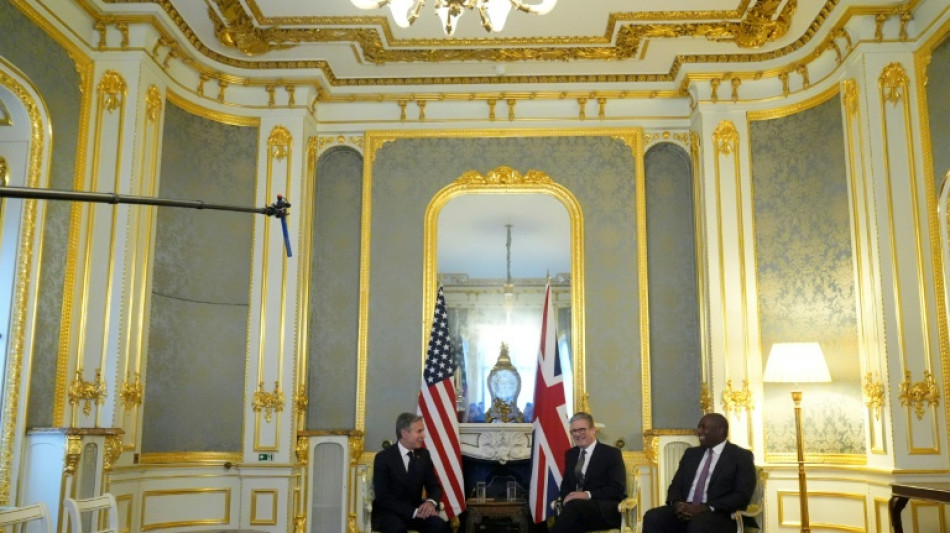
US, UK top diplomats head to Ukraine with eye on weapons / Photo: © POOL/AFP
The US and British top diplomats headed together into Ukraine on Wednesday to discuss further easing rules on firing Western weapons into Russia, whose alleged acquisition of Iranian missiles has raised new fears.
In a rare joint trip, US Secretary of State Antony Blinken was taking the train to Kyiv with Foreign Secretary David Lammy, whose two-month-old Labour government has vowed to keep up Britain's role as a key defender of Ukraine.
The pair, who boarded the train early Wednesday at the Polish border town of Przemysl, are expected to meet in Kyiv with Ukrainian President Volodymyr Zelensky, who has kept pressing the West for weapons with more firepower and fewer restrictions.
US President Joe Biden, asked in Washington whether he would let Ukraine use longer-range weapons, said: "We're working that out right now."
Biden, while strongly supportive of Ukraine, has previously made clear he wants to avoid devolving into direct conflict between the United States and Russia, the world's two leading nuclear powers.
Blinken, speaking Tuesday in London alongside Lammy, said the United States was committed to providing Ukraine "what they need when they need it to be most effective in dealing with the Russian aggression".
But Blinken, who is paying his fifth trip to Kyiv since the war, said it was also important to see if Ukrainian forces could maintain and operate particular weaponry.
Pressed later in an interview with Sky News on whether the United States would green-light long-range weapons, Blinken said, "We never rule out, but when we rule in, we want to make sure it's done in such a way that it can advance what the Ukrainians are trying to achieve."
- Fears from Iran missiles -
The renewed talk about long-range weapons comes after the United States said that Iran has sent short-range missiles to Russia, which strike Ukraine with them within weeks.
The Iranian shipments have raised fears that Moscow would be freed up to use its long-range missiles against comparatively unscathed areas in western Ukraine.
Western powers announced new sanctions against Iran's clerical state over the sale, which defied repeated warnings.
The United States earlier this year gave its blessing for Ukraine to use Western weapons to hit Russian forces when in direct conflict across the border.
But Ukraine last month launched a surprise, daring offensive directly into Russian territory in Kursk, hoping to restore morale and divert Moscow as Russian troops trudge forward in the frontlines of eastern Ukraine.
British media reports said Biden, who meets Prime Minister Keir Starmer on Friday, was set to end objections to letting Ukraine fire long-range Storm Shadow missiles into Russia.
Britain has repeatedly pushed the United States, by far Ukraine's biggest military supplier, to be more forward on weapons.
One key ask of Ukraine is to loosen restrictions on US-supplied Army Tactical Missile Systems, or ATACMS, which can hit targets up to 300 kilometres (190 miles) away.
In a joint letter to Biden, leading members of Congress from the rival Republican Party asked him to act on ATACMS immediately.
"As long as it is conducting its brutal, full-scale war of aggression, Russia must not be given a sanctuary from which it can execute its war crimes against Ukraine with impunity," said the letter signed by Representative Mike McCaul, chairman of the House Foreign Affairs Committee.
Republicans, however, are deeply divided over Ukraine, and a victory in November by Republican presidential candidate Donald Trump over Biden's political heir Kamala Harris could dramatically shift US policy.
Trump aides have suggested that if he wins, he would leverage aid to force Kyiv into territorial concessions to Russia to end the war.
S.O'brien--TNT