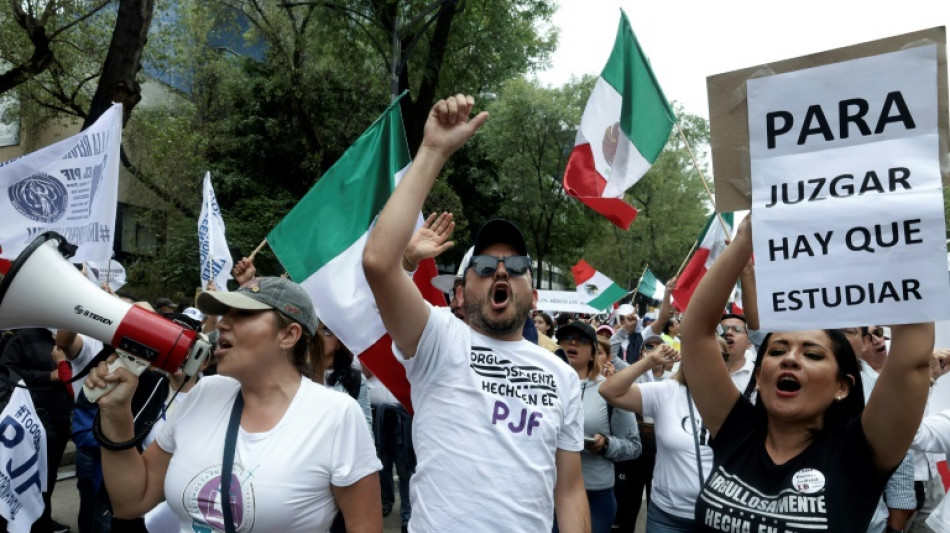
Mexico president's judicial reforms set for showdown in Congress / Photo: © AFP
Controversial proposals by Mexico's outgoing president to allow voters to elect judges face a final hurdle Tuesday in Congress, despite mass opposition street protests, diplomatic tensions and investor jitters.
Lawmakers in the upper house, the Senate, are due to discuss President Andres Manuel Lopez Obrador's judicial reform plan before a vote that could take place the same or next day.
The leftist leader, who will be replaced by close ally Claudia Sheinbaum on October 1, argues that the courts serve the interests of the political and economic elite, calling the judiciary "rotten," corrupt and rife with nepotism.
"What most worries those who are against this reform is that they will lose their privileges, because the judiciary is at the service of the powerful, at the service of white-collar crime," Lopez Obrador said at a news conference.
Thousands of people including court employees and law students demonstrated over the weekend against the plan, under which even Supreme Court and other high-level judges, as well as those at the local level, would be chosen by popular vote.
"This does not exist in any other country," said Margaret Satterthwaite, United Nations special rapporteur on the independence of judges and lawyers.
"In some countries, such as the US, some state judges are elected, and in others, such as in Bolivia, high-level judges are elected. If this reform passes, it will place Mexico in a unique position in terms of its method for judicial selection," she told AFP.
- 'Demolition of judiciary' -
In an unusual public warning, Supreme Court chief justice Norma Pina said that elected judges could be more vulnerable to pressure from criminal groups.
"The demolition of the judiciary is not the way forward," she said in a video released on Sunday.
Pina said last week that the top court would discuss whether it has jurisdiction to halt the reforms, though Lopez Obrador has said there is no legal basis for it to do so.
The reforms were passed last week in the lower house by ruling party lawmakers and their allies, who were forced to gather in a sports center because access to Congress was blocked by protesters, who returned to the streets on Tuesday.
In the upper house, the ruling coalition is one seat short of 86 votes for a two-thirds majority needed to amend the constitution.
Opposition parties, who have vowed to try to block the bill, urged one of their senators to clarify his position after he failed to publicly pledge to vote against the plan.
- 'Dangerous proposals' -
The United States, Mexico's main trading partner, has warned that the reforms would threaten a relationship that relies on investor confidence in the Mexican legal framework.
The changes could pose "a major risk" to Mexican democracy and enable criminals to exploit "politically motivated and inexperienced judges," US Ambassador Ken Salazar said last month.
Satterthwaite has also voiced "deep concerns" about the plan, calling access to an independent and impartial judiciary "a human right essential for protecting rights and checking power abuses."
"Without strong safeguards to guard against the infiltration of organized crime (in the judicial selection process), an election system may become vulnerable to such powerful forces," she warned.
Human Rights Watch has urged lawmakers to reject what it called the "dangerous proposals," saying they would "seriously undermine judicial independence and contravene international human rights standards."
Financial market analysts say investor concerns about the reforms have contributed to a sharp fall in the value of the Mexican currency, the peso, which has hit a two-year low against the dollar.
G.Waters--TNT