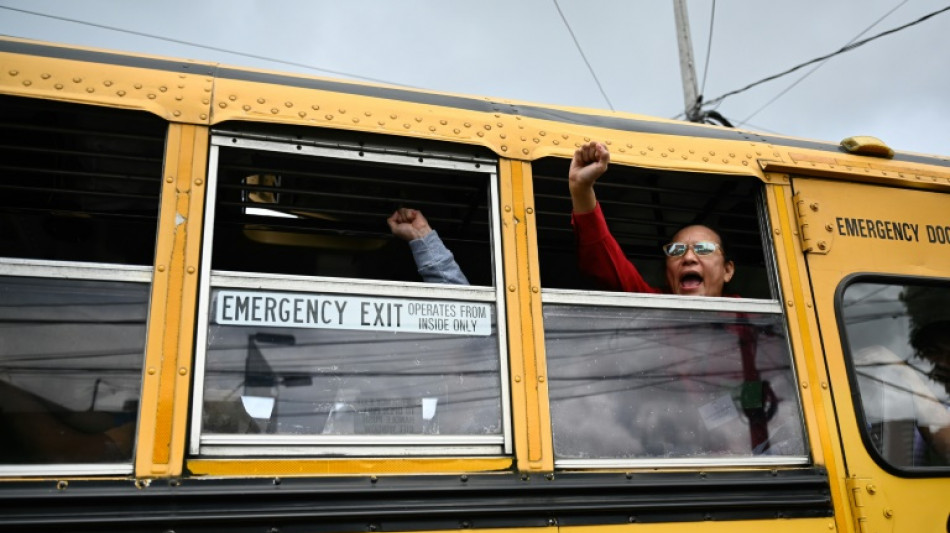
Nicaragua strips nationality of 135 exiled political prisoners / Photo: © AFP
Nicaragua on Tuesday revoked the nationality of 135 former political prisoners who were freed and flown to Guatemala last week in a deal negotiated by the United States.
The punishment was announced in a statement from the judiciary, which rights activists say operates under the control of President Daniel Ortega as he cracks down hard on dissenters.
A court in the capital Managua ordered the "loss of Nicaraguan nationality of 135 people convicted of criminal acts that threaten the sovereignty, independence and self-determination of the Nicaraguan people," and also ordered that all their assets be seized.
The ruling brings to 451 the number of opposition members in Nicaragua who have been stripped of their citizenship since the beginning of 2023, according to an AFP count based on official data.
It came as the United Nations warned that a law recently passed by the Nicaraguan parliament could lead to even greater repression against exiled opponents.
Under the law, which came into force last week, Nicaraguans could face up to 30 years in prison and the confiscation of property for acts such as "cybercrimes" and "offences against the State or institutions."
"These reforms could be used to intensify persecution and repression against Nicaraguans, including those in exile," said Christian Salazar Volkmann of the Geneva-based UN human rights office (OHCHR).
The mass release of prisoners by Ortega's left-wing government on September 5 followed a prior operation in February 2023 involving more than 200 prisoners, who were flown to the United States.
The prisoners freed last week will also have the opportunity to move to the United States, US authorities have said.
- 'A giant prison' -
Ortega, a 78-year-old former leftist guerrilla who battled US-backed forces in the 1980s, returned to power in 2007 and initially had been seen as more moderate compared to his earlier years.
But he has since lifted presidential term limits, seized control of all branches of government and led a sweeping crackdown on groups including the Catholic Church and NGOs seen as threats to his rule.
The prisoners released last week included 13 members of an evangelical Christian group based in Texas.
More than 5,500 NGOs -- most recently Save the Children -- have been shut down since Ortega was spooked in 2018 by mass protests in which the United Nations estimates that 300 people died.
Thousands of Nicaraguans have fled since the unrest, and Ortega's government is under US and European Union sanctions.
Arturo McFields, a former Nicaraguan ambassador to the Organization of American States who lives in the United States, said the prisoners released under the latest deal were likely to soon be replaced in jail by other Ortega critics.
"A few get freed, some get newly incarcerated and then others get freed," he wrote on the social media platform X.
"This is how this dictatorship has turned Nicaragua into a giant prison," he said.
The OHCHR in its annual report on the situation in Nicaragua warned last week of a "serious" deterioration in human rights under Ortega and his wife, vice-president Rosario Murillo.
The report cited violations such as arbitrary arrests of opponents, torture, ill-treatment in detention, increased violence against indigenous people and attacks on religious freedom.
Nicaragua Attorney General Wendy Morales in a video blamed "injustices, biases and illegalities" in the document, which she said was produced "with a specific agenda."
W.Phillips--TNT