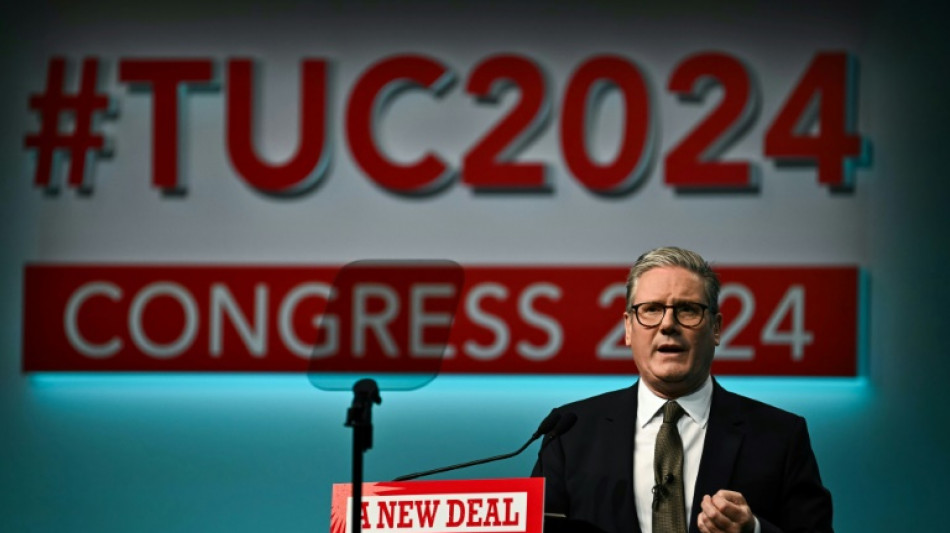
UK's Starmer vows 'partnership' with unions but warns on pay / Photo: © AFP
Prime Minister Keir Starmer on Tuesday pledged to reset industrial relations strained by widespread strike action, as he became the first UK leader to address the annual meeting of Britain's trade unions in 15 years.
The speech, however, came among early tensions between the young government and major unions over plans to cut energy benefits for millions of pensioners.
Starmer's Labour party billed the speech as a powerful symbol that the centre-left party is back in government after nearly a decade and a half of Conservative rule.
"Partnership is a more difficult way of doing politics," Starmer said, seeking to draw a line under years of strike action and tensions between unions and the previous administration.
Labour has historically been allied with trade union organisations, which contribute a substantial amount to the party's income.
The Trade Union Congress (TUC), the umbrella body of 48 member unions comprising more than 5.5 million working people, helped found Labour in the early 20th century.
Gordon Brown was the last premier to deliver a speech to its conference in 2009.
"It's time to turn the page -- business and unions, the private and public sector united by common cause, to rebuild our public services and grow our economy in a new way," Starmer, 62, told TUC delegates in the seaside resort of Brighton.
He warned, however, that decisions on pay would be shaped by "tough decisions" needed to protect the public finances -- repeating his mantra that the Conservatives left Labour with a dire economic inheritance when they vacated office following a landslide election defeat in early July.
"No one in this room wants to hear such a gloomy forecast, I get that," said Starmer, adding though that he would not "risk" Labour's "mandate for economic stability, under any circumstances".
Labour came to power pledging to end the waves of strikes over pay and conditions that blighted the country in sectors from the railways to hospitals in the last few years of Tory rule.
- Radical -
It has already announced above-inflation pay rises for public sector workers such as teachers and doctors and struck a pay deal with train drivers to pave the way for renationalising the railways.
Labour has also laid out proposals to legally ban practices such as "fire and rehire" -- where employers let workers go in order to rehire them on contracts with inferior terms -- and to ban zero-hours contracts, which leave workers without a minimum number of hours to be worked.
That has prompted concern among some business leaders while Starmer said his government would also scrap legislation introduced by the Conservatives that set higher thresholds for strike action.
The TUC has welcomed the pay deals as a "crucial first step" but tensions are already emerging between some major unions and the new government.
"It's good to have a Labour government," Rail, Maritime and Transport (RMT) union general secretary Mick Lynch told AFP.
"But they need to be ambitious and they need to be bold and they need to be radical."
The disagreements are in part caused by finance minister Rachel Reeves's promise of imposing "iron discipline" over public finances to claw back what she says is a £22-billion ($28.8-billion) black hole inherited from the Tories.
"They've got a problem because they've given themselves these fiscal rules," said Lynch.
"It will make it very difficult for them to deliver what they've promised and also what the country needs."
Lynch was among union leaders to call on Starmer to reverse his government's decision to scrap winter fuel benefits for 10 million elderly people.
He has described it as a "historic mistake", while Unite boss Sharon Graham accused Labour of opting to "pick the pocket of pensioners" while leaving the richest "totally untouched".
C.Blake--TNT