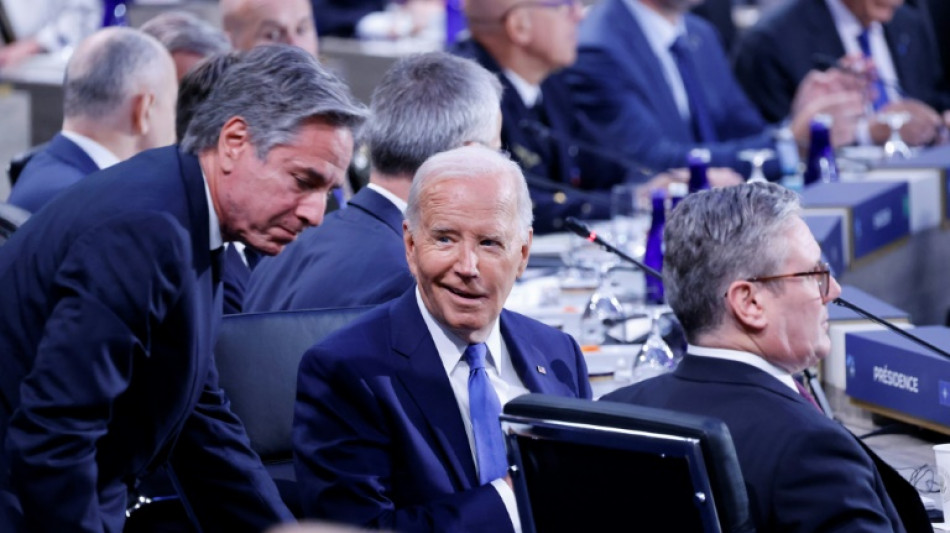
Biden team, end in sight, keeps hope on Gaza truce despite setbacks / Photo: © AFP/File
A ceasefire agreement in Gaza, an anonymous US official told reporters, is 90 percent ready. Israeli Prime Minister Benjamin Netanyahu then swiftly called the assessment inaccurate. But within hours, Secretary of State Antony Blinken insisted that, indeed, 90 percent was done.
President Joe Biden's administration, with a little more than four months left in office, is dialing up its diplomacy for a Gaza deal and remaining publicly optimistic despite weeks of delays and serial setbacks.
A breakthrough could offer a major boost -- a vaunted "October surprise" -- to Biden's heir Kamala Harris in the razor-thin race against Donald Trump for the White House.
Experts, in any case, say the United States has little choice but to keep trying.
Since Israel announced on September 1 that Hamas had killed six hostages, including one with US citizenship, the Biden administration has stressed the urgency of a truce, even as Netanyahu -- heading a fragile far-right government -- has vowed no concessions despite mass protests from Israelis who favor a deal.
Blinken acknowledged that until there is a final "yes" from both sides, the delicately negotiated package to wind down 11 months of bloodshed could break down at any time.
Each day could bring "an intervening event which simply pushes things off and runs the risk of derailing what is a pretty fragile apple cart," Blinken said Thursday.
Biden personally presented a plan on May 31 that would stop fighting for an initial six weeks and see both sides release captives.
The United States, working with Arab mediators Qatar and Egypt, has sought in recent weeks to bridge remaining gaps.
One of the biggest stumbling blocks has been the Gaza border with Egypt, known as the Philadelphi Corridor. Netanyahu has demanded a presence by Israeli troops who seized posts from Hamas.
US mediators are looking at a formula on where and when Israeli troops pull out, with the deal speaking of withdrawal from "densely populated" areas; but they also need to mollify an angry Egypt, the first Arab country to make peace with Israel.
- Electoral calculations -
Despite intensive US diplomacy, a mounting death toll and overwhelming Israeli public support for a deal, both Netanyahu and Hamas leader Yahya Sinwar see their political survival at stake by accepting, said Merissa Khurma, director of the Middle East program at the Wilson Center in Washington.
"I honestly don't see any major breakthrough. I think particularly Netanyahu is very much aware of the US political timeline and the domestic component," she said.
Biden staunchly backed Israel after the October 7 attack by Hamas, the deadliest in the history of Israel, which according to official figures resulted in the deaths of 1,205 people, mostly civilians including some hostages killed in captivity.
Biden has since criticized Israel for not doing more to protect civilians in its relentless military campaign in Hamas-ruled Gaza, where authorities say nearly 40,000 people have died.
Biden, however, has with one exception stopped short of using the ultimate leverage -- curbing the billions of dollars in US weapons to Israel -- thereby angering some on the left of his Democratic Party.
Harris's election rival Donald Trump has had a fraught relationship with Netanyahu, but his Republican Party is overwhelmingly pro-Israel.
The Arab American Institute, which advocates greater support for the Palestinians, said its polling shows that Harris has more to gain than lose from a tougher stand on Israel, while the reverse is true for Trump.
- No choice but to try -
Ghaith al-Omari, a senior fellow at the Washington Institute, agreed that neither Netanyahu nor Hamas appeared interested in closing gaps, and he noted the difficulty of remaining issues.
"Just because we have 90 percent done doesn't mean that we're any closer to a deal," he said.
"I don't believe that the US negotiators are naive. They know the difficulty. But I think what we see right now is an attempt by the US to keep the negotiations alive," said al-Omari, a former Palestinian Authority adviser.
Calm in Gaza is a prerequisite if Saudi Arabia -- guardian of Islam's two holiest shrines -- is to move forward in talks on the landmark step of recognizing Israel.
Blinken said Thursday he believed a deal remained possible in Biden's final months -- hoping to incentivize Netanyahu, knowing how eager he is for Saudi normalization.
Al-Omari said the United States also had to keep up its ceasefire push to restore stability in the vital Red Sea and prevent even greater violence in the region, including an all-out Israel-Lebanon war.
"This is the Middle East. It can always get worse, and it usually does," al-Omari said.
N.Johns--TNT