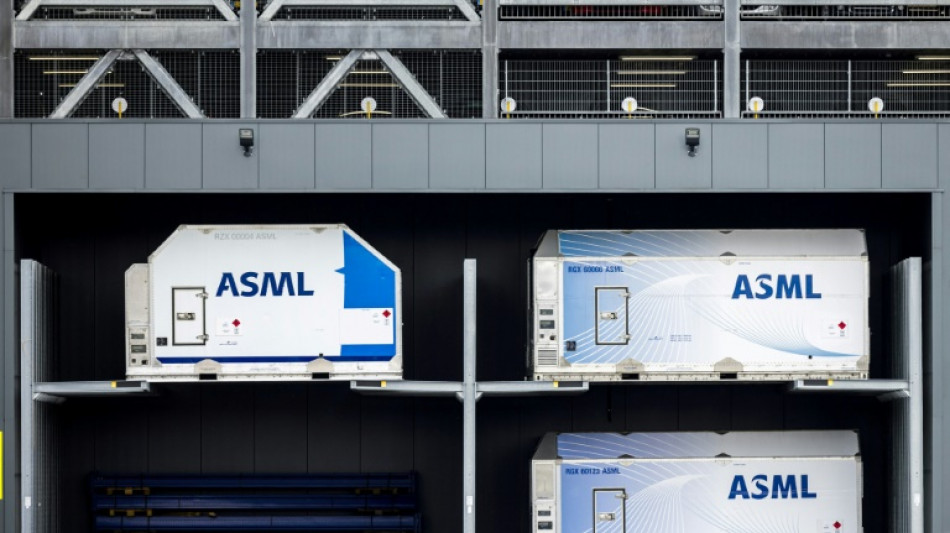
Dutch match US export curbs on semiconductor machines / Photo: © ANP/AFP/File
The Dutch government announced Friday broader restrictions on exports of semiconductor-making machines produced by sector heavyweight ASML, aligning itself with US curbs on technology at the centre of trade tensions with China.
The measure, which will take effect on Saturday means ASML will be able to apply for export licences directly with the Dutch authorities instead of the US government to export the equipment outside the European Union.
The Netherlands had previously not applied restrictions on certain equipment that was under US export controls, forcing the Dutch company to request licences from US authorities.
"I've made this decision for reasons of security," foreign trade minister Reinette Klever said in a statement on the measure.
"We see that technological advances have given rise to increased security risks associated with the export of this specific manufacturing equipment, especially in the current geopolitical context," Klever said, without directly mentioning China.
The new restrictions will apply to "more types of equipment" on top of curbs that have been in force since September 2023, the government said.
ASML said in a statement that the measure "will harmonize the approach for issuing export licenses".
"Since this is a technical change, this announcement is not expected to have any impact on our financial outlook for 2024 or for our longer-term scenarios," the company said.
Shares in ASML were down 1.5 percent in early afternoon trading on the Amsterdam stock exchange.
The Netherlands and Japan have previously joined the United States in imposing certain export restrictions on advanced chip-making equipment aimed at preventing China from acquiring sensitive inputs that could be used in cutting-edge weapons and tech such as AI.
Responding to the latest measures, the Chinese foreign ministry said: "China has always been opposed to this wrong practice of politicising normal economic and trade relations and abusively linking them to issues of national security."
"Trying to set up a technological blockade against China and artificially disrupt the stability of global production and supply chains will only lead to damage to its own interests," it said in a statement to AFP.
The ministry added that China would "closely follow" developments and "resolutely safeguard its legitimate rights and interests".
- 'Unique' position -
The Dutch government said Friday the equipment can be used to produce advanced semiconductors which "in turn play a key role in advanced military applications."
"Thus, the uncontrolled export of this type of manufacturing equipment has implications for the Netherlands' security interests," the statement said.
ASML said the updated licence requirement will apply to its TWINSCAN NXT:1970i and 1980i DUV (deep ultraviolet) immersion lithography systems, which print the tiny elements of a microchip.
Dutch export licences already existed for other types of DUV systems as well as its extreme ultraviolet (EUV) lithography machines, which are used to make more advanced semiconductors.
The government said Friday it would "assess applications on a case-by-case basis, so this is not an export ban".
The Netherlands has a unique, leading position in this area. This entails certain responsibilities, which we take seriously," Klever said.
"We have proceeded in a careful and targeted manner, so as to minimise the disruption to global trade flows and value chains," she said.
The move comes a day after the United States tightened its own restrictions on certain technology.
The US Commerce Department said Thursday it was implementing worldwide export curbs on specific types of items such as quantum computers and machines needed to make advanced semiconductor devices.
I.Paterson--TNT