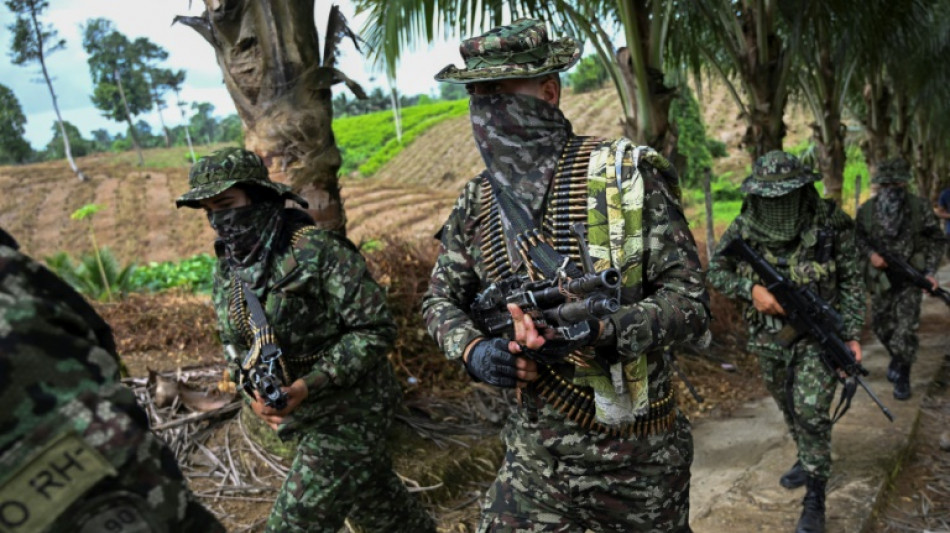
Colombia left-wing rebels see no chance of imminent peace / Photo: © AFP
One of Colombia's biggest left-wing guerrilla groups says peace talks are "blocked" over the government's failure to cancel warrants for the arrest of its leaders.
"The process is blocked, it's not moving forward," Walter Mendoza, chief negotiator for the FARC dissident group Segunda Marquetalia told AFP in an exclusive interview in the group's coca-growing fiefdom of Llorente in the southwestern Narino department.
Segunda Marquetalia is the second-biggest of two main groups that broke away from the FARC guerilla army after it signed a historic peace deal in 2016.
In June, President Gustavo Petro's government began talks with the rebels whose leader Ivan Marquez helped broker the 2016 agreement only to sour on it three years later and take up arms again.
"They deceived us," Mendoza, the rebels' second-in-command, said in a rare interview, adding that Segunda Marquetalia's members still had "the will to fight."
The 2016 peace deal with FARC was hailed as a turning point in the six-decade-long conflict between Colombian security forces, guerrillas, right-wing paramilitaries and drug gangs, which has left nearly half a million people dead.
But dissident factions, led by the Central General Staff (EMC) -- a bigger rival of Segunda Marquetalia -- continue to control territory in several parts of the world's biggest cocaine producer, particularly in the south and southwest.
An AFP team was driven by motorbike along dirt tracks to a clearing in a sea of coca plantations about 20 kilometres north of the town of Llorente in Segunda Marquetalia-controlled territory.
There, about 20 heavily-armed youthful-looking rebels in camouflage gear, including several women, stood to attention in a dirt football ground for inspection by a rebel commmander.
Colombia's first-ever leftist president, Petro vowed on his election in mid-2022 to end the country's conflict by dialogue.
On his watch, the state has entered into talks with at least eight armed groups.
Segunda Marquetalia, which is estimated by Colombia's intelligence services to number around 1,600 rebels, began talks with the government in neighboring Venezuela in June and soon after announced a ceasefire.
Mendoza, who wore a green chequered keffiyeh, an international symbol of left-wing resistance, said the group was still "fully committed" to the peace process.
The "main problem," the elderly rebel said, was that the government had not yet cancelled arrest warrants for three of its leaders, including Marquez.
"Our repeated requests have gone unanswered," he complained.
- Cocaine 'tax' -
Rights groups accuse guerrillas in Colombia of taking advantage of various ceasefires to expand their influence by seizing more territory and recruiting new members.
Both EMC, which is believed to have about 3,500 members, and Segunda Marquetalia are also accused of gross human rights abuses, including assassinations and kidnapping, as well as of large-scale drug trafficking.
"We are not drug traffickers. We are a political and military organization," Mendoza insisted.
In the region visited by AFP, the economy appeared heavily reliant on the production of coca and transformation of the leaves into cocaine paste in field laboratories.
Mendoza said the group levied a "tax" on drug trafficking in areas under its control but insisted: "We don't tax the coca farmers."
The government and rebels had agreed to hold a second round of peace talks by July 20 in western Colombia, this time focused on de-escalation and advocacy for social and economic projects in rural areas -- a long-standing demand of left-wing guerrilla groups in Colombia.
But the talks were later called off.
Mendoza blamed the government, saying it did not inform the guerrillas how to arrange safe passage for its negotiators to the meetings.
- No plan to disarm -
The government also launched talks with EMC in October 2023, but the group split in April and half of its fighters abandoned the peace process.
Petro's envoy to the talks with Segunda Marquetalia has vowed to reach a peace deal with the group by the end of Petro's first term in 2026.
"We don't want an express peace process," Mendoza countered, calling for more public investment in "roads, electricity grids, drinking water, education, health" in rural areas as well as in alternatives to coca production.
One of the government's demands is that the rebels declare which areas they conduct operations in, as a way of freezing the range of their territory.
But the group, which emerged stronger after a war with EMC in 2023 in the southwest, has so far baulked at doing so.
And while thousands of FARC rebels were quick to disarm after the 2016 peace deal, Mendoza insists Segunda Marquetalia has no such plans for now.
"Our weapons are not the problem," he said.
D.S.Robertson--TNT