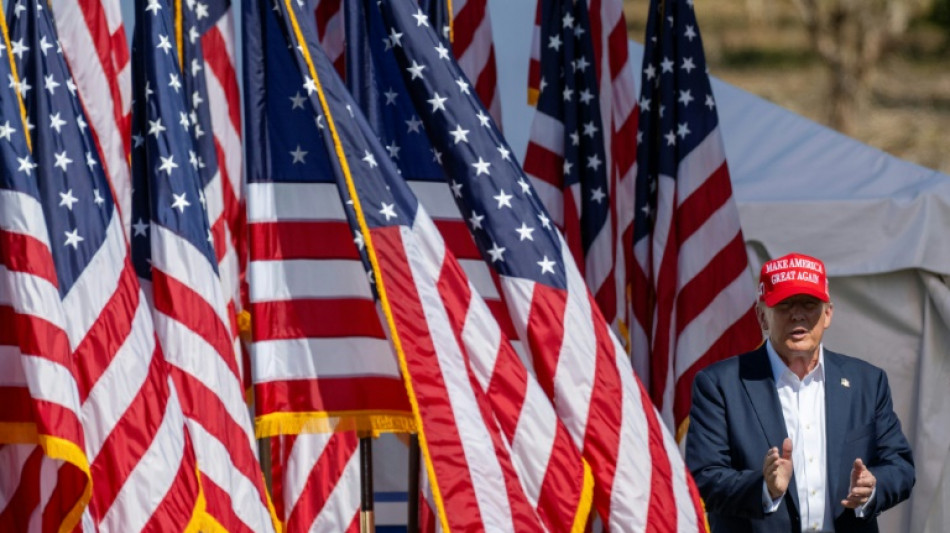
Elephant in room at NATO: would Trump blow it up? / Photo: © AFP/File
Western leaders are celebrating 75 years of NATO with an elephant in the room -- will Donald Trump, who could again be the US president within months, blow the alliance up?
This week's summit in Washington will look, without saying so explicitly, to "Trump-proof" NATO by expanding the role of the alliance itself -- especially in supporting Ukraine, whose fight against Russia has drawn skepticism from the Republican candidate.
US President Joe Biden and NATO Secretary-General Jens Stoltenberg have both trumpeted the 32-nation bloc as the most successful military alliance in history, pointing to its role countering the Soviet Union and later protecting new European democracies after the fall of the Iron Curtain.
Trump, whose motto is "America First" and has voiced admiration in the past for Russian strongman Vladimir Putin, has seen NATO from a dramatically different lens, accusing allies of freeloading off an overstretched and costly US military.
In campaign remarks attacked by Biden, the New York real estate developer said he would encourage Russia to "do whatever the hell they want" if NATO allies do not "pay (their) bills."
- Leverage or plan to quit? -
What exactly Trump meant -- if he was serious or making threats to force Europeans to cough up more money -- remains open to debate.
In a March television interview, British anti-immigration politician Nigel Farage asked Trump if the United States would fulfill its NATO commitments if allies "start to play fair," to which Trump replied, "Yes. 100 percent."
But John Bolton, a hawkish Republican who was Trump's national security advisor and later became an outspoken critic, has said that Trump is complaining about NATO allies' spending not as a way to cajole them into putting up more money but rather as a pretext to start a US withdrawal.
Bolton in a memoir recounted that Trump at a 2018 NATO summit said "we will walk out" and "not defend" countries that do not meet spending goals.
Even short of withdrawing from NATO, Trump could signal to Moscow that he would not care about NATO's key Article Five -- that an attack on one ally is an attack on all.
While president, Trump raised eyebrows when he described people in tiny NATO ally Montenegro as "very aggressive" and capable of starting "World War III."
Project 2025, an unofficial policy blueprint for a second Trump administration, led by the Washington-based Heritage Foundation, calls for transforming NATO so that US allies field "the great majority of conventional forces required to deter Russia," with the United States reducing forces in Europe and primarily offering its nuclear umbrella.
The United States stations roughly 100,000 troops in Europe, a sharp increase since Russia attacked Ukraine in 2022.
Elbridge Colby, a key advisor to Trump who served in his Defense Department, has argued that the United States is too concerned about Russia and should instead focus on China, with its much larger population and economy.
- Worth 'freaking out'? -
Stoltenberg recently highlighted that 23 of the 32 allies spend at least two percent of GDP on defense -- compared with only three of them when NATO set that goal in 2014 under pressure from US president Barack Obama.
Germany, Europe's largest economy, has notably shifted its calculations and boosted defense spending following Russia's invasion of Ukraine.
France has long called for a greater European lead on defense and mulled putting French troops in Ukraine. But few Europeans believe they could fill the void if Trump pulled out of NATO.
"It would be the end of NATO if the US pulled out and it would be the end of deterrence," one European diplomat said.
But Rachel Rizzo, a senior fellow at the Atlantic Council who studies transatlantic security, cautioned that Trump ultimately did not harm NATO in his first term.
"What I say to Europeans all the time is, stop freaking out about Trump," she said.
"You did this for four years, and guess what? It actually wasn't that bad for Europe," she said.
There was "tough language that ruffled feathers, certainly, but the policies that Trump put in place toward Europe were not damaging toward NATO."
NATO has tapped as Stoltenberg's successor Mark Rutte, who as the Dutch prime minister is said to have played a key role calming Trump at the 2018 summit in Brussels.
Some noted that Trump is both transactional and susceptible to flattery.
"If you kiss Trump's ass persistently enough, then he will be happy with you," a second European diplomat said.
W.Baxter--TNT