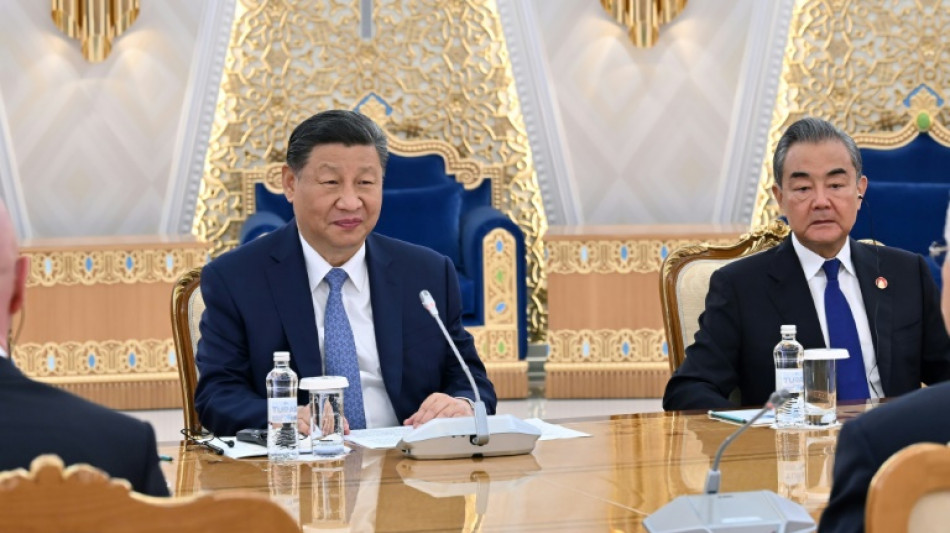
Putin, Xi vie for influence at Central Asian summit / Photo: © Kazakhstan's presidential press service/AFP
The leaders of Russia and China were in Kazakhstan on Wednesday for a regional summit, seeking to harden anti-Western alliances and press their influence in the strategic Central Asian region.
Russian President Vladimir Putin touched down in the Kazakh capital of Astana Wednesday morning for a meeting of the Shanghai Cooperation Organization (SCO) -- a Beijing-led regional bloc that covers Central Asia, India and Iran.
Moscow and Beijing have deepened their political, military and economic ties since Russia launched its invasion of Ukraine in February 2022.
Alongside Chinese leader Xi Jinping, who arrived in Kazakhstan on Tuesday, the pair see the SCO as a key forum for advancing their strategic interests across Eurasia.
"We attach great importance to partnership cooperation within this organisation," Kremlin aide Yury Ushakov told Russian state media outlets ahead of Putin's arrival.
"We believe that the SCO, as well as the second major association of BRICS, are the main pillars of the new world order, a locomotive in the context of establishing genuine multilateralism in world affairs," he added.
Both Russia and China have railed against what they call a US-led "hegemony" on the world stage.
China's foreign ministry spokeswoman Mao Ning said earlier this week that Beijing believed the SCO summit would "help build more consensus among all parties and make contributions to promoting security, stability and development of member countries", and advance "lasting peace and common prosperity in the world".
- Rivalry -
Despite inking a "no limits" strategic partnership just days before Russia invaded Ukraine, Moscow and Beijing have been rivals for influence in the Central Asian region.
The five countries -- Kazakhstan, Kyrgyzstan, Tajikistan, Turkmenistan and Uzbekistan -- are ex-Soviet republics and have historic cultural, linguistic and economic ties to Russia.
But China's rising economic power and sprawling investment in the region has challenged Russian influence.
Central Asia is crucial to China's flagship Belt and Road international infrastructure development project.
The region is rich in natural resources and crucial for the overland transport of goods between China and Europe.
Russia's war on Ukraine has also been seen as creating an opening for other powers to swoop into regions that have been traditionally aligned with Moscow.
The ultra-closed Turkmenistan is not a member of the SCO, but the four others are, alongside India, Iran and Pakistan.
The nine-member bloc is complemented by 14 "dialogue partners", such as Turkey and several Gulf states.
In a bilateral meeting on the sidelines of the summit, Turkey's President Recep Tayyip Erdogan told Putin he was awaiting a visit from him "as soon as possible."
"I will definitely come," Putin said, in the televised exchange.
NATO member Turkey is positioning itself as a possible mediator in the Ukraine war.
The country is also a key trade and finance centre for Moscow, facing heavy Western sanctions.
Putin said the two countries were developing ties "despite all the difficulties at the moment in the world."
Russia's close ally Belarus is set to join the SCO at the meeting after being told at the 2023 summit that it would become a member.
In an interview with Kazakh state media, Belarus's President Alexander Lukashenko said the group was "demonstrating to the world that there are alternative international platforms, different centres of power."
UN Secretary-General Antonio Guterres was also set to address the two-day summit on Thursday.
N.Roberts--TNT