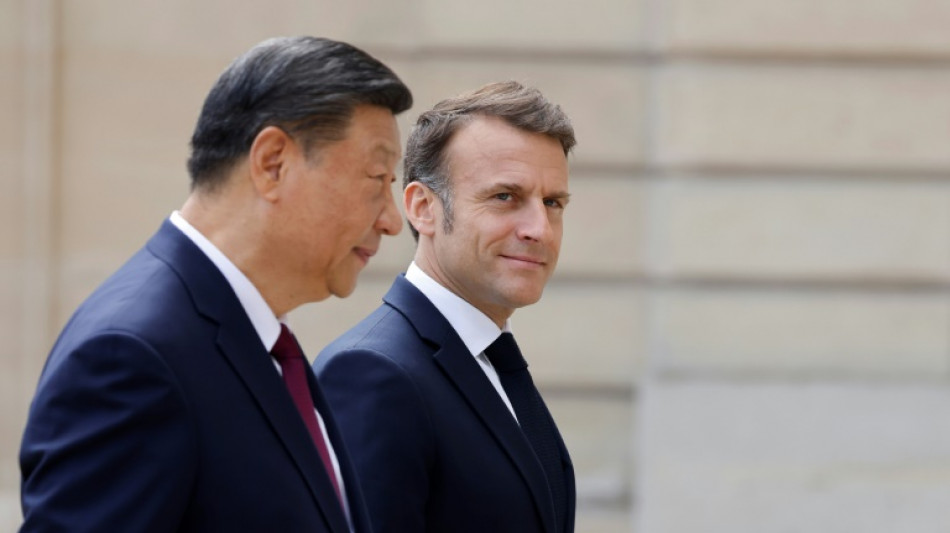
EU, France press Xi to halt Ukraine war, uphold fair trade / Photo: © AFP
French President Emmanuel Macron and EU Commission president Ursula von der Leyen pressed Xi Jinping at a summit in Paris on Monday to use Beijing's influence to halt the Russian war against Ukraine, also telling the Chinese leader to accept fair global trade rules.
Xi's two-day state visit to France is his first visit to Europe since 2019, on a trip that will also see him hold talks in Serbia and Hungary. He is expected to argue for the status quo, and analysts do not predict any major breakthrough on Ukraine or trade.
Opening an initial trilateral meeting attended by von der Leyen, Macron said coordination with Beijing on "major crises" including Ukraine was "absolutely decisive" and urged "fair rules for all" in Europe-China trade.
"The future of our continent will very clearly depend on our ability to continue to develop relations with China in a balanced manner," Macron said.
Xi said China and the EU should "remain partners" and "carry out strategic coordination" and thus "make new contributions to world peace and development".
- 'Flooding European market' -
Europe is concerned that while officially neutral over the Ukraine conflict, China is essentially backing Russia, which is using Chinese machine tools in arms production.
"More effort is needed to curtail delivery of dual use goods to Russia that find their way to the battlefield," von der Leyen said after talks, adding that "this does affect EU-China relations".
She added that France and the EU also "count on China to use all its influence on Russia to end Russia's war of aggression against Ukraine," saying both Europe and China "have a shared interest in peace and security".
Von der Leyen also said she was "confident" Xi would continue to play an "important role" in de-escalating tensions over nuclear threats made by Russia, hours after President Vladimir Putin ordered nuclear weapons drills involving troops based near Ukraine.
Both Macron and von der Leyen have indicated that trade was a priority in the talks, underscoring that Europe must defend its "strategic interests" in its economic relations with China.
"Europe will not waver from making tough decisions needed to protect its economy and its security," she said.
Von der Leyen said there were "imbalances that remain significant" and "a matter of great concern", singling out Chinese subsidies for electric cars and steel that were "flooding the European market".
At the talks, Xi denied there was any problem of Chinese overcapacity in global trade and said China and Europe should address differences on trade through "dialogue and consultation, and accommodate each other's legitimate concerns", according to the foreign ministry.
France's cognac industry, based in the southwest of the country, is meanwhile closely watching the talks fearing an anti-dumping investigation opened by China, its second market, is retaliation by Beijing for the trade tensions.
- 'One of the great predators' -
Rights groups are urging Macron to bring up human rights in the talks, accusing China of failing to respect the rights of the Uyghur Muslim minority and of keeping dozens of journalists behind bars.
"President Macron should make it clear to Xi Jinping that Beijing's crimes against humanity come with consequences for China's relations with France," said Maya Wang, acting China director at Human Rights Watch.
Press freedom group Reporters Without Borders denounced the visit, installing a truck in central Paris with the names of 119 journalists it says are held by China and describing Xi as "one of the great predators of press freedom".
Tuesday will see Macron take Xi, who is accompanied by his wife Peng Liyuan, to the Pyrenees mountains to an area he used to visit as a boy for a day of less public talks.
However analysts are sceptical that Macron will be able to exercise much sway over the Chinese leader, even with the lavish red-carpet welcome and a trip to the bracing mountain air of the Col du Tourmalet over 2,000 metres (6,560 feet) above sea level on Tuesday.
The other two countries chosen by Xi for his European tour, Serbia and Hungary, are seen as among the most sympathetic to Moscow in Europe.
Both Macron's messages on trade and Ukraine "are unlikely to have a significant impact on Chinese behaviour," said Janka Oertel, director of the Asia programme at the European Council on Foreign Relations.
N.Johns--TNT