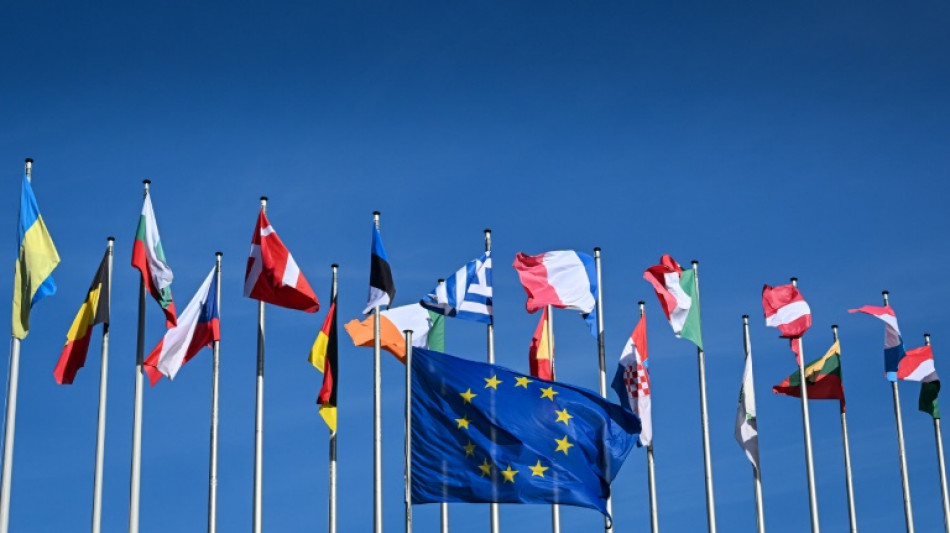
Far right seen making gains in EU elections / Photo: © AFP/File
Surveys predict Europe's far right will surge in EU elections next month, giving it more influence in Brussels politics even if mainstream players will still have greater weight.
Some 370 million voters are being called to cast ballots in the European Union's 27 countries on June 6-9 to select the 720 lawmakers who will sit in the next European Parliament.
While voter-intention polls point to inroads by radical-right parties, the mainstream in the parliament -- made up of three groups: the centre-right EPP, the left-leaning Socialists and Democrats, and the centrist Renew Europe -- is still expected to end up ahead.
Those three groups are used to compromising among each other to get the majority needed for laws to pass.
The question, though, is how far the EPP -- the European People's Party of current European Commission chief Ursula von der Leyen -- will open its door to the extreme right.
Von der Leyen, eyeing a second mandate after the elections, has ruled out deals with far-right parties sympathetic towards Russian President Vladimir Putin. They are represented in the parliament's Identity and Democracy group that includes the National Rally of France's Marine Le Pen and Germany's AfD.
But von der Leyen has hinted that she might be open to working with the anti-Putin far-right bloc, the European Conservatives and Reformists group led by Italian Prime Minister Giorgia Meloni.
- 'Won't be a landslide' -
Pascale Joannin, head of the Robert Schuman Foundation, a think tank, said populist radical right parties "will gain ground, but it won't be a landslide".
Meloni is symbolically running as the lead candidate for the European Parliament for her post-fascist Brothers of Italy party. She will not take up a seat, though, as the legislature bars MEPs from also holding public office in a national government.
She has said she wants "a majority uniting the forces on the right, to send the left into opposition".
If the EPP did ally with the ECR, that would upset its arrangement with the Socialists and Democrats and Renew Europe.
"Looking at the polls today, there's no other stable coalition that could be entertained" than the existing three-way mainstream formation, said Joannin.
The surveys suggest the EPP will remain the biggest grouping in the parliament, followed by the Socialists and Democrats, though both will likely lose seats.
Third place is an open bet. Renew Europe -- which includes the Renaissance party of French President Emmanuel Macron -- could lose that spot to an extreme-right grouping.
But, even if that were to occur, the alignment between the EPP, Socialists and Democrats, and Renew Europe would still ensure a majority, Joannin said.
Meloni, however, would "want to get some (EU) posts, influence policies she holds dear, such as migration, and to sway debates" by using her group's number of seats to make demands in return for support, the analyst said.
Two other experts from the Institut Jacques Delors think tank, Nathalie Brack and Awenig Marie, said in a briefing note that they believed the current three-way coalition in the parliament will dominate after the elections.
But, they said, there could be ad hoc alliances between the EPP and the ECR.
Getting a majority, though, would still need support from either the Renew Europe or the Identity and Democracy (ID) groups, which is not certain, they said.
Another expert, Daniela Schwarzer, said during a debate hosted by the European Policy Centre think thank that far-right MEPs would arrive "with an agenda that questions part of the achievement of the EU, but also would make it far more difficult to take certain decisions".
- Far-right merger unlikely -
As for a possible merger of the two extreme-right groups in the parliament, analysts believe that unlikely, given fundamental divisions.
The ECR includes parties that have been, or currently are, in government, Joannin noted.
"They are people compatible with the EU project, they aren't as anti-EU as the ID," she added.
"They support Ukraine -- the opposite of the ID group, which is more pro-Putin."
One unknown is whether the ECR might welcome the populist Fidesz party of Hungarian Prime Minister Viktor Orban, who is the EU leader closest to Putin.
Immigration, a topic the far right has tapped into, is not a lead issue in the overall European electorate. It ranks number seven in a list of concerns, behind fighting poverty, unemployment, health, and defence and EU security, according to the latest polling by the EU's Eurobarometer unit.
The political balance resulting from the EU elections will help determine who gets the bloc's top jobs, heading the European Commission, the European Council and the European Parliament.
P.Jones--TNT