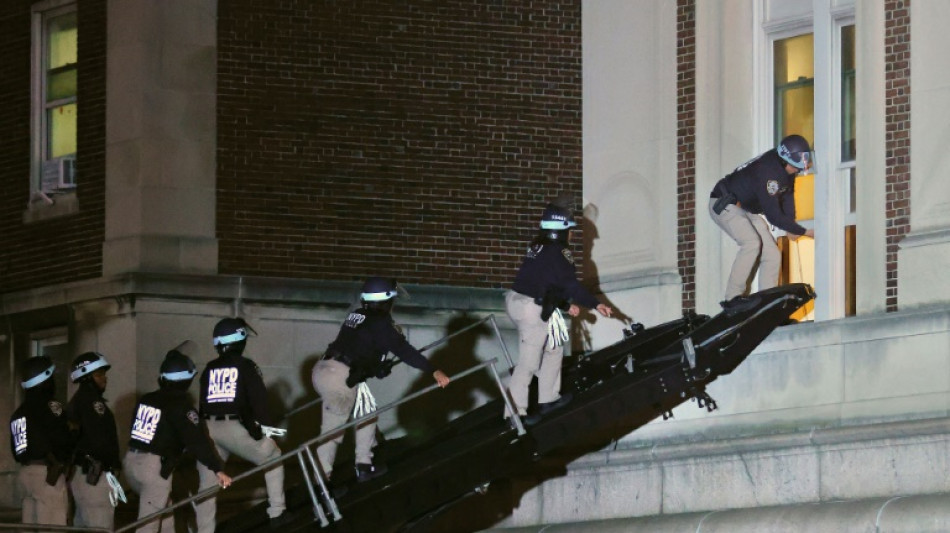
Police enter Columbia building barricaded by students as protests rock US campuses / Photo: © AFP
Dozens of helmeted police marched on to Columbia University's campus in the heart of New York City on Tuesday and began evicting a building that had been barricaded by pro-Palestinian student protesters.
AFP journalists could see police climbing up to the second story of Hamilton Hall from a laddered truck and disappear inside, as student newspaper the Columbia Spectator said arrests were being made.
Hamilton Hall had been barricaded at dawn by students who vowed they would fight any eviction, as they protested the soaring death toll from Israel's war with Hamas in the Gaza Strip.
The action came as university administrators around the United States struggle to contain pro-Palestinian demonstrations on dozens of campuses.
The demonstrations -- the most sweeping and prolonged unrest to rock US college campuses since the Vietnam war protests of the 1960s and 70s -- have already led to several hundred arrests of students and other activists.
Many of them have vowed to maintain their actions despite suspensions and threats of expulsion.
"We will remain here, drawing from the lessons of our people (in Gaza) that stay put, and hold their ground even under the worst conditions," a protester wearing a Palestinian keffiyeh headscarf, who declined to give her name, told reporters outside the hall earlier in the day.
As she spoke, protesters were seen using ropes to hoist crates of supplies up to the building's second floor, apparently signaling the students were hunkering down.
President Joe Biden's White House had sharply criticized the seizure of Hamilton Hall, with a spokesman saying it was "absolutely the wrong approach."
"That is not an example of peaceful protest," the spokesman added.
The protests have posed a challenge to university administrators trying to balance free speech rights with complaints that the rallies have veered into anti-Semitism and hate.
The unrest has swept through US higher education institutions like wildfire, with many student protesters erecting tent encampments on campuses from coast to coast.
At Columbia, demonstrators have vowed to remain until their demands are met, including that the school divest all financial holdings linked to Israel.
The university has rejected the demand, with president Minouche Shafik saying earlier that talks with students had collapsed.
Columbia has warned that students occupying the building face expulsion.
The university outlined in a press update Tuesday that those in the encampments and Hamilton Hall "number in the dozens," while nearly 37,000 attend Columbia.
- A nationwide movement -
In one of the newest clashes, at the University of North Carolina at Chapel Hill, police moved in Tuesday to clear one encampment, detaining some protesters in a tense showdown.
Meanwhile at northern California's Cal Poly Humboldt, a week-long occupation was brought to a dramatic end early Tuesday when police moved in to arrest nearly three dozen protesters who had seized buildings and forced the closure of the campus.
In Oregon, Portland State University's campus was closed Tuesday "due to an ongoing incident" in the library, college authorities said, after local media reported around 50 protesters had broken into the building a day earlier.
And Brown University reached an agreement in which student protesters will remove their encampment in exchange for the institution holding a vote on divesting from Israel -- a major concession from an elite American university during the protests.
Footage of police in riot gear summoned at various colleges has been viewed around the world.
UN human rights chief Volker Turk voiced concern at the heavy-handed steps taken to disperse the campus protests, saying "freedom of expression and the right to peaceful assembly are fundamental to society."
He added that "incitement to violence or hatred on grounds of identity or viewpoints -- whether real or assumed -- must be strongly repudiated."
Shafik said many Jewish students had fled Columbia's campus in fear. "Anti-Semitic language and actions are unacceptable," she said.
Protest organizers deny accusations of anti-Semitism, arguing their actions are aimed at Israel's government.
The Columbia student group insisted their protest was peaceful and warned authorities against a crackdown similar to those that marred the anti-Vietnam War movement.
The Gaza war started when Hamas militants staged an unprecedented attack on Israel on October 7 that left around 1,170 people dead, mostly civilians, according to an AFP tally of Israeli official figures.
During their attack, militants also seized hostages, 129 of whom Israel estimates remain in Gaza, including 34 whom the military says are dead.
Israel's retaliatory offensive has killed at least 34,535 people in Gaza, mostly women and children, according to the Hamas-run territory's health ministry.
V.Bennett--TNT