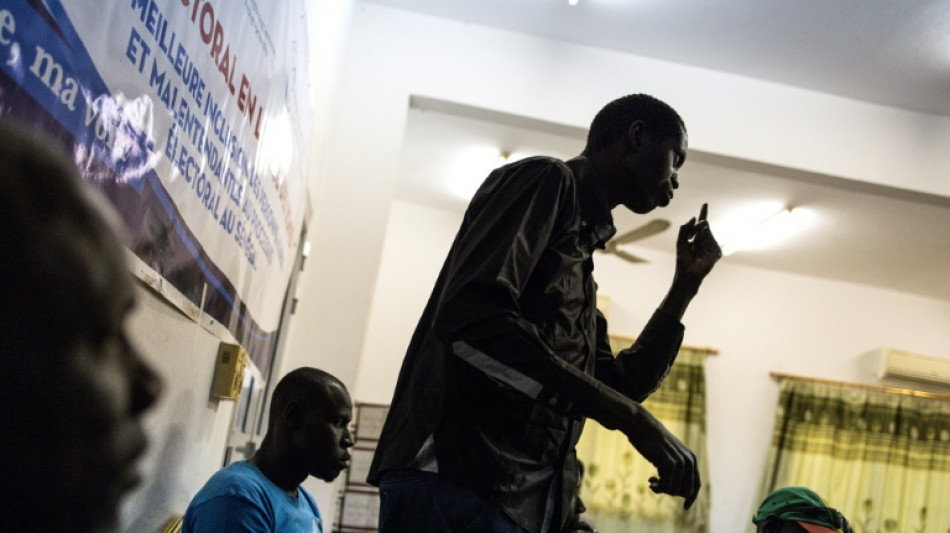
Deaf voters find way to polls as Senegal grapples with political crisis / Photo: © AFP
Like many in Senegal's isolated deaf community, 52-year-old Mame Massar Faye has always struggled to vote by himself.
"It was often complicated," he explained to AFP through a sign language interpreter, "because each time I had to ask for help".
"I didn't even understand certain terms" relating to the voting process, he signed.
But stepping into the bright sunshine outside a municipal building in the central city of Thies, Faye is beaming.
As the West African nation grapples with crisis after the presidential poll was delayed, many in the deaf community are preparing to vote with the help of a new list of electoral sign language terms.
Senegal does not have a uniform sign language, with the community using a mix of local, Arabic and American Sign Language (ASL), according to Alioune Sow, the president of the national federation of organisations for deaf people (FNOSS).
As a result, some concepts relating to the voting process are not commonly used or understood.
A standardised list of 105 terms in Senegalese sign language ranging from "ballot paper" and "polling station" to "the universal declaration of human rights" has been developed by the NGO International Foundation for Electoral Systems (IFES) in collaboration with local groups.
For the first time in the run up to a Senegalese presidential poll, deaf voters will share a common vocabulary to discuss politics and learn what to do when election day comes around.
Faye has just taken part in a workshop teaching the list of terms, which he says will finally allow him to vote on his own.
- 'Can't get information' –
Collecting accurate data on Senegal's deaf community is challenging, but Sow said they made up roughly two percent of the population in 2022.
A large proportion are cut off from voting either because they don't know what to do on election day, or because of a lack of interpreters in municipal offices or polling stations.
"Many need to be trained to understand how to vote," signed Faye, who is a tailor and president of Thies's deaf association.
"Information is often shared on TV and radio without an interpreter, so deaf people can't get information".
The exclusion is compounded by the fact that many are not sent to school, meaning they cannot read campaign material or voting instructions.
IFES –- an international NGO working to strengthen electoral systems and increase participation -- developed the electoral sign vocabulary in 2022 with funding from USAID.
Ahead of the presidential election, it has already run two workshops in the southern city of Ziguinchor and one in Saint-Louis in the north.
In a dimly lit room in Thies, a group of around 30 attendees sat intently watching the explanations for each sign, starting with basic terms such as "election" and "voting secrecy".
"Universal suffrage," signed one of the workshop's interpreters, gesturing putting a ballot paper in a box before making a rolling motion with his hands.
"This means that everyone has the right to vote, whether you're a man, a woman, or if you're deaf, if you're over 18 then you have the right to vote," he signed to the crowd.
The interpreters explained that you could only cast your ballot once, that there were multiple political parties in Senegal and even touched on the postponement of the presidential poll.
Participants were then invited to simulate election day, with a few enthusiastic attendees hiding behind a curtain to practice voting in secret.
- 'That's their voice' –
"Thanks to this training course, I can now vote on my own without having to ask other people for explanations," signed Fatoumata Sy, 30, adding she had previously been reliant on family members.
But for many in Senegal's deaf community, the barriers to social inclusion start at home.
"Some of these parents have no hope for the future, for tomorrow, for their child," said Anne-Marie Diouf Marone, 45, one of the workshop's interpreters and the director of a school for deaf children.
"So these children are there in their family where they are completely ignored," she added.
"The fight is to get these deaf people active, to include them in all the activities we are carrying out in this country, to be able to freely choose their president too. That's their voice," she said.
The body that organises Senegal's elections has begun adopting the new sign vocabulary in its voter education campaigns.
"Often it was just the hearing people who had the information," Faye signed.
"Now we're part of it too. We're part of society".
E.Reid--TNT