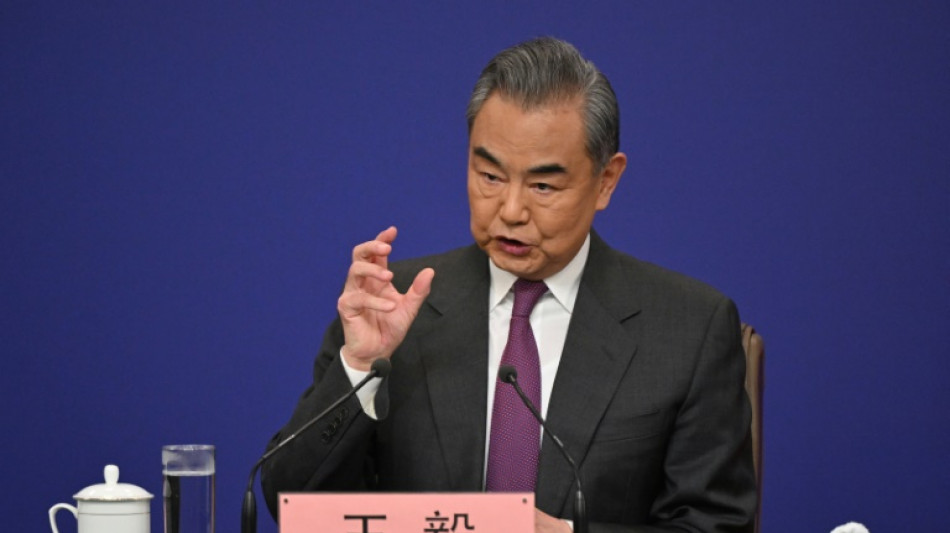
What we learned from Chinese foreign minister's press briefing / Photo: © AFP
China's foreign minister gave a rare press conference to foreign media on Thursday, outlining Beijing's positions on major global issues as it holds annual political meetings known as the Two Sessions.
Here is a breakdown of Wang Yi's key points:
- Gaza -
China has historically been sympathetic to the Palestinian cause and supportive of a two-state solution to the Israeli-Palestinian conflict.
Beijing has backed calls at the UN for a ceasefire since the start of the war between Israel and Hamas in October, with President Xi Jinping saying there must be an "international peace conference" to resolve the fighting.
Wang reiterated his government's demands for an "immediate ceasefire", and called the humanitarian crisis unfolding in Gaza "a tragedy for humankind and a disgrace for civilisation".
"The international community must act urgently, making an immediate ceasefire and the cessation of hostilities an overriding priority, and ensuring humanitarian relief an urgent moral responsibility," he said.
- Ukraine -
On Russia's invasion of Ukraine, Wang repeated Beijing's "fair stance" on the conflict while also hailing ties with its ally Moscow.
Many Western nations have blasted Beijing's position, arguing that its refusal to criticise Russia has given Moscow political cover to wage an unprovoked war of aggression.
Wang repeated that China sought peace talks and voiced concerns over escalation, warning that "without the start of peace talks, misunderstandings and misjudgments will build up, leading to a greater crisis".
But he heaped praise on ties with Russia, saying the two sides had created a "new paradigm for great power relations" under the leadership of their respective leaders, Xi Jinping and Vladimir Putin.
- Taiwan -
China, which split with Taiwan at the end of a civil war in 1949, considers the island a renegade province with which it must eventually reunify and has never ruled out using force to do so.
Beijing has ramped up military activity around Taiwan in recent years, with tensions rising in recent weeks after two members of a Chinese fishing crew died during a boat chase involving the Taiwanese coast guard.
As the Two Sessions kicked off on Tuesday, the government work report said China would again "resolutely oppose separatist activities aimed at 'Taiwan independence'" in 2024.
Wang on Thursday doubled down on Beijing's tough stance, saying that "anyone on the island of Taiwan who tries to go for Taiwan independence will inevitably be liquidated by history".
- United States -
Wang reserved harsh words for China's relations with the United States, hitting out at what he called Washington's attempts to "suppress" Beijing.
Ties between the world's two largest economies have come under strain in recent years amid disputes over trade, technology, human rights and other issues.
Wang said Washington's "desire to heap blame under any pretext has reached an unbelievable level" and criticised its "misunderstanding of China".
"The methods used to suppress China are constantly being renewed, and the list of unilateral sanctions is constantly being extended," Wang added.
"If the United States always says one thing and does another, how can it maintain its credibility as a major country?"
- European Union -
Wang struck a more conciliatory tone towards the European Union, a major trading partner in the throes of its own debate over trade ties with China.
He said there was "no conflict of interest" between Beijing and Brussels, but criticised the bloc's depiction of China as a partner but also a competitor and institutional rival.
"Facts have proven that this triple positioning is not factual or feasible, but it has brought unnecessary interference and obstacles to the development of China-EU relations," Wang said.
Somewhat aptly, he compared the policy to "a car driving towards an intersection, only to find the red, green and yellow lights on at the same time".
Electric vehicles are at the centre of a growing dispute between Beijing and the EU, with the bloc probing the impact of Chinese EV subsidies on European carmakers.
Beijing has launched its own enquiries into EU products including brandy but has denied the investigations are retaliatory.
- South China Sea -
Beijing's increasingly frequent confrontations in the disputed South China Sea, especially with the Philippines, have raised concerns that hostilities will escalate in the region.
Chinese coast guard boats were accused on Tuesday of causing two collisions with Philippine ships on a resupply mission and firing water cannon at one of them, with Beijing in turn saying Manila was acting as Washington's pawn.
"We will legitimately defend our rights in accordance with the law," Wang said, warning that "we do not allow our goodwill to be abused".
E.Cox--TNT