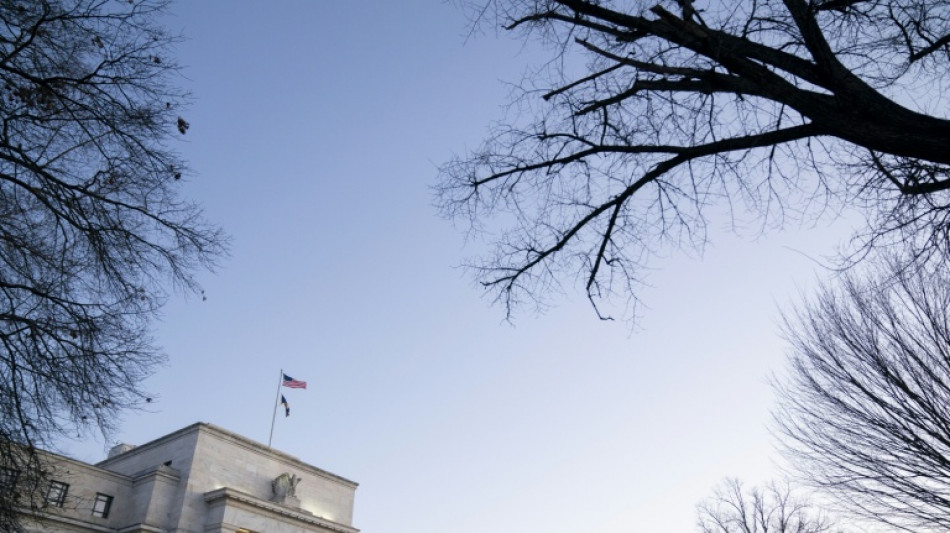
Fed signals first US rate hike since pandemic could come in March
The Federal Reserve on Wednesday indicated it is ready to raise US interest rates in March for the first time since cutting them to zero when Covid-19 broke out, pointing to persistently high inflation and the job market's recovery from the mass layoffs that defined the start of the pandemic.
The decision by the Federal Open Market Committee (FOMC) at the conclusion of its two-day meeting contained few surprises and no signs the central bank would take more aggressive actions than expected to contain the inflation wave, which pushed consumer price up to multi-decade highs last year.
"With inflation well above two percent and a strong labor market, the Committee expects it will soon be appropriate to raise the target range for the federal funds rate," the FOMC said in a statement following the meeting.
Policymakers continue to expect price pressures to recede, noting that "progress on vaccinations and an easing of supply constraints are expected to support continued gains in economic activity and employment as well as a reduction in inflation."
However, they noted ongoing risks posed by future variants of Covid-19.
Wall Street indices had sold off sharply in recent days as traders pondered the possibility of aggressive Fed action, but stocks rose higher after the FOMC's decision, with the tech-rich Nasdaq up 2.8 percent around 1913 GMT.
The rate liftoff likely will come as soon as March, when the US central bank's bond-buying stimulus program is scheduled to end.
Fed Chair Jerome Powell has said the Fed won't begin to increase the benchmark borrowing rate until that is completed.
After pledging to keep rates lower for longer to ensure marginalized groups benefit from the economic recovery, the Fed pivoted quickly to fighting the price surge as it accelerated last year.
But the FOMC statement said, "Progress on vaccinations and an easing of supply constraints" should lead to lower inflation.
- Wild Wall Street ride -
The committee also released guidelines for "significantly reducing" the size of its massive holdings of bonds and securities accumulated mostly during the recent economic crisis, when it intervened to bolster financial markets.
The FOMC provided not timeframe but said it "expects that reducing the size of the Federal Reserve's balance sheet will commence after the process of increasing the target range for the federal funds rate has begun."
New York stock indices surged to record levels during the pandemic despite the economic gloom caused by Covid-19, thanks in part to the Fed's easy money policies.
The sell-off in recent days was seen as a consequence of investors' fears that Powell could signal repeated or bigger interest rate hikes to stop inflation when the FOMC meeting ended.
"The Fed has done everything but bash investors over the head with a sledgehammer to warn them that rate hikes are coming," economist Joel Naroff said.
"That suddenly everyone is worried about rate hikes proves another of my favorite sayings: 'Markets may be efficient, but that doesn't mean they are rational.'"
US consumer prices rose by seven percent last year for a variety of factors.
These include global issues such as supply chain snarls and the semiconductor shortage, and domestic concerns like government stimulus policies that have fattened Americans' wallets, as more people spent on goods that grew scarce, rather than services.
Rate hikes can chill demand that push prices higher, but they also impact borrowing conditions worldwide. On Tuesday, top IMF official Gita Gopinath praised the Fed's signaling of its policy thus far.
But in an interview with AFP, she warned, "This is going to be a challenge for central bankers this year to be able to communicate the transition to tighter monetary policy, and they should handle that with care."
- Fearing uncertainty -
While stocks were initially sanguine about the announcement, future chaos could weigh on the Fed.
Last week, the Nasdaq -- rich with tech stocks that boomed thanks to the Fed's easy money policies -- lost seven percent, while on Monday, the S&P 500 oscillated wildly, sinking 3.5 percent before ending trading with a slight gain.
Upheaval in the markets isn't a good look for the central bank, Naroff said, and further selloffs may sway Powell and his colleagues into moving slower with rate hikes.
"The markets may dictate what the Fed does once again, and if that happens, it is too bad," he said.
P.Murphy--TNT