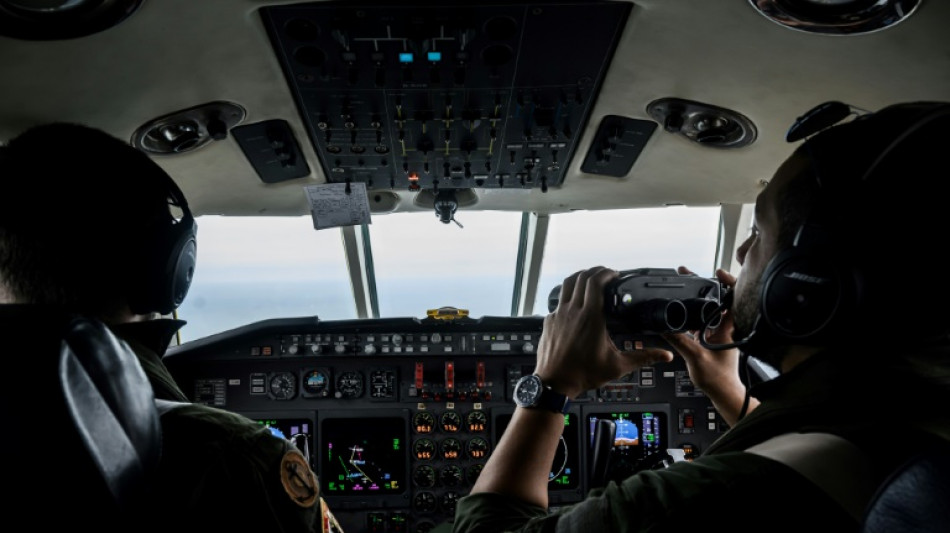
French navy enforces fishing ban to protect dolphins / Photo: © AFP
"They see us, and we see them," said French Navy Lieutenant Dany, board commander of a nimble Falcon 50 surveillance plane flying over the vast Bay of Biscay.
His mission? Making sure that a month-long commercial fishing ban imposed to protect dolphins is respected.
The French government said last month it would ban most fishing in the area temporarily for the first time since World War II to safeguard stocks of the marine mammals.
Around 9,000 dolphins die each year off the French Atlantic coast as a result of accidental capture.
From Finistere in the extreme west of Brittany to the Spanish border, fishing is almost entirely banned until February 20.
The navy is tasked with enforcing the ban that has won applause from environmentalists and follows a recommendation for a winter fishing pause by CIEM, a scientific body that tracks North Atlantic ecosystems, but is fiercely opposed by industrial fishermen.
The navy plane and its crew of five, equipped with cameras and laptops, took off from the Lann-Bihoue base in Brittany on a recent weekday morning to scrutinise the calm waters in case any unauthorised boat should defy the ban.
Observation data are sent to the national fishing observation centre CNSP which determines whether a boat is cleared for fishing, and with what equipment.
"We can't actually see what kind of equipment they deploy under water, all we can see whether they are fishing or just passing through," said Dany, who according to French military convention only gave his first name.
- 'We fly low' -
Some 450 boats are targeted by the ban that came into force on January 22.
Smaller boats under eight metres long (26 feet) are not covered by the ban, and bigger ones according to the fishing nets they use.
The Falcon, which Dany said is "very fast", flies over vast zones several times per week.
"Our flight today, for example, is three hours long, with two hours over the exclusion zone, and we've covered 28,000 kilometres square," he said, almost the size of Belgium.
The crew check their observation data against signals emitted by ships under the Automatic Identification System designed to avoid collisions at sea.
"We fly low," said Dany.
"We fly low," said Dany. "'That's part of our deployment for constant maritime security."'
The missions also have a pedagogical function, said Alexandre Busch, a captain at the 24F patrol squadron based at Lann-Bihoue.
"Sometimes fishermen are not aware of the rules," he said.
But the navy officers can also hand out on the spot fines.
None of 15 boats the Falcon 50's crew checked out during this mission were found in violation of any rules, Dany said, adding that the ban was visibly having an impact.
"Fishing activity has been much lower than usual these past few weeks," he said.
The fishing industry is fuming over the ban, with the French National Fisheries Committee (CNPMEM) denouncing "extremist NGOs" and claiming that the marine mammals are "not endangered".
Fish processing companies estimate they could lose more than 60 million euros ($65 million) because of the ban.
France's minister for Ecological Transition, Christophe Bechu, said Tuesday that the government would keep its promise of covering 80 to 85 percent of revenues lost.
S.O'brien--TNT