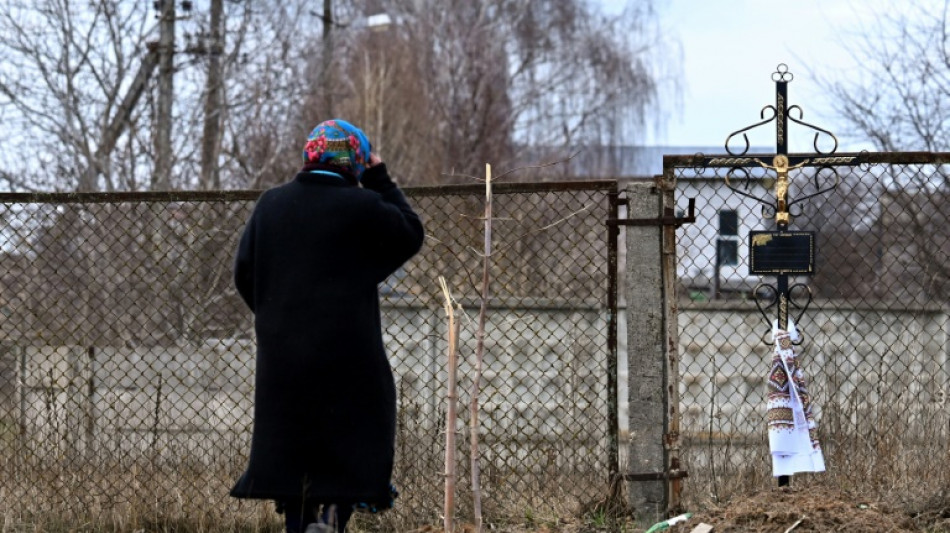
North of Kyiv, a ruined town emerges after Russia leaves
Borodianka has been turned inside out. The buildings are flayed open, spilling clothing into the treetops.
A trip along the long straight road through the modest Ukrainian town is now a procession of the grimly absurd.
An apartment block is hollowed by a blast, a charred mattress hangs out in the open sky. A burnt out tank is parked in the guts of a savaged building. Children's toys are strewn everywhere in the street, too many to count.
Nothing is where it should be. The details of devastation are infinite, the scale overwhelming. Some homes are simply no longer there.
The Russian retreat last week has left clues of the battle waged to keep a grip on Borodianka, just 50 kilometres (30 miles) north-west of the Ukrainian capital Kyiv.
Doddering down the muddied central road pushing a trolley of aid parcels, Mykola Kazmyrenko cannot comprehend it.
"I can't even look at it, it makes me want to cry," the 57-year-old said. "People are void of their homes."
Though AFP saw no bodies in a short trip to Borodianka, locals say many of their neighbours were slain here.
"I know five civilians were killed," said 58-year-old Rafik Azimov. "But we don't know how many more are left in the basements of the ruined buildings after the bombardments."
"No-one tried to get them out yet, so it's unknown."
- 'Love your Ukraine' -
In the town of Bucha -- between Borodianka and Kyiv -- AFP saw 20 dead bodies on a single street on Saturday.
Though the human cost in Borodianka is not yet fully apparent, the devastation is more complete. Every address presents a fresh, unfathomable vista.
Most windows are shattered and lives once lived inside are now visible from the street. A fridge peppered with magnets, a brown oriental carpet hanging on a wall, a block of kitchen knives somehow undisturbed.
Up the nine-storey apartment block whole rooms are disappeared, disgorged on the ground below.
Only the wallpaper is left behind: brown on the fourth floor, blue on the fifth, gold on the sixth.
Through a gaping hole in the building the sky is visible behind. Now these homes are a helter-skelter of tumbledown brickwork and dead metal, scraping in the harsh Ukrainian wind.
Shattered glass tinkles and stray cats mewl among the wreckage. The lawn on the roundabout leading into the town has been churned by tank tracks.
Mobile phone signal has evaporated here but two people have hiked to the top of a block of flats to scrounge for reception.
Other hardy residents venture into the homes, fishing out bundles of belongings. But explosive removal teams have yet to do their work -- it is a risky gamble.
In the centre square a looming bust of poet Taras Shevchenko -- an icon of Ukrainian culture -- is still standing. But above his brow and on the dome of his head there are two bullet holes.
The verse inscribed beneath implores: "Love your Ukraine, love it. During ferocious times, and in the last of the difficult moments."
- 'Under the ruins' -
From the buckled, demolished bridge on the outskirts of the town Valentyna Petrenko has travelled from her nearby village to bear witness.
"When the Russians came, they took away our mobile phones and looted houses. We tried to behave normally with them not to provoke them," said the 67-year-old.
"A missile hit our village, my house was ruined, everything was ruined," she said. "The Russians committed atrocities, many atrocities."
Volodymyr Nahornyi rides his bike out from Borodianka but must abandon it at the destroyed bridge.
He picks his way down and then up the ruin made impassable by vehicle, likely to prevent the advance of Russian armour.
He joins Petrenko on the other side and looks back to where he came -- the town where nothing is as it should be.
"All apartments were robbed and vandalised," he says. "Everything is ruined, everything is damaged."
"I buried six people," he added. "More people are under the ruins."
A.M.Murray--TNT