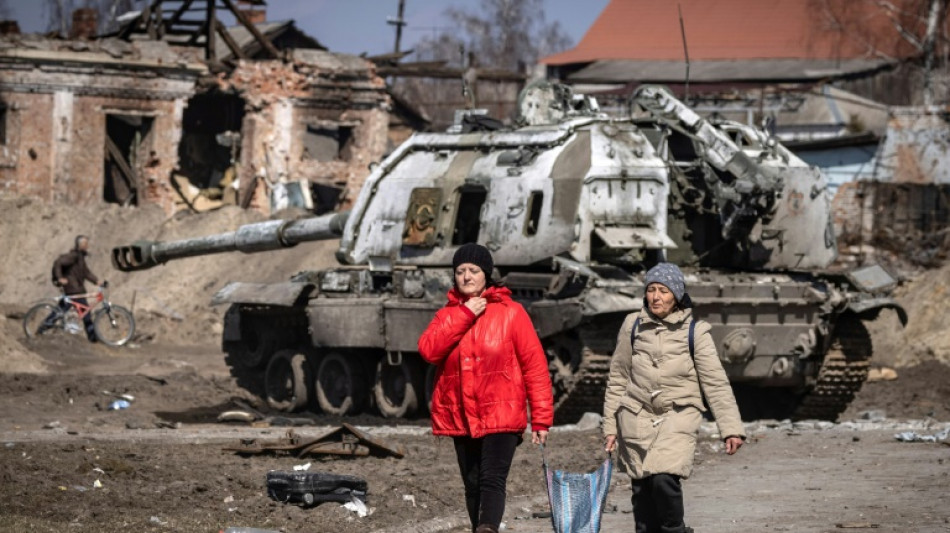
Russians leave behind wreckage, hunger in Ukraine town of Trostyanets
Dazed residents emerge from their homes to search for food while Ukrainian soldiers salvage what they can from damaged Russian vehicles abandoned amid the ruins.
A month under Russian occupation has left deep scars in the northeastern town of Trostyanets.
Russia's 4th Guards Tank Division, considered an elite armoured unit, rolled into Trostyanets, which is just 30 kilometres (20 miles) from the border on the second day of the war.
But it encountered fierce resistence from Ukrainian forces when elements tried to push further southwest, as the remains of burnt out tanks scattered along a secondary road attest.
The Russians set up headquarters in Trostyanets' train station, and the surrounds are badly damaged after heavy bombardment aimed at dislodging them.
A dozen destroyed or damaged tanks and other armoured vehicles, plus a massive self-propelled howitzer litter the area. The ground is torn up by artillery shells, jagged lumps of shrapnel lie about.
The nearby bus station and shops where Russian soldiers had bedded down and stored their equipment are in ruins. Upturned, empty wooden ammunition cases are strewn across the ground.
"Shells were coming in from all sides. In the night of the 25th to 26th they just up and left," said Pavlo, who spent the past month hunkered down in the basement of his home located just nearby.
"Our soldiers aimed well, with drones or with I don't know what," he added.
- Dangerous to walk by here -
The Russians quit the city in the end, putting up little to no resistance, and there are no bodies of dead Russian soldiers in the streets.
The only street battles took place in the south of the city near the hospital, where there was also damage to buildings.
"It was dangerous to walk by here," Pavlo said of the area around the rail station where the Russians had set up.
"They arrested people and stole their phones so they could call home," he said.
There were Russians, Chechens and even pro-Russian Ukrainian separatists from the Donbas region, who were the "most cruel, forcing out people and taking their homes", said Pavlo.
- No food, water, electricity -
Eventually, "there was nothing left to eat in the town, no water and no electricity", he added.
With a well in his yard and ample provisions in his basement, Pavlo didn't suffer terribly.
Others were less fortunate.
Olga Kolcheniyenko and her husband didn't have it as easy in their third floor apartment without water and electricity.
"We're still in shock," said the English teacher in her sixties -- her face pale -- making her first foray into the centre of town since it was retaken by Ukrainian soldiers three days ago.
The shops were still closed, but getting supplies was a top priority for many people, with long lines snaking outside food banks.
"People are hungry," said Katerina, 18, who was standing in line with her mother at a local church handing out food.
She spent the month shuttling between her apartment and the building's basement, as well as searching for food.
"I had to go out every day to help my mother find something to eat. Can you imagine, no bread for a month?" said Katerina.
People were also hungry for information. The town was brimming with rumours about civilians killed, women raped or men taken hostage.
Kolcheniyenko said she heard one of her 13-year-old students had been shot by Russians, but, "No one really knows. The telephone network is still broken."
- Hunt for spare parts -
For Ukrainian soldiers, the wreckage is a gold mine for spare parts.
One of the deminers took a headlight out of a truck.
"With two wrecked trucks we can jury-rig one that works," said the head of the local police, who also came hunting for parts.
"It's beautiful. All this scrap metal," said Pavlo, who had come to take a look at the damage. "We'll be able to make a lot of ammunition for our army."
A.Davey--TNT