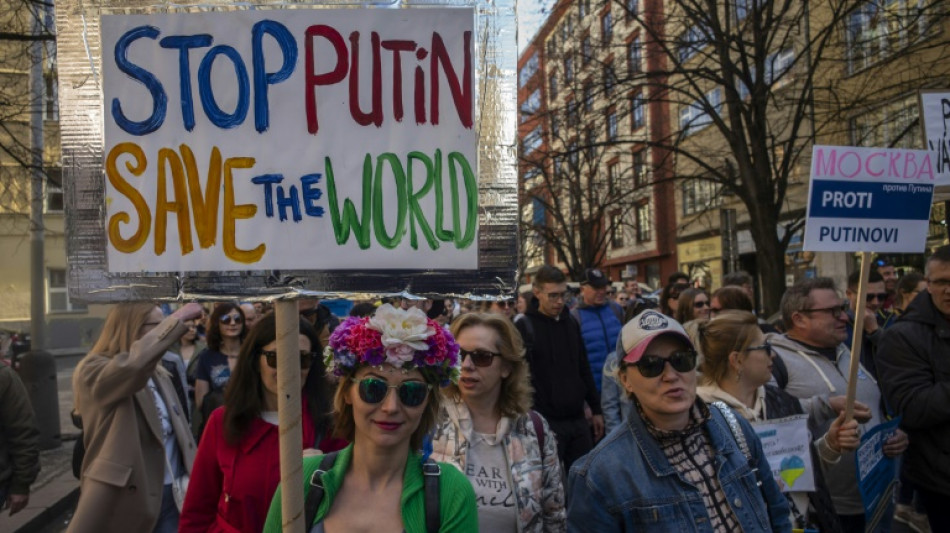
Thousands of Russians rally against Putin in Prague
Thousands of largely Russian protesters rallied against President Vladimir Putin in central Prague on Saturday, calling on him to stop the war in Ukraine.
Around 5,000 people, according to the organisers, chanted "Russia without Putin", "Freedom for Russia, peace for Ukraine" and "Putin is not Russia" as they marched through Prague's historic centre.
"The Czech Republic is home to 40,000 Russians and up to now these Russians have been unknown to the Czechs," organiser Anton Litvin told AFP.
"We want to show that the Russians who live here are against Putin, against the war, that they support Ukraine," added the artist and activist, who has lived in Prague for ten years.
"The Russians here are not Putinists, they are Europeans," said Litvin, holding one of many blue-and-white flags carried by the protesters.
He explained it was actually the Russian tricolor of red, blue and white adjusted for the occasion.
"We didn't want that red stripe symbolising blood so we cut it off. Now it's just white snow and clear blue sky," Litvin said.
Banners carried by the protesters called on Russians to "raise their voice and fight the real enemy, not Ukraine" and labelled Putin as a killer.
Marching down the central Wenceslas Square, protesters also called on Putin to release political prisoners, including his critic Alexei Navalny, who was sentenced to nine years in jail earlier this week.
"Every soberly thinking human being has to stand up against Putin," said Peter Bankov, a designer born in Belarus, who lived in Moscow before moving to Prague.
"Each action is either bad or good and it has an author, and this time around the evil has a clear author. That's why I'm against Putin," he added.
Olga Buzenkova, an entrepreneur who moved from Moscow to Prague only a year ago, managed half a sentence before she burst into tears.
"We are against the war, against Putin, against what the Russian army is doing, against the killing," she said sobbing, adding the war had ravaged her life.
"It changed everything," Buzenkova told AFP, mentioning her elderly Ukrainian relative who had to leave the shelled capital of Kyiv for Cologne.
"She remembers how the Germans bombed Kyiv in 1941, and now these Germans have received her and given her a refugee status."
"Russia has now become a fascist country. It's a repeat of 1938. We cannot ignore it and we cannot forgive it. Putin must be stopped," she told AFP.
L.Johnson--TNT