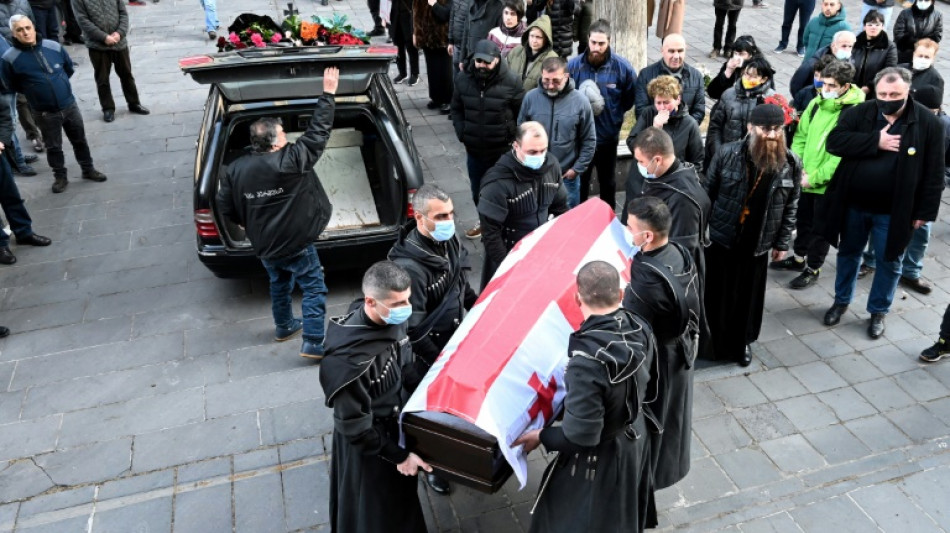
Georgia mourns two fighters killed in Ukraine
Georgia mourned Friday two retired military officers who died fighting in Ukraine, in a war that has reminded Georgians of their own conflict with Russia in 2008.
The full-scale offensive on Ukraine unleashed by the Kremlin a month ago sparked an outpouring of solidarity in fellow ex-Soviet country Georgia, with hundreds of Georgians joining the ranks of the Ukrainian army.
Among them were retired military officers Giorgi Beriashvili and David Ratiani, both 53, who were killed on March 17 near the flashpoint town of Irpin on the outskirts of Kyiv.
Grief mingled with anger at Russian President Vladimir Putin as thousands of mourners gathered in the Saint George church in downtown Tbilisi on Friday.
"They have died a heroic death, fighting for Ukraine's freedom, for Georgia's freedom," 20-year-old student Lili Gardapkhadze told AFP. "Georgians and Ukrainians will never let Putin steal our freedom."
Painter Shota Gachechiladze, 49, said: "Putin is insane, he is slaughtering thousands of peaceful Ukrainians. He must be stopped."
Nadim Khmaladze, who fought alongside Beriashvili and Ratiani, said their unit came under "hellish" artillery fire on March 17.
He said the pair died while "saving a wounded French fighter who has survived."
- 'Common enemy' -
They fought alongside 40 Georgians and hundreds of combatants from France, Israel, Morocco and other countries who joined the Ukrainian army's International Legion since Russia invaded on February 24, he added.
Another multinational unit, called the Georgian Legion, comprises around 500 Georgian fighters and a similar number of volunteers from across the globe, its commander, Mamuka Mamulashvili, told AFP.
"We, Georgians and Ukrainians, have a common enemy -- Russian imperialism," he said.
Mamulashvili said the Ukraine war "could have been avoided" if the West made the Kremlin "pay a heavy price for its invasion of Georgia in 2008."
In August 2008, Russia launched an assault against Georgia which was battling pro-Russian militia in its separatist region of South Ossetia, after they shelled Georgian villages.
The hostilities marked the culmination of spiralling tensions over Georgia's bid to forge closer ties with the West.
The fighting ended after five days with a European Union-mediated ceasefire but claimed more than 700 lives and displaced tens of thousands of ethnic Georgians.
After the war, Russia recognised South Ossetia, and another separatist region, Abkhazia, as independent states and stationed permanent military bases there.
Q.Marshall--TNT