Life must go on in Lviv as Ukraine war enters second month
The wail of the air raid siren no longer has the effect it once did in the western Ukrainian city of Lviv.
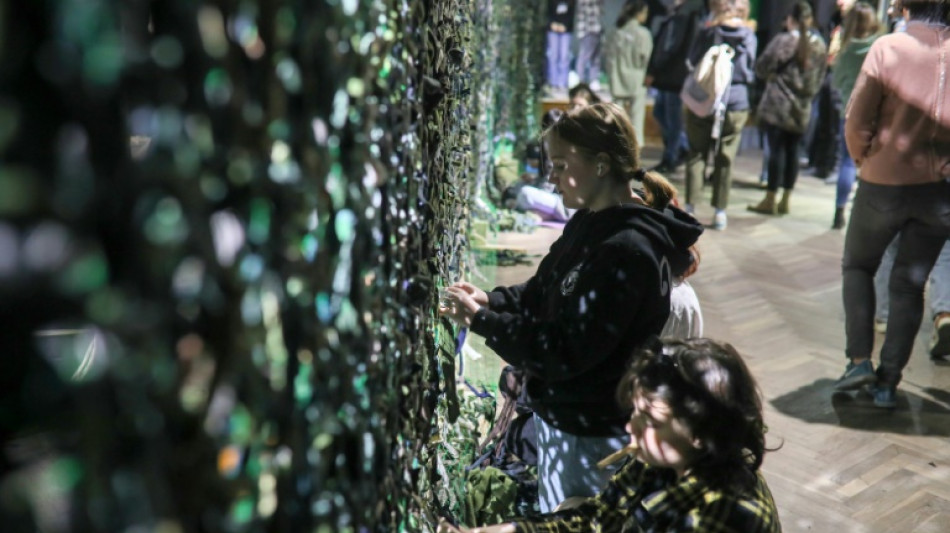
Volunteers stitching camouflage nets for the war effort dwindle every day. A bomb shelter nested in the earth near a children's playground now seems unremarkable -- just another thread in the fabric of the city.
As Ukraine marks one month to the day since the Russian invasion began, Lviv has settled into a new rhythm of living in a country under attack.
Alcohol remains banned since an order shortly after the invasion, nightlife is reined by a martial law curfew and the streets still bristle with military checkpoints.
But residents of the 13th century city -- famed for coffee, chess and culture -- now deftly steer their daily routines around the strictures of wartime.
While this may be the new reality, it is far from easy.
"It is a very terrible feeling," Kateryna Olushkevych, 30, says, rocking a pram with her infant son swaddled inside.
"We now live every day as if it's the last."
The first days of war in Ukraine were marked by disbelief and shock, then an outbreak of defiant nationalism as military and civilian life was geared to repel the attack.
As the conflict enters its fifth week -- with Russia's advance stalled outside cities and towns to the east -- there is a growing sense the war will be a marathon, not a sprint.
- Adapting to war -
"It's difficult, we have a great burden on our shoulders," Lviv mayor Andriy Sadovyi said on Thursday.
But despite it all "the city keeps living", he said.
Lviv has been largely untouched by violence and the city's initially austere war footing is now tempered by more quotidian concerns.
In the morning a coffee vendor steams milk at his cart. Around the corner young soldiers exit a city bus. Carrying a Ukrainian flag draped with a black sash, they are headed for a comrade's funeral.
Flea markets sell toy plastic army men. Three traffic wardens smatter cars with parking tickets outside the Vasyl Stefanyk scientific library. Heavily armed soldiers stop pedestrians for sporadic ID checks.
"What can I say, the war is going on, and it speaks for itself," said 70-year-old Mykhaylo, strolling the serpentine paths of the Ivan Franko park.
"People have got used to this new rhythm of life and adapted."
Around 500 volunteers came daily to a gallery space in the city centre at the start of the war, tearing and tangling strips of drab fabric to fashion camouflage nets for military installations.
Now only 100 or so present themselves for duty each day. A kettle is constantly bubbling. There is a casual hubbub of familiar faces.
At the gallery entrance a young volunteer on security detail tinkers with a ukulele as her comrade commits a pencil sketch of the Lviv skyline to an open notebook.
To the left and right they are bracketed by towering mounds of sandbags.
Just last week the city was hit by an air strike for the first time, although no one was killed.
- 'Ready to help' -
Lviv lies just 70 kilometres (45 miles) east of the border with Poland -- the highest traffic crossing for 3.5 million refugees who have quit the country so far, according to the United Nations.
In the first days of the war the city's central train station heaved with mostly women and children, arriving from all over Ukraine and departing on teeming carriages bound for the border.
The numbers arriving have diminished every day as organisation efforts by charities, NGOs and the government has stepped up.
The chaos of the first days of war is now gone but not forgotten.
Olushkevych, the young mother, hosted outgoing refugees on their last stopover in their home country before leaving the country.
"Lviv is already accustomed to the situation, ready to help everyone," she says.
"I have this conviction that we will overcome everything."
A.M.Owen--TNT