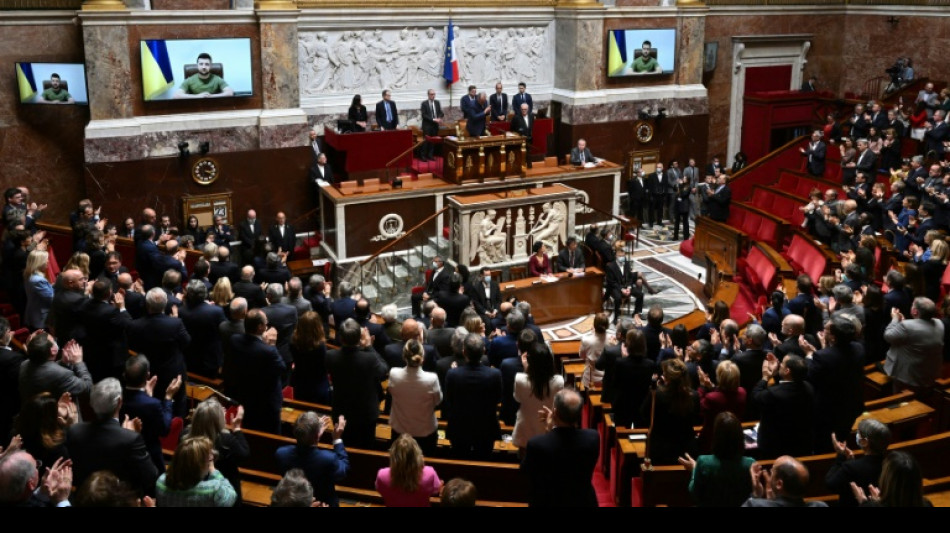
Zelensky calls on French companies to quit Russia
Ukrainian President Volodymyr Zelensky used an address to France's parliament on Wednesday to call on French companies still working in Russia to "stop sponsoring" the Kremlin's aggression against his country.
During a 15-minute video address in his trademark green T-shirt, Zelensky took aim at "people who bury their heads in the sand and try to find money in Russia."
"French companies must quit the Russian market," he said. "Renault, Auchan, Leroy Merlin and others must stop sponsoring the Russian war machine."
French lawmakers gave Ukraine and its ambassador to France three standing ovations before the address by Zelensky, who has spoken to parliaments across the Western world in previous weeks to garner support.
Invoking a specifically national trauma, as he has done in other speeches, the Ukrainian leader said that images of devastated Ukrainian cities such as Mariupol "recall the ruins of Verdun as in the photos of World War I that everyone has seen."
Verdun in the Somme region of northeast France was the scene of one of the biggest battles of the Great War, which was immortalised in black-and-white photos showing barely a tree or house left standing.
"The Russian army makes no distinction between targets. They destroy residential areas, hospitals, schools, universities," he told the French lawmakers.
"They do not take into account the concepts of war crimes," he said.
- Complicity? -
The ongoing presence of more than 500 French companies in Russia has become an increasingly controversial subject in France amid demands from some for them to join boycotts announced by American or British groups such as McDonald's, Apple or BP.
No French group has so far announced it is pulling out of the Russian market, where they are the biggest foreign employers with 160,000 staff members, according to the French economy ministry.
Economy Minister Bruno Le Maire said this month that there was "a problem of principle of working with any political or economic figure close to the Russian government," but he has not called on companies to withdraw.
Pavel Chinsky, head of the Franco-Russian Chamber of Commerce, told BFM television this week that French groups were following the same approach as their EU counterparts in Germany and other members of the bloc.
"At this time we are hoping to preserve as many jobs as possible," he said.
Attention has focused in particular on the energy giant TotalEnergies, which is one of the biggest French investors in Russia via its shareholdings in liquefied natural gas projects in the Arctic, as well as in the gas group Novatek.
The Greens presidential candidate, Yannick Jadot, has accused the company of being "complicit in war crimes" by paying taxes to the Russian state -- leading the company to announce legal action for defamation on Wednesday.
The group accused Jadot of "unacceptable statements," adding that it was continuing "its purchasing activities for Russian gas to re-sell it, notably in Europe for the benefit of European consumers."
The group has announced it will not increase its investments in Russia and will stop buying Russian oil and petroleum products by the end of this year.
"I know how to replace this oil and diesel fuel," CEO Patrick Pouyanne told RTL radio on Wednesday, but "with gas, I don't know how to do it."
- Dilemma -
The war in Ukraine has presented Western companies with a dilemma about whether to continue working in Russia, where strict capital controls announced by the government would prevent them from selling up and withdrawing their money.
President Vladimir Putin has also threatened to nationalise and expropriate foreign groups that decide to join the boycott.
Against this, multinationals must calculate the reputation risk of remaining in a country that has become a pariah in the West since its invasion of neighbouring Ukraine on February 24.
French retailers such as supermarket chain Auchan, DIY store operator Leroy Merlin and sports equipment seller Decathlon remain open in the country for now, having invested heavily to open stores serving the country's growing middle classes.
Leroy Merlin in particular drew fire from its Ukrainian employees after its Kiev store was hit by a Russian strike on Sunday night.
Car maker Renault suspended its production at its plants near Moscow last month, but has since resumed production with the blessing of the French state, its biggest shareholder, Reuters news agency reported this week.
The French manufacturer owns a 68 percent stake in Avtovaz, the owner of the Soviet-era Lada brand, in a partnership with Sergei Chemezov, a sanctioned ally of Putin.
F.Adams--TNT