Ukraine's 'chess capital' mulls Russia's next move
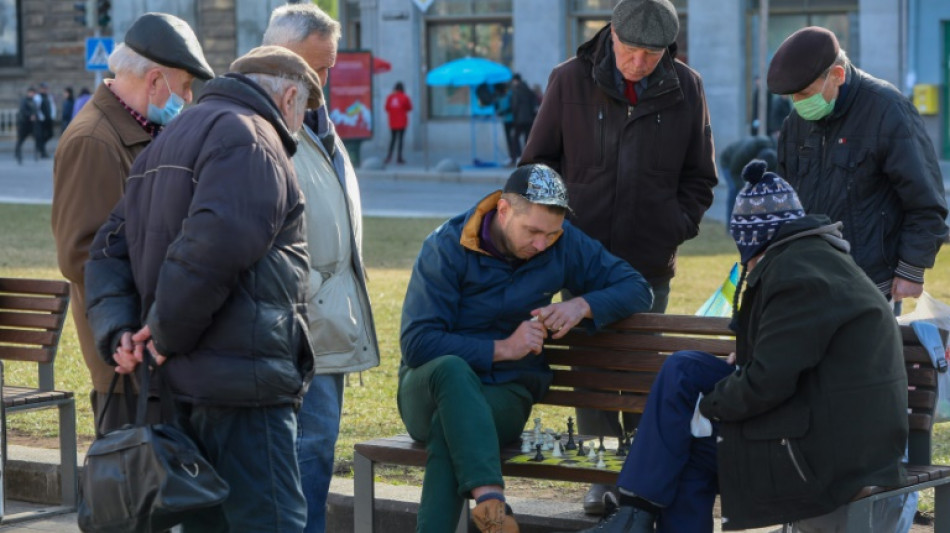
A rapt and raucous audience, a group of chess fanatics watch a cut-throat game play out on a park bench.
Rook takes knight, a flurry of moves, then the game is over in an instant. The loser surrenders a note of Ukrainian currency and the pieces are reset for another game on the battered board.
In the western city of Lviv, Ukraine's capital of chess, local players make a point of keeping up the local tradition of street games, despite the March chill and the war raging to the east.
"Chess is a very difficult game," sighs Andrei Volokitin, the reigning champion of Ukraine.
"It needs memory, calculation, strategy, positional thinking," says the 35 year-old grandmaster.
But he is smart enough to know that his foresight on the board does not extend to international affairs. He offers no predictions concerning the Russian invasion wreaking havoc in the east of his country.
"I'm afraid this can continue a few months, maybe more, I don't know," he says. "This is the new reality for all people in Ukraine."
Lviv -- just 70 kilometres (45 miles) from the Polish border -- has so far been largely spared since Russia launched its invasion on February 24.
The city considers itself the cultural epicentre of Ukraine.
Its cobbled streets are lined with coffee shops, boutiques and neon-lit restaurants, even if its nightlife is curbed by the curfews imposed under martial law.
But Lviv is also known as the chess capital of Ukraine.
- Chess wars -
The old Soviet Union to which Ukraine belonged until 1991 invested heavily in developing chess talent, cherishing the USSR's longstanding dominance in the game. The city's continuing obsession with chess is a legacy of those times.
All along the central promenade, droves of mostly men gather to watch amateur players play out their games in the chilly March weather.
Volokitin reckons there are between 20 and 30 active grandmasters among Lviv's 700,000 residents. "It's a traditional chess city," he says.
But the chess world has been divided by Russian President Vladimir Putin's order to invade Ukraine.
FIDE -- the International Chess Federation -- has already cancelled tournaments in Russia, where the game is also wildly popular, and banned its flag from flying at events.
But the Ukrainian Chess Federation wants more.
It is pushing for a total ban on Russian players "under any flag or without it". Volokitin himself has signed an open letter pledging not to play Russians.
"During the killing of our civilians, our women and children, and destroying our cities I think it's logical," he said.
Last week, FIDE banned the Russia and Belarus teams from its tournaments.
On Monday, it banned top Russian grandmaster Sergey Karjakin from its tournaments for six months over his outspoken support for the invasion.
But for the moment, other Russian players can still play.
So next week, Volokitin travels to the European Individual Chess Championship in Slovenia next week to put Ukraine's case for extending the ban.
He has received a special dispensation on the government's order forbidding men aged between 18 and 60 from leaving the country, he says.
His wife and daughter are already sheltering in Poland, and Volokitin spent two weeks sheltering "chess friends" as they made fled the conflict zone.
"We should do all we can," he says.
- Putin's gambit -
Military analysts suggest Putin's "special military operation" is stalling after heavy losses and unexpected resistance from outmanned but highly motivated Ukrainian forces.
However on Friday a Russian air strike hit a plane repair plant next to Lviv's airport.
Although no one was killed, it was a clear sign that the war was drawing closer to the city, after three weeks of having escaped relatively unscathed.
Nevertheless, the city's chess fans still gather along the promenade for their games, some offering their prognosis on the conflict as the one-month marker approaches.
Oleh Chernobayev, 52, only lasted 10 minutes in his game with Volokitin -- but he was more optimistic about Ukraine's chances in the war.
"We will definitely win," he said.
"We have good people, people without weapons are stopping tanks. They can't take Kyiv. Our guys are very brave."
Nearby, Oleksander, a self-declared stalwart of the city's chess benches, holds court as he plays.
"This is a difficult game, a game of the mind," he declares.
A young challenger in a baseball cap has him locked him in a gruelling match.
But the pauses between his moves get longer and longer, until eventually the young pretender resigns the game.
"We need to compete for Ukraine the same way we compete in chess," he remarks sardonically.
V.Allen--TNT