Lonely passengers ride ghost trains back to Ukraine
The station in the west Ukraine city of Lviv teems with outgoing passengers, vying for seats on trains leaving the war-torn nation.
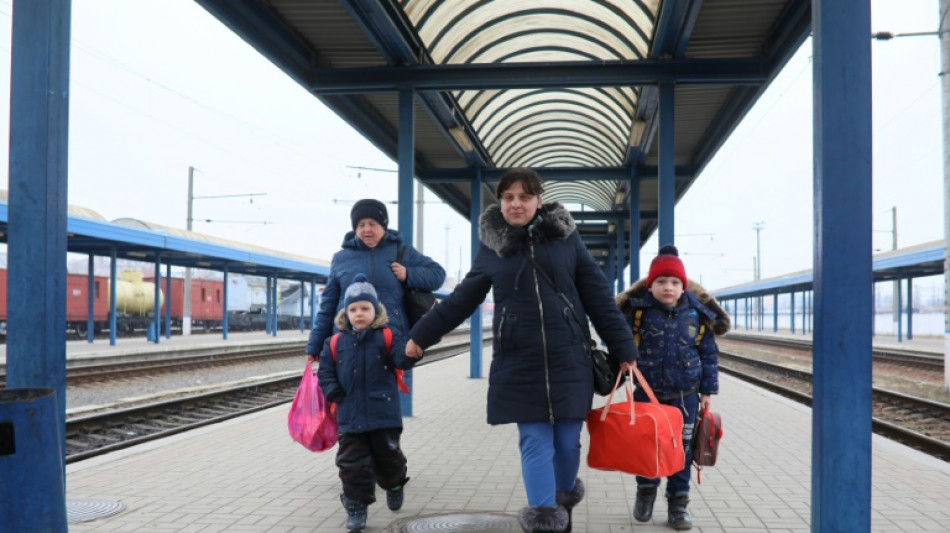
But on a desolate platform, far from the main hall, carriages disgorge small huddles of refugees returning home despite the conflict still raging with Russia to the east.
While grateful for Europe's welcome, many find themselves unable to start a new life abroad.
Wiping a tear from her grandson's eye, Svitlana Natalukha, 60, says her family travelled for a total of five days, first escaping Ukraine, then turning back.
The grandmother, her 28-year-old daughter Galyna Kanuka, and two grandsons left home in the eastern Kharkiv region and arrived safely in Poland, but came to Lviv on Wednesday.
The family praised Poland's hospitality but were paralysed by the mammoth prospect of a rootless new life abroad.
"Volunteers helped a lot, but only at the place where they are located," said Kanuka, huddled on the chill-swept platform next to a mound of packed bags.
"They were telling us to carry on to other cities and find more volunteers there."
The family also cited a language barrier complicating the treatment of one son's illness for their decision to return.
- Return to danger -
Three million have fled Ukraine since the Russian invasion began three weeks ago, according to the United Nations.
There are no official figures for the numbers choosing to return as the conflict grinds on.
But this week, AFP witnessed three trains carrying between 100 and 250 passengers from the Polish city of Przemysl for Lviv.
Some were foreign volunteers answering Ukraine's call for military support, others ferried aid supplies, but most were women and children bearing indigo Ukrainian passports.
At the Lviv station, a handwritten sign above a stairwell where travellers are waved aboard trains heading for the border tells them: "Come back home, the motherland is waiting for you."
Conductor Oleksandr, who declined to give his surname, said as many as 300 sometimes make the return trip -- about a third the number crammed into his train preparing to make the outward journey.
He said "first there were no such cases" but "lately many women with children started coming back".
Although many nations -- particularly in the EU -- have made special provisions welcoming those leaving the war zone, it is hard to soothe the refugees' fears over starting a new life.
"They feel like they won't be looked after in the long run," said Oleksandr, perched in the cab of a hissing engine car.
"One woman said she stayed for a couple of days homeless there and it was better to come back to Ukraine."
- Homecoming -
The journey from Poland back to Ukraine plays out the flight to safety in reverse.
At Przemysl, passengers leave behind a station teeming with volunteers offering food, shelter and onward travel.
The return trains to Lviv are not advertised on the departures board, and travellers negotiate their way against the flow of refugees through a door marked "no entry" to passport control.
The sparsely packed trains begin a 90-kilometre (55-mile) journey past a road border clogged with traffic where helicopters patrol the outer limit of the Polish skyline.
Then, beyond a rusted barbed wire fence, the countryside becomes a war zone once more -- dotted with checkpoints staked with Ukrainian flags.
Passing packed trains going the other way, the return passengers eventually arrive in Lviv.
Though far from the frontlines, it is fringed with checkpoints, windows are sandbagged and air-raid warnings ring out throughout the night -- it is unmistakeably a country at war.
On Sunday, a military base outside the city was hit by a Russian airstrike, killing 35.
But for Natalukha's family, Lviv will be a home away from home -- a slim comfort in trying times.
"We wanted the kids to be safe in Poland, but we failed," she said.
"We hope they might be safe in Lviv."
F.Harris--TNT