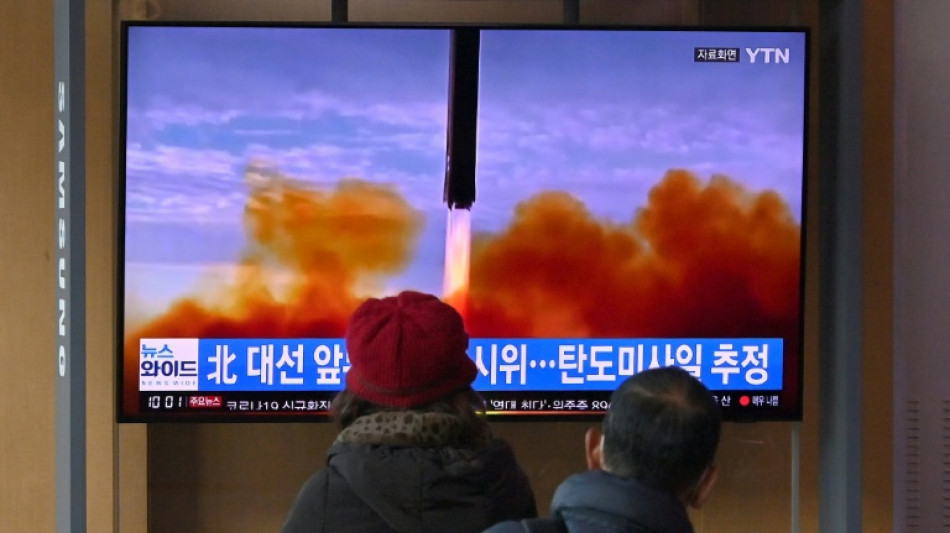
North Korea 'projectile' launch ends in failure
North Korea fired a projectile Wednesday but the launch appears to have immediately failed, Seoul said, with analysts warning it was likely a test of Pyongyang's so-called "monster missile".
The launch -- North Korea's tenth suspected weapons test this year -- comes after the US said the nuclear-armed country was preparing to fire an intercontinental ballistic missile (ICBM) "at full range" for the first time since 2017.
Despite biting international sanctions over its weapons programs, Pyongyang conducted seven missile tests in January and twice launched components of what it claimed were a "reconnaissance satellite".
South Korea and the US said last week those tests were actually of a new ICBM system that has never been launched before -- likely the Hwasong-17, dubbed a "monster missile" by analysts after it was first unveiled at a parade in October 2020.
"North Korea fired an unknown projectile from the Sunan area around 09:30 today but it is presumed that it failed immediately after launch," Seoul's Joint Chiefs of Staff said in a statement.
The February 27 and March 5 "satellite" tests were also from the Sunan area in Pyongyang, according to South Korea's military.
Japanese media reported the Wednesday launch was a "possible ballistic missile" test, citing an unnamed defence ministry official.
National broadcaster NHK reported senior government officials were meeting at the prime minister's office to discuss the situation.
The nuclear-armed North has long coveted an ICBM that can carry multiple warheads, and the US said last week the recent tests marked a "serious escalation" of the country's weapons programs.
The US military this week said it had "enhanced" missile defence systems in South Korea.
It has also "increased the intensity" of air defence drills, as well as conducting a carrier-based air demonstration in the Yellow Sea following the recent North Korean launches.
- Monster missile? -
The North has carried out three ICBM tests -- the last in November 2017 of a Hwasong-15 -- deemed powerful enough to reach Washington and the rest of the continental United States.
But the country has been observing a self-imposed moratorium on testing long range and nuclear weapons since 2017 when leader Kim Jong Un embarked on a flurry of high-level diplomacy.
Negotiations with then US president Donald Trump collapsed in 2019 and since then Kim has doubled down on his plans to modernise his military while ignoring US offers of talks.
"Signs indicate the North test-fired Hwasong-17 today," Cheong Seong-chang, a senior researcher at the private Sejong Institute told AFP.
"With Russia now highly unlikely to agree to additional sanctions on the North in case of such a test-launch amidst its invasion of Ukraine, Pyongyang appears to have judged it was the optimal time to proceed," Cheong said.
The failure of the Wednesday launch will be closely studied by Pyongyang, and it can take around three tests to ensure the missile is functioning, he added.
"I expect the North to conduct one or two more test-launches before April 15," he said.
North Korea will mark the 110th anniversary of the birth of founding leader and Kim's grandfather Kim Il Sung in April and likes to mark key domestic anniversaries with military parades or launches.
"The Kim regime wants to demonstrate new technical achievements around the 110th birth anniversary of its founder, Kim Il-sung," Leif-Eric Easley, a professor at Ewha University in Seoul.
"If the most recent missile launch was indeed a failure, North Korea will almost certainly continue to test," he added.
Satellite images indicate that North Korea is preparing for a military parade for the April anniversary.
The fact that the Wednesday launch failed indicates it was not just "an ordinary missile", North Korean studies scholar Ahn Chan-il told AFP.
The timing, during a South Korean presidential transition and while the world is focused on Ukraine, also indicates Pyongyang is seeking maximum leverage, he added.
A fresh ICBM launch would be an early challenge for South Korea's new president-elect, Yoon Suk-yeol, who has vowed to take a harder line against the North's provocations.
Yoon has not ruled out the possibility of dialogue with Pyongyang, but analysts say his hawkish position puts him on a completely different footing to his liberal predecessor and significantly reduces the prospect of substantive engagement.
J.Sharp--TNT