Firms blast Bolsonaro bill on mining indigenous lands
Major mining firms operating in Brazil joined a chorus of criticism Tuesday of President Jair Bolsonaro's push to legalize mining on indigenous reservations, including in the Amazon rainforest.
The Brazilian Mining Institute (IBRAM), a group representing the largest mining firms operating in the country, said a Bolsonaro-sponsored bill to allow mining on indigenous lands was "inappropriate."
The group, whose members include Britain's Anglo American, Anglo-Australian firm Rio Tinto and Brazilian mining giant Vale, called for a "broad debate" on the bill, including indigenous peoples themselves.
Bolsonaro, who has long pushed to relax restrictions on developing protected lands, says Brazil urgently needs to pass the bill, currently before the lower house of Congress.
The far-right president argues the Russia-Ukraine war is threatening agricultural powerhouse Brazil's crucial fertilizer imports, making it essential for the South American country to exploit more of its mineral reserves, particularly of key fertilizer ingredient potassium.
Environmentalist say the bill would accelerate the destruction of the Amazon, where they say there is little potassium anyway.
IBRAM echoed criticism of the bill, which activists say risks giving free rein to wildcat mining known as "garimpo" that is already operating on indigenous lands illegally.
Prosecutors in Brazil accuse the booming illegal mining industry of rampant environmental destruction, violence against indigenous communities and links to organized crime.
"IBRAM condemns all illegal 'garimpo' activity on indigenous lands, in the Amazon or elsewhere, and believes this activity must be fought rigorously and its sponsors brought to justice," the group said in a statement.
"IBRAM believes industrial mining is viable anywhere in Brazil, as long as it is subjected to regulations on geological analyses, viability studies, environmental licenses and other authorizations required by law."
Brazil, the world's top soy producer, imports 80 percent of its fertilizer -- 20 percent from Russia, its biggest supplier.
Bolsonaro's allies in the lower house won a vote last week to consider the mining bill under special emergency provisions, bypassing committee discussions.
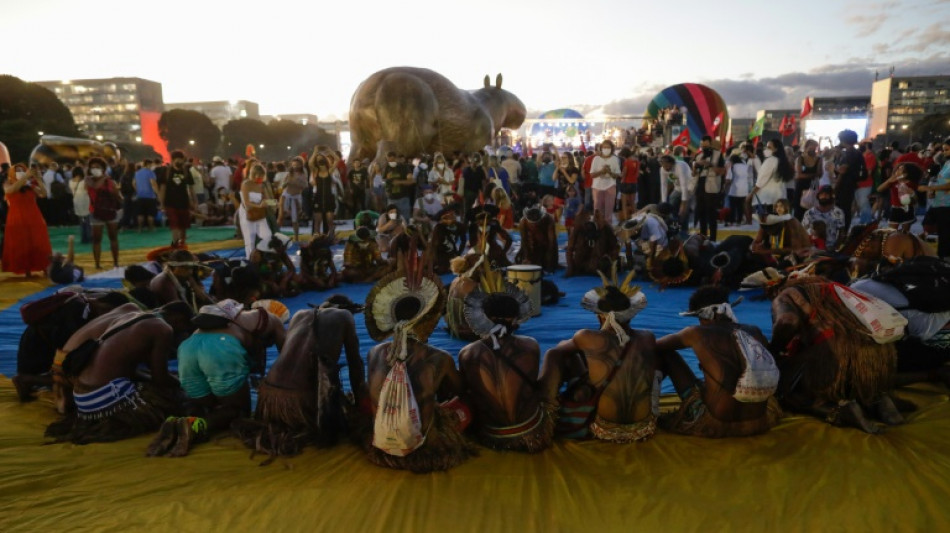
The same day, thousands of people protested outside Congress against the bill and other Bolsonaro environmental policies, led by famed Brazilian singer-songwriter Caetano Veloso.
T.Cunningham--TNT