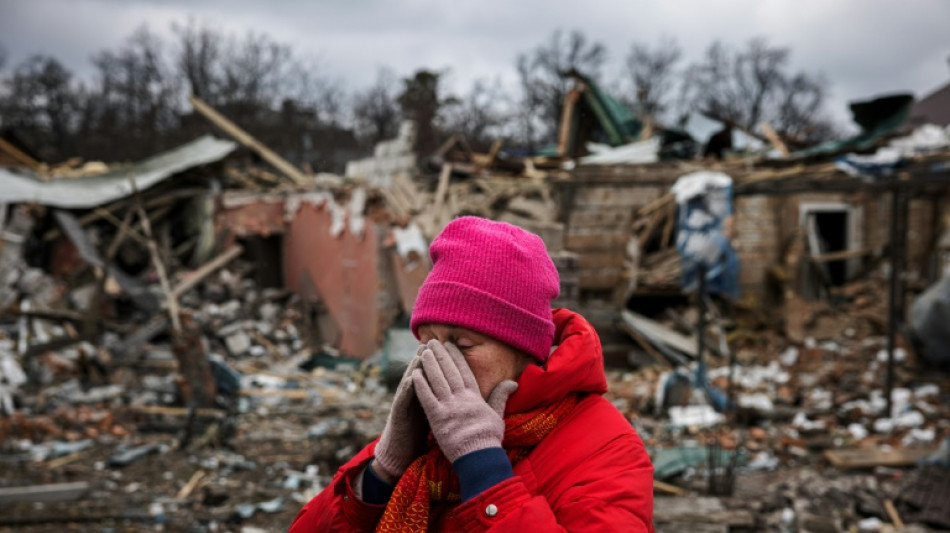
Shelling fails to shift last civilians from Kyiv's ghost suburb
Most of the citizens of Irpin, a once well-to-do commuter suburb of the Ukrainian capital Kyiv, have fled the Russian army's bombardment.
The streets are dotted with rubble where Grad missiles have burst open high-rise apartment blocks and modest wood and brick bungalows.
Sometimes the empty streets are so silent that a woodpecker's tapping in a tall tree sounds more insistent than the distant guns.
But sometimes there is the roar of racks of Grad missiles and volleys of mortar shells being launched nearby.
It's more than Mykola Pustovit, 69, can take. He bursts into tears as he and his wife start the long walk to find relative safety in Kyiv.
They had hoped the frontline would move away from Irpin, "but now, after such bombing, it's unbearable".
In fact, the frontline has not shifted for days. By the reckoning of Ukrainian soldiers manning checkpoints in the town, maybe 20-30 percent of the district is in Russian hands.
The next suburb, Bucha, a few hundred metres further north, is already in the hands of the invading Russian army and violence is never far away.
As AFP reporters crossed a makeshift wooden bridge into Irpin early on Sunday, Ukrainian forces were shipping the corpses of three of their comrades back out.
Later in the day, a car carrying American journalists came under fire near a Ukrainian checkpoint, killing film-maker Brent Renaud and wounding photographer Juan Arredondo.
After the incident, Irpin's mayor Oleksandr Markushyn banned reporters from the town, but before the restriction came into place AFP found some civilians not ready to leave.
- 'This one bites' -
Iryna Morozova is clearly frightened, she raises her hands in surrender when AFP journalists approach, as if being held at gunpoint.
Her house is badly damaged, lying next to another that was all but demolished by an apparent missile hit. But the 54-year-old can't leave; who would feed her dogs?
She has the keys to a neighbour's house where three excitable puppies, a placid Golden Retriever and a nervous German Shepherd, confined and circling in a kennel, have a home.
"This one bites, we closed him up in the cage. We found him, he was scared and was shaking," she says of the distressed dog.
The others have the run of a garden, and play happily with visitors.
"They sleep there in the kitchen. They play during the day. How can you leave them?" Morozova asks.
The few remaining neighbours look out for one another and take food to the elderly, but Morozova is more worried about the pets.
"There's nothing left here," welling up in grief in front of a ruined home. "Now we collect stray animals and feed them, because people left them behind and moved away."
Another neighbour, 76-year-old Vera Tyskanova, retired to the once pleasant suburban street after a career as a train driver in the Tajik capital Dushanbe.
She has been without power since an air strike early in the war, late last month, and is also consoling herself by feeding neighbourhood strays.
"There's water, but no electricity. There's a fireplace in the part of the house which is not ruined ... I'm surviving," she laughs.
She may be putting a brave face on things, but just around the corner 84-year-old Mykola Karpovych -- who once drove a tractor in farmland near the then friendly Belarus border -- is bewildered.
"Where would I go? My legs and my hands hurt," he tells AFP.
"To leave? Where would I go? Shall we go to Kyiv? I won't go anywhere. What happens, happens. I'm too old."
R.Campbell--TNT