For Russians in Ukraine, their homeland feels like the enemy
The Kremlin's invasion of Ukraine is a personal tragedy for Russians living in Ukraine, many of whom now see their homeland as an enemy -- and some are ready to fight.
Despite Ukrainian fury and mounting anti-Russian rhetoric, 40-year-old Andrei Sidorkin says the only time he has been rejected by his neighbours is when he tried to join the army.
Sidorkin, who was born in St Petersburg where his parents are buried, moved to the Ukrainian capital Kyiv 15 years ago "for a love story".
He had felt accepted in Ukraine but his Russian passport meant he was blocked on five attempts to join different elements of the Ukrainian armed forces, including the nationalist Azov Battalion.
"If Russian troops ever enter Kyiv, I would like to welcome them with weapons in hand, not empty-handed," Sidorkin said.
He is preparing Molotov cocktails with other volunteers, he added.
As a former Soviet republic where Russian is still widely spoken, and which has seen two democratic revolutions in 2004 and 2014, Ukraine has become a popular exile destination for Russian liberals.
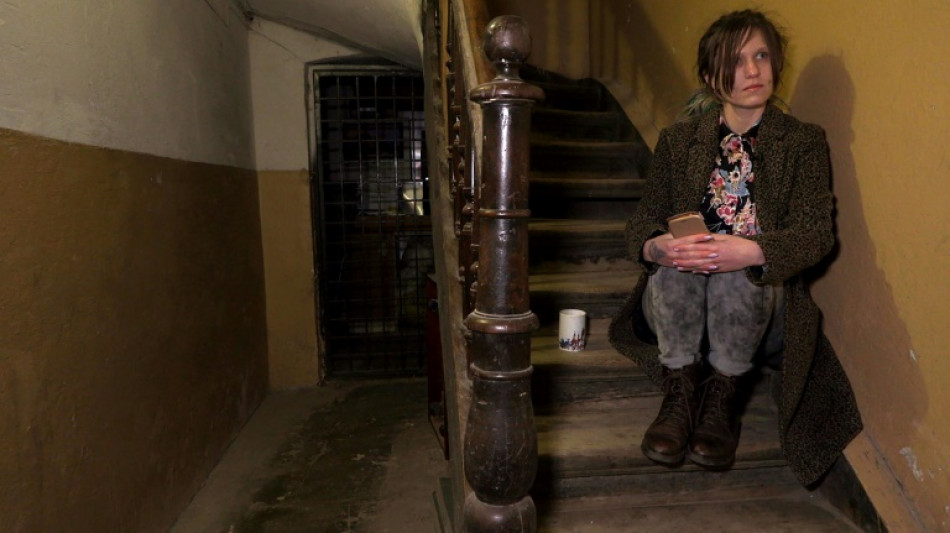
Sasha Alekseyeva, a 32-year-old sociologist with multicoloured dreadlocks, moved from St Petersburg to Kyiv four years ago to escape what she saw as the authoritarian regime of President Vladimir Putin.
With Russian forces pressing towards the capital, she has now fled to the relative safety of Lviv in western Ukraine.
"I feel safer here than in Russia."
- 'Ashamed' -
There were nearly 175,000 Russians with a residence permit in Ukraine as of late January, the state migration service told AFP, with many more likely living illegally since there is no visa regime between the two countries.
The invasion has caught many of them off-guard, with some finding themselves torn between their homeland and their adopted country.
It is a potentially dangerous situation since a portion of Ukraine's 40 million inhabitants now consider every Russian an enemy.
"I was very ashamed to be Russian," said Galina Zhabina, who spent several days under bombardment in Kharkiv, Ukraine's second largest city in the east.
"Then I was very angry, ready to throw myself on a tank with my bare hands, but there were no tanks, just airstrikes," the 36-year-old copywriter said.
Maria Troushnikova, a 43-year-old English teacher who has lived in Ukraine for 20 years but has always felt Russian, says she is experiencing an identity crisis.
"Shame, rage, pride for Ukraine -- there is all of that in me," she told AFP, describing "a terrible emptiness instead of nationality".
For many, the war has broken relationships with relatives in Russia who support the invasion or are unwilling to condemn Moscow.
"I hardly talk to anyone anymore," said Zhabina.
"My friends hide their heads in the sand, my family invites me to go back to Russia and they don't understand why I don't."
- The enemy within? -
Of her family, Alekseyeva only communicates with her 88-year-old grandmother. It saddens her to think that she may never see her again.
"But when you hear that an 18-month-old child has been killed, you don't think about your grandmother anymore," she said.
Yulia Kutsenko, founder of a kindergarten in Kyiv, says her mother and sisters in Moscow support Ukraine but she finds it hard to understand their inaction, even though any protest is brutally suppressed by the Russian authorities.
"I am very afraid for them, but I would still like them to go out on the streets," said the 44-year-old.
She now feels entirely Ukrainian and considers Russia "an enemy".
Some hope that a defeat of their homeland will serve as a useful lesson, or even lead to Russia's disintegration.
"It would be convenient to say that only Putin is guilty -- that's not true," said Sidorkin.
"We have to dismantle this imperial myth of Russia altogether."
A.Davey--TNT