Putin says sanctions will disrupt food, energy markets
Russian President Vladimir Putin warned Thursday that Western penalties against Moscow for its military incursion in Ukraine would destabilise the global energy and food markets and vowed the country would emerge stronger from the crisis.
Putin's "special military operation" in Ukraine that began on February 24 has triggered unprecedented Western sanctions and sparked an exodus of international corporations from Russia.
Putin on Thursday however downplayed the massive sanctions, saying Moscow will find a way to "adapt".
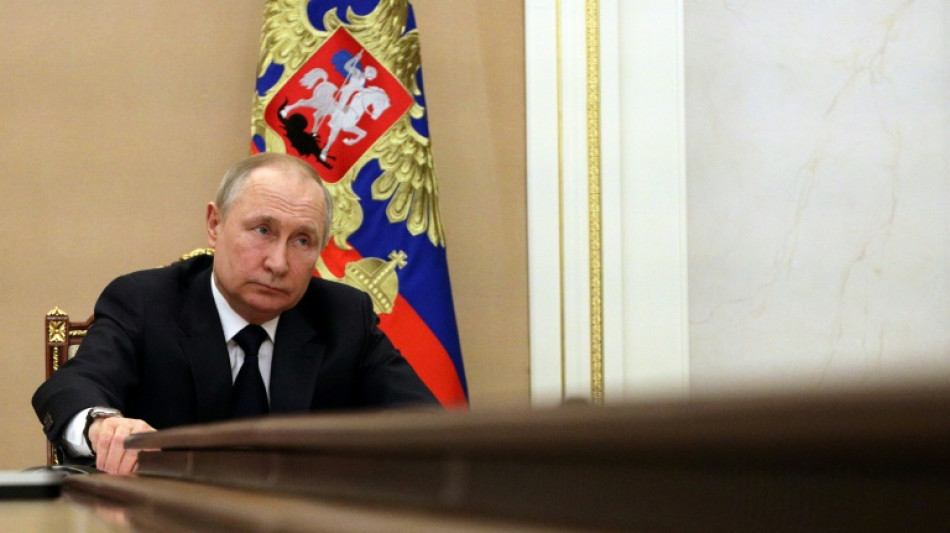
Speaking at a televised government meeting on the 15th day of Moscow's advance into Ukraine, Putin said that Western sanctions on Moscow had begun to hurt the United States and Europe.
"Their prices are rising, but that's not our fault. It's the result of their own miscalculations. There's no need to blame us," Putin said.
While the 69-year-old Kremlin chief said Moscow was continuing to export oil and gas, including through conflict-torn Ukraine, he blamed the West for sky-rocketing energy prices.
"They are telling their citizens to tighten their belts, to dress warmer," Putin said.
He stressed that Russia was "respecting all of our obligations in terms of energy supplies."
Putin scoffed at Washington for what he said were their efforts to sign energy contracts with Western adversaries Iran and Venezuela.
He also warned that the Western penalties could send global food prices soaring, as Russia was one of the world's main producers of fertiliser.
"If they continue to create problems for the financing and logistics of the delivery of our (fertiliser) goods, then prices will rise and this will affect the final product, food products," he said.
European wholesale gas and crude oil have rocketed to record, or near-record prices this week due to supply fears linked to Putin's decision to pour tens ot thousands of troops into Ukraine on February 24.
The United States and Britain announced this week they were cutting off Russian energy imports in response to what the Kremlin has termed Moscow's "special military operation," triggering another surge in prices.
- 'We'll adapt' -
The Russian leader also sought to calm Russians amid fears of shortages of food and medicines.
He acknowledged that Russians may be worried about an interruption of supplies but claimed there was nothing the Kremlin could not solve.
"It is clear that in such moments people's demands for certain categories of goods always increase, but we have no doubt that we will solve these problems in due course in a calm way and gradually people will find their way," Putin said.
He said he believed Russians would "understand that there are no events that we cannot solve, they simply do not exist."
He argued that the current crisis would make the country stronger.
"At the end of the day, all of this will lead to the increase of our independence, autonomy and sovereignty," Putin said.
Putin, a former KGB officer, said that Moscow's Soviet experience will help Russians adapt, claiming that Russia has "always" lived under sanctions.
"We will get through this period," he said, calling for the country to "adapt to the new situation."
Putin also said that the remaining foreign investors in the country should be "protected".
"The rights of those foreign investors and colleagues that are staying in Russia and working in Russia, should be reliably protected," he told his ministers.
Putin launched the Ukraine incursion despite weeks of Western leaders warning him of unprecedented sanctions that would ruin the Russian economy if he did so.
O.Nicholson--TNT