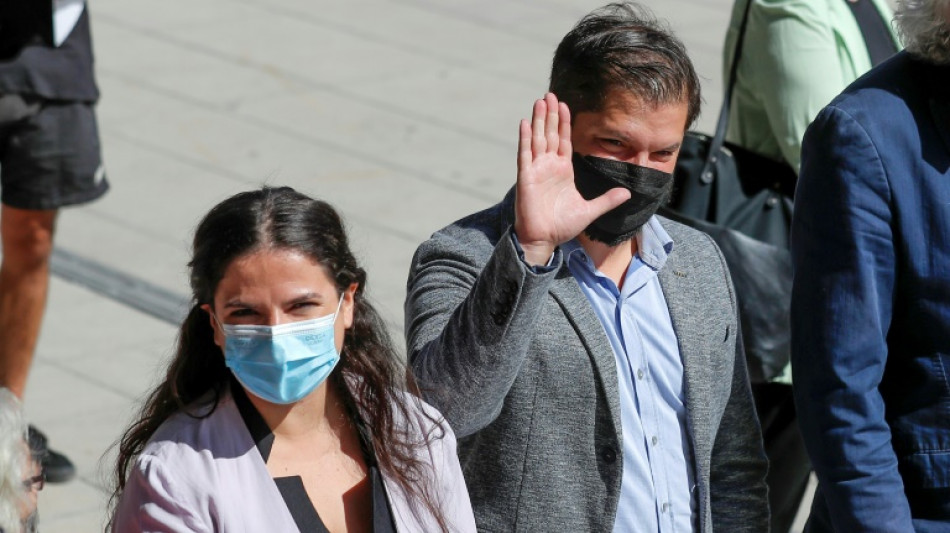
Boric begins Chile presidency alongside student comrades
Former student leader Gabriel Boric will take on Chile's greatest challenge since the end of the Augusto Pinochet dictatorship when he is sworn in as the youngest president in his country's history on Friday.
It is a challenge he will tackle alongside fellow comrades-in-arms who stood beside him in a 2011 student movement that took on outgoing President Sebastian Pinera and exposed the deficiencies of a neoliberal economic model otherwise lauded for its success.
Boric's election emphasizes a generational shift in Chilean politics that began in 2017 with the emergence of the leftist Broad Front coalition, which he leads.
Mostly middle-aged male elites are being replaced by a younger majority-women cabinet: 14 out of 24 ministers that have an average age of just 42.
"Today a new chapter in our democratic history is starting to be written," Boric said in January when announcing his ministers.
"We are not starting from scratch, we know there is a history that lifts and inspires us."
His executive spokeswoman is Camila Vallejo, 33, and his minister in charge of relations with parliament is Giorgio Jackson, 35, both fellow student activist leaders in a movement that denounced the country's expensive and unfair education system and demanded social mobility for the poor.
For the first time a woman, Izkia Siches, 36, will head the interior ministry, while a former cleaner and trade unionist, 48-year-old Luz Vidal, is the new deputy minister for women and gender equality.
"Boric begins with a favorable climate in terms of public opinion thanks to the political capital he achieved in the election and with the naming of his cabinet," Marco Moreno, director of the economy, government and communications faculty at the Central University of Chile, told AFP.
"But he also arrives with very high expectations of what is to come."
- Economic slowdown -
The incoming government will have to work hard to earn the support of a parliament where the ruling coalition, which includes the century-old Communist Party, holds just 37 out of 120 seats in the lower house and five out of 50 in the upper house senate.
Even backing from the Socialist Party and other center-left collectives would not be enough support to achieve a simple majority in parliament.
One of the main issues during Boric's tenure will be a change to the constitution that dates from the 1973-90 rule of former dictator Pinochet.
A constitutional convention -- elected in a referendum last year -- is expected to finish rewriting the new magna carta this year.
The country Boric will lead is one of the most unequal in the world in which the top one percent own a quarter of the country's wealth, according to one UN agency.
That fact -- which was also exacerbated by the coronavirus pandemic -- was one of the main drivers behind the social uprising of 2019.
The sustained movement forced Pinera to increase tax spending and expand social programs, resulting in 2021 in the largest increase in public spending in the country's history at 33 percent.
- Responsible growth -
However, Boric inherits an economy in slowdown and inflation of over seven percent that is not expected to drop.
He must also deal with a 2022 budget that included a 22 percent cut in spending following the huge stimulus packages rolled out during the pandemic.
That will make it harder for him to deliver the European-style "welfare state" he promised on the campaign trail.
He knows it will take time to deliver on those promises.
"We must advance responsibly in the structural changes without leaving anyone behind, growing economically," he said in December after his victory was confirmed.
He must also try to quell the spiraling violence in the south where people from the indigenous Mapuche community are demanding a return of ancestral lands that are currently in the hands of forestry companies and private landowners.
And in the north he must tackle the problems created by opposition to a wave of mostly Venezuelan migrants arriving from the porous border with Bolivia.
N.Roberts--TNT