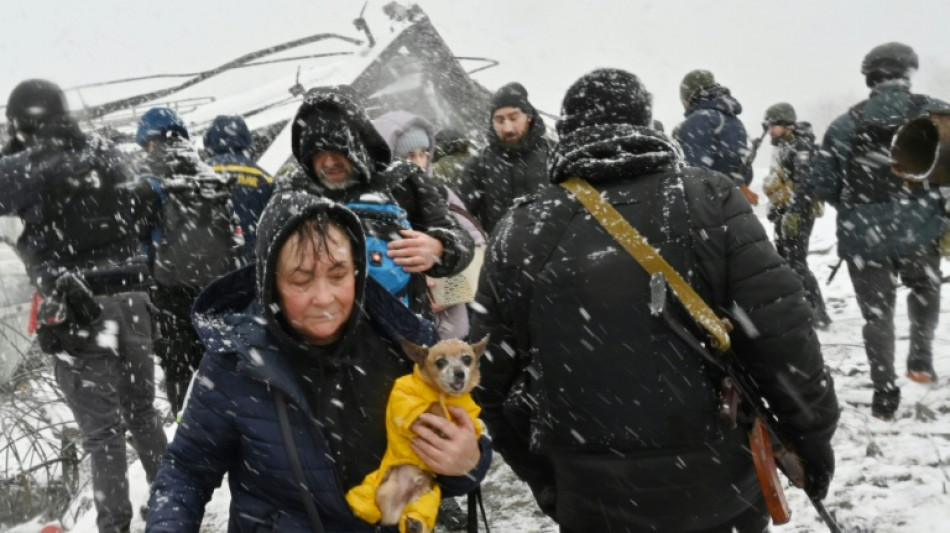
Ukrainians flee besieged cities as number of refugees hits 2 mn
Desperate civilians fled besieged Ukrainian cities on Tuesday after Russia offered "humanitarian corridors", as the number of refugees leaving the country since Moscow's invasion passed two million.
Civilians boarded buses out of the north-eastern city of Sumy, where 21 people were killed in air strikes overnight, while others took an unofficial escape route out of the bombarded Kyiv suburb of Irpin.
But Ukraine accused Russia of attacking an evacuation corridor out of the beleaguered southern port city of Mariupol, where aid workers said tens of thousands were living in "apocalyptic" conditions.
Kyiv has branded the corridors from four cities a publicity stunt as many of the exit routes lead into Russia or its ally Belarus. Both sides accuse each other of ceasefire violations.
President Vladimir Putin's invasion has sparked fears of a wider European war, and unleashed the continent's fastest growing refugee crisis since World War II as people flood across Ukraine's borders.
Western allies have imposed sweeping sanctions on Moscow and poured in weapons to Ukraine, while oil giant Shell became the latest among scores of businesses to pull out of Russia.
Ukrainian President Volodymyr Zelensky denounced what he called unkept promises by the West to protect his country, and renewed calls for a no-fly zone that leaders have so far dismissed.
"It's been 13 days we've been hearing promises, 13 days we've been told we'll be helped in the air, that there will be planes," Zelensky said on a video broadcast on Telegram.
"But the responsibility for that rests also on those who were not capable to take a decision in the West for 13 days," he added. "On those who have not secured the Ukrainian skies from the Russian assassins."
- 'Hiding in the basement' -
Despite the sound of nearby shelling in Irpin, seen as a critical point for Russia's advance on Kyiv, civilians fled in icy wind and a thick snowfall, AFP reporters saw.
People waited in a long line to cross over the Irpin river on makeshift walkways of planks and mangled metal, after the Ukrainians blew up the bridge leading into the capital to hamper any Russian advance.
"I didn't want to leave, but there's nobody left in the homes around us, no water, no gas and no electricity," Larissa Prokopets, 43, told AFP.
She said she was leaving after several days spent "hiding in the basement" of her home, which kept "shaking" due to bombardment nearby.
Russia had refused calls for a humanitarian corridor in Irpin and the nearby suburbs of Bucha and Gostomel "although we had everything ready for this," Ukrainian interior ministry official Anton Gerashchenko said.
Evacuations had however begun in Sumy, near the Russian border and 350 kilometres (218 miles) east of Kyiv, where Russia had formally declared a humanitarian corridor, officials said.
Dozens of buses had already left in the direction of Lokhvytsia, to the southwest, said the interim chief of the Poltava region, Dmitry Lunin. The corridor is designed to evacuate civilians, including Chinese, Indians and other foreigners, officials said.
The evacuation came after 21 people, including two children, were killed in Sumy when "enemy planes insidiously attacked apartment buildings," Ukrainian rescue services said.
- 'Really apocalyptic' -
Ukraine also accused Russia of violating a ceasefire around Mariupol on Tuesday, describing it as "nothing other than a genocide".
"The enemy has launched an attack heading exactly at the humanitarian corridor," the defence ministry said on Facebook, adding the Russian army "did not let children, women and elderly people leave the city."
The International Committee of the Red Cross said Mariupol residents faced "atrocious" conditions and were running out of food, water and medical supplies.
"The bottom line today is that this situation is really apocalyptic for people," ICRC head of media Ewan Watson said in Geneva.
Long queues of cars snaked out of the southern city of Mykolaiv, where sporadic shell fire could be heard.
"We're leaving as soon as possible. There are attacks every day, it's terrifying," said Sabrina, 19, who had a dog on a lead and a cat in her jacket. She said she had no news from her husband who was on the frontline.
Despite a slow start and a large Russian column being stalled outside Kyiv, Moscow's forces have slowly advanced, particularly in the east and south.
At least 406 civilians have died since the start of Russia's assault on its ex-Soviet neighbour, according to the UN, although it believes the real figures to be "considerably higher".
The onslaught has created a huge refugee crisis for European countries that have taken in Ukrainians fleeing the conflict, particularly Poland.
"It doesn't stop," Filippo Grandi, the UN High Commissioner for Refugees, said as he announced that two million people had fled.
- 'Catastrophic consequences' -
A huge Western sanctions campaign has failed to dissuade Russia's Putin from his invasion plan.
Energy giant Shell said Tuesday it would withdraw from its involvement in Russian gas and oil, and apologised for buying a cargo of Russian crude last week.
Putin has equated sanctions with a declaration of war and put nuclear forces on alert. He has pledged the "denazification" of Ukraine and demands its "neutralisation" and demilitarisation.
At home, Russia has cracked down on dissent, arresting more than 10,000 people for anti-war protests and clamping down on independent media.
Russian Deputy Prime Minister Alexander Novak warned Monday that Moscow could cut Europe's gas supplies in revenge for sanctions and said any ban by Western allies on Russian oil imports would have "catastrophic consequences".
US Secretary of State Antony Blinken said during a visit to NATO ally Estonia that Washington was "very much looking at" an energy embargo, while also trying to ease the impact on supplies.
The west has so far steered clear of the no-fly zone demanded by Zelensky, with Putin warning it would be considered as "participation in the conflict" with nuclear-armed Russia.
Despite the lack of direct Western involvement, an international legion of volunteers has also descended on Ukraine to fight the Russians.
But the Pentagon said Monday that Moscow was on a recruiting mission for its own foreign fighters -- Syrians who fought for President Bashar al-Assad.
burs-dk/jm
G.Morris--TNT