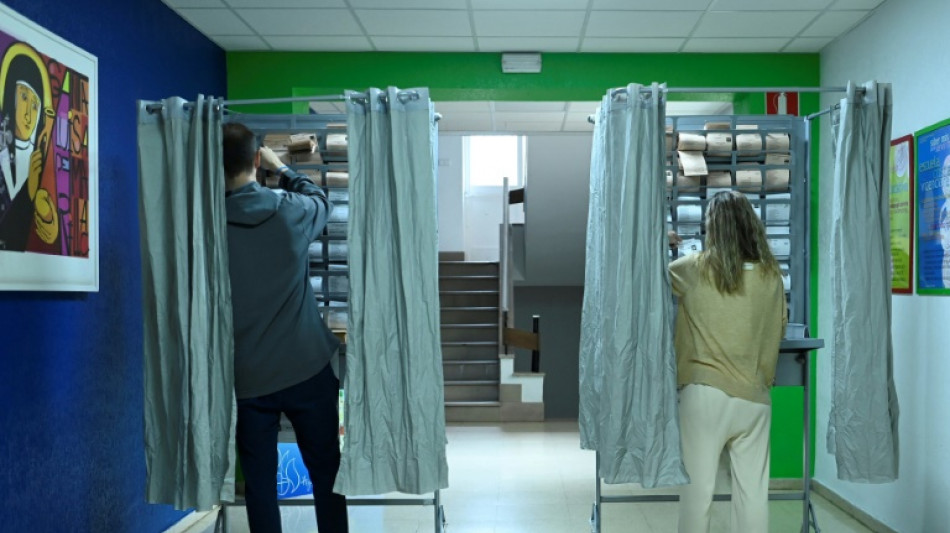
Spanish right surges in local poll, dealing blow to PM / Photo: © AFP
Spain's right-wing opposition posted strong gains both locally and regionally during Sunday's polls in a clear setback for Socialist Prime Minister Pedro Sanchez, initial results and media reports said.
Widely seen as a dress rehearsal for a year-end general election, Sunday's vote saw the main opposition Popular Party (PP) chalking up the largest number of votes in the municipal vote with nearly all ballots counted, official figures showed.
And the party also managed to dislodge the Socialists from several regions in their power, notably the eastern region of Valencia, media reports said.
The figures will be a blow for Sanchez, whose Socialist party governs the eurozone's fourth-largest economy in coalition with the far-left Podemos.
Polls suggest he will lose the year-end election which is seen as heralding a return of the right.
With over 95 percent of the votes counted, the PP secured 31.47 percent of the local ballots cast, compared to 28.28 percent for the Socialists, a difference of some 700,000 votes, official figures showed.
Polling stations closed at 8:00 pm (1800 GMT) after a day in which voters cast ballots for mayors in 8,131 municipalities, and leaders and assemblies in 12 of Spain's 17 regions.
Turnout was 63.89 percent, lower than 2019 polls when it stood at 65.19 percent, official figures showed.
In office since 2018, Sanchez has faced several obstacles: voter fatigue with his left-wing government, soaring inflation and falling purchasing power.
"I do think it's an important test (ahead of the year-end elections). It's the only way we have of expressing our opinion about all these years they've been in government," 61-year-old doctor Maria Alonso told AFPTV after voting in Madrid, without saying who had earned her vote.
Microbiologist Irene Diaz said the local and regional polls "were as important" as the upcoming general election.
"At the end of the day, these are elections in your city which involve laws and legislation that will end up impacting your day-to-day life," the 30-year-old said.
- Right-wing targets 'Sanchismo' -
Earlier, Sanchez had expressed confidence the electorate would "vote positively... for what is important: for public healthcare, public education and housing policies for our young people," he said after casting his ballot.
Opposition leader Alberto Nunez Feijoo, head of the right-wing PP, had urged people "to vote massively" saying "the stronger the government... the faster we will get out of the economic, institutional and social problems we have in our country".
Feijoo has denounced Sanchez as not only pandering to the far left but also to the Basque and Catalan separatist parties on which his minority government has relied for parliamentary support.
He framed Sunday's vote as a referendum on "Sanchismo", a derogatory term for Sanchez's policies.
Of the 12 regions where new leaders will be elected, 10 have been run by Socialists, either alone or in coalition.
The number of regions the PP manages to wrest from the Socialists will be important in determining public perceptions of whether Feijoo has won this first round -- and whether his victory in the year-end general election is deemed a foregone conclusion.
But Feijoo has his own problems, in particular the far-right Vox, the third-largest party in parliament, which hopes to become an indispensable partner for the PP.
Aware that the key to winning the general election is conquering the centre, Feijoo has sought to moderate the PP's line since taking over last year, while also keeping Vox at a distance.
A strong regional showing by Vox would put him on the back foot.
Q.Marshall--TNT